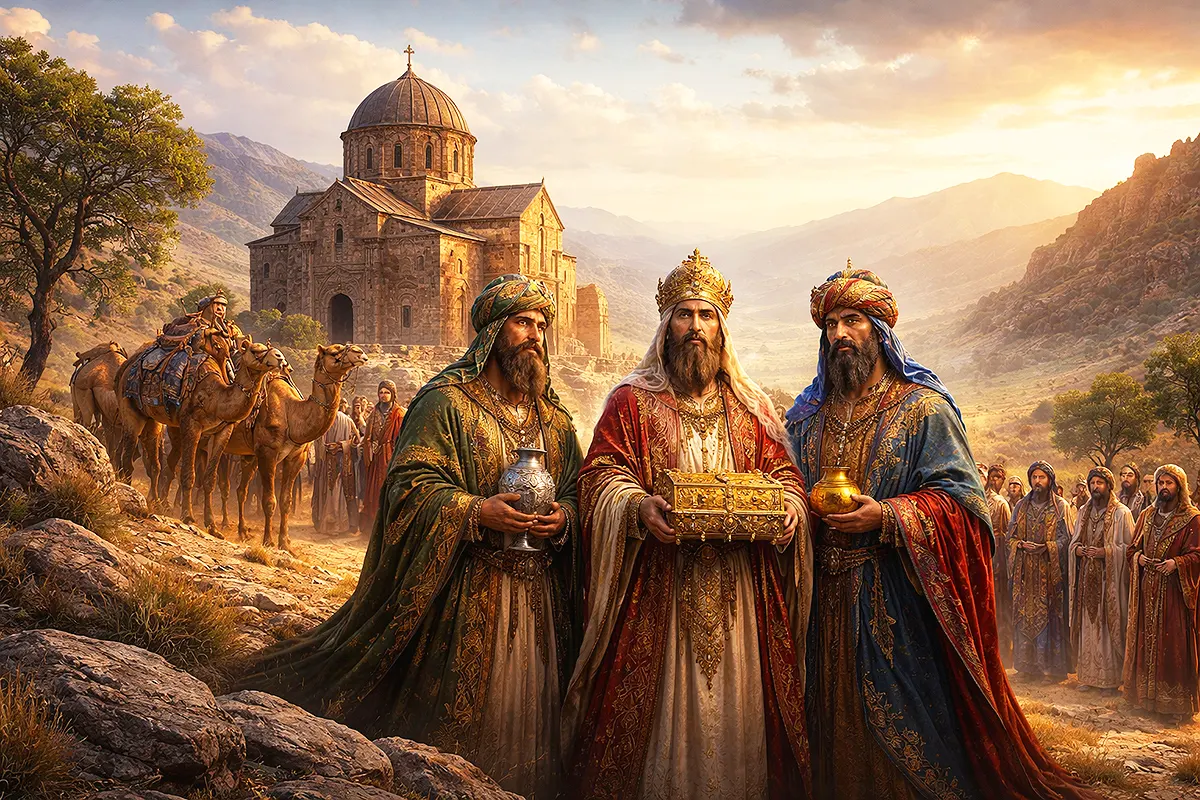
In the heart of the historic Tur Abdin region of southeastern Turkey, one of the lesser-known legends of the Magi is preserved. According to a local account from the Syriac Christian community, in the village of Hah – today Anıtlı, in the Midyat district of the province of Mardin – 12 kings or Wise Men from the East gathered and, guided by a star, set out in search of the new-born Messiah. From this group, three of them continued on to Bethlehem, according to the oral tradition of the local inhabitants.
The Church of the Virgin Mary (Yoldath Aloho) – a temple of the Syriac Orthodox Church built around 450 AD – marks the epicentre of this legend. According to the story, twelve kings or wise men from the East gathered at a place in Asia Minor (modern-day Anatolia) before the birth of Jesus, but of these, only three continued the journey to Bethlehem. After worshipping the Child Jesus, they received a relic, which in some versions is part of Jesus’ clothing.
Local accounts tell how, after returning from Bethlehem, the three wise men showed their companions the cloth wrapped by Mary that they had received as a gift. This cloth, according to tradition, miraculously turned to gold – a symbol of divine blessing – when they tried to divide it among them. Impressed by the prodigy, the twelve kings built a monument at the place where they had initially gathered – according to some local versions of the legend, that place would be precisely Hah – which, in time, was transformed into a church.
Tur Abdin – which in Aramaic means “Mount of God’s servants” – was for centuries a vital centre of Eastern Christianity, with numerous churches and monasteries scattered throughout the region. Today, however, only a few thousand Syriac Christians live in the region, remaining centuries-old guardians of their language and traditions.
They were neither kings nor did they worship a newborn child
It should be noted, however, that none of the elements present in this legend appear in the canonical biblical texts: indeed, while the Gospel of Matthew mentions the Wise Men or Magi following a star to Bethlehem, it does not specify how many there were, nor does it give details of specific geographical locations.
In a broader context, the same traditional idea of the three Wise Men from the East arises later in the Western Christian tradition, linked to the three gifts they offered: gold (symbol of royalty), incense (used for the worship of the gods) and myrrh (a spice used for embalming), being a tradition with special roots in Spain and Latin American countries, but also among the Catholic population of countries such as France, Poland, Italy or Germany.
Historically, however, in various Eastern interpretations – including Syriac – the Magi who came to worship Jesus could have numbered twelve or more, and in most Eastern Christian traditions they are considered to be wise astrologers of Persian origin rather than monarchs or kings as such.
Even the Christian legends of the East do not speak of a worship of a newborn child. Matthew, in fact, speaks in his Gospel of a “child” (Greek παιδίον, paidíon), not a newborn, and specifies that the magi entered a house, not a stable.
In many Eastern texts, the visit to Jesus occurs weeks or months after the birth (even up to 2 years later), the manger scene with magi and shepherds together being a much later liturgical synthesis emerging in Europe in the Middle Ages, and not a historical account or based on the Gospels.
Did the Magi arrive in Bethlehem on 6 January?
As for the 6th of January, it is a very old date, even more ancient than Christianity itself. As early as the 2nd-3rd centuries AD, the Epiphany (manifestation) was celebrated on this day, commemorating several key moments in the revelation of Jesus: his birth, the adoration of the Magi, his baptism in the Jordan, and, in some traditions, his first miracle. In other words, 6 January was not traditionally ‘Three Kings’ Day’ in ancient times, but the day on which Christ manifested himself to the world in various forms and along different stages of his life.
When in the 4th century the date of the birth of Jesus was fixed in the Roman Empire as 25 December (contrary to common belief, the date was not chosen at the famous Council of Nicaea in 325, but around 336) to coincide with the important pagan festival of the Sol Invictus, from then on in the West the celebrations were separated: 25 December was reserved for the Nativity (Christmas), and 6 January was reserved for the worship of the Magi, understood as a symbol of the non-Jewish peoples. Thus was born the celebration of the Magi on 6 January that we know today in Catholicism, where the manifestation of Christ to the Gentiles is celebrated, while in the East, 6 January remains, first and foremost, the feast of the Baptism of Jesus.
As for the date of 6 January, in Western Christianity this day was chosen for the arrival of the Magi because there are 12 days from 25 December: the number 12 has a strong biblical symbolism (12 tribes of Israel, 12 apostles, etc.), understood as a time of waiting and progressive manifestation, from the birth of Jesus to his revelation to the world through the visit of the Magi.
In the East, however, the date of 6 January was already important long before; in the Eastern and Hellenistic world, this date was already associated from ancient times with divine manifestations, revelations, and the symbolism of water (the key to Baptism); certain Eastern religions already celebrated epiphanies of gods on 6 January, so that with the arrival of Christianity in the region, this date – as happened with 25 December – was adopted and reinterpreted. It is therefore no coincidence that, in the East, the reason for the celebration of 6 January is still the Baptism of Jesus, and not the worship of the Magi.
The legend about Hah (Anıtlı) and the Magi is therefore not just a curiosity: it represents a link between the very origins of Christianity and older traditions. Although historians believe it to be a legendary tradition rather than a verifiable historical account, its value lies in how these local narratives integrate elements of early Christianity and place them in the geographical context of Anatolia, in present-day Turkey; and also, in how different Christian communities have interpreted the story of the Birth of Jesus and the Wise Men (Magi) from their own cultural and geographical context.
VOTE

EDITORIAL TEAM
🧿 About us
.
Edited and reviewed by:

Pablo Gómez is a specialist in Turkey and has been editor-in-chief of Hispanatolia since 2011. He has been analysing current affairs and geopolitics in Turkey and the surrounding region since 2006.
…
📣 Your ADVERTISING on Hispanatolia
.
🤗 HELP US WITH A DONATION:
💗 Paypal