Among the lush forests and mountain valleys of northeastern Turkey, very close to the Georgian border, hides one of the most unknown jewels of the country’s medieval Christian heritage : the Christian church of Tbeti, in Turkey. Off the beaten track and shrouded in an almost mystical silence, this ancient Georgian cathedral – now in ruins but still brimming with history – invites the traveller to step into a past where kingdoms, religions and cultures intertwined in the Tao-Klarjeti region.
If you are passionate about religious tourism, off-the-beaten-track historical sites and the feeling of discovering a place that seems to stand still in time, Tbeti deserves a privileged place on your itinerary in eastern Anatolia.
What is the Tbeti Church, and where is it located?
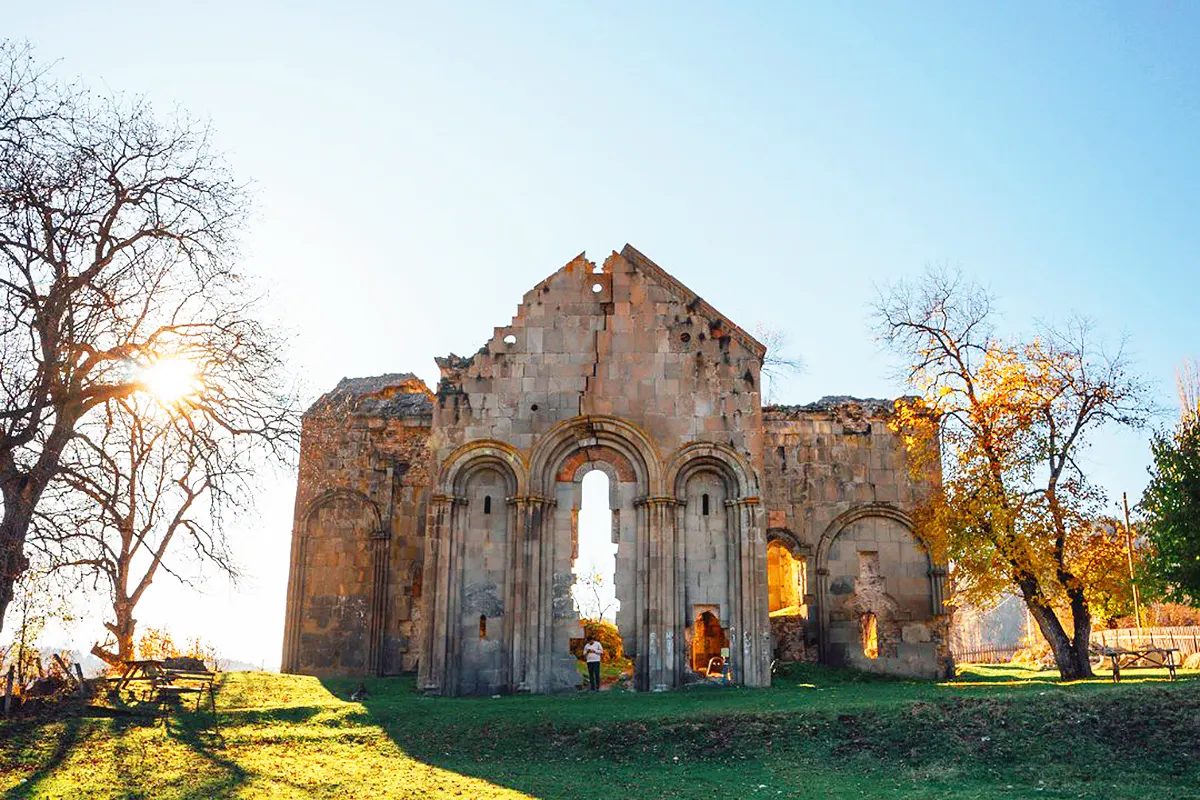
Tbeti Church (in Turkish Tbeti Kilisesi) is a medieval building of Christian origin located in the village of Cevizli Köy, in the Şavşat district of Artvin province, on the east coast of the Turkish Black Sea region. It is about 14 km from the centre of the district of Şavşat, and is located at an altitude of approximately 1,200 m in an area of forests and mountains, which gives the place a very beautiful natural environment.
For the traveller interested in religious and historical tourism, this church is an ideal stop: a building that bears witness to the crossroads of cultures (Georgian, Byzantine, Ottoman) and which today survives in a state of ruin, offering an atmosphere of contemplation.
Origin and history
The origin of the church of Tbeti dates back to the medieval period of the Georgian principality of Tao-Klarjeti, a region which today is mainly in Türkiye but which at that time was part of the Georgian sphere of rule. Official Turkish sources mention that the construction was carried out between 899-914 by order of the Bagratid prince Ashot Kukhi (or Ashot Kuhi), who ruled the region.
The original design, according to architectural studies, was based on a central, cross-shaped plan incorporating elements of 9th-10th century Georgian architecture. However, extensions and restorations were carried out during the 11th-13th centuries, and over time the church became part of an important monastic complex, considered a centre of culture, manuscript copying and calligraphy among the Georgians.
Already during the Ottoman period, the building was converted into a mosque after the Islamisation of the region, functioning as an Islamic temple according to sources until the end of the 19th century. It survived standing – albeit unused – for most of the 20th century until 1961, when much of the roof and side walls collapsed: it is unclear whether this was due to neglect or vandalism, although in previous years the building had been used as a quarry by local inhabitants.
Interesting facts
- The name “Tbeti” comes from the Georgian tba-eti, meaning “region of lakes” or “place of many lakes”, alluding to the church’s natural environment, full of deep woods and small lakes.
- It is built mainly of worked stone, characteristic of medieval Georgian architecture, with a dome and a central free-cross (or cruciform) plan.
- On the outside of the structure, each face of the roof (the four surfaces) was depicted with carvings of rams (“koç heykeli”).
- Despite its dilapidated state, the remains of the walls can still be seen, as well as some particular plant ornamentation in relief.
- The church went through several phases of construction and restoration during its history: the first building ~918 AD was followed by extensions in the AH 960s, the AH 990s, the 13th and 14th centuries, and the addition of a bell tower around 1527.
Reliefs and murals
The interior walls of the church of Tbeti have traces of Georgian murals dating from buildings and alterations between the 10th and 13th centuries. According to expert studies, up to two layers of overlapping wall-painting from different periods of Tbeti’s history have been identified.
The themes include hagiographic scenes (about the lives of Christian saints), including St George among other figures, as well as liturgical decoration. For example, some scenes in the west wing of the building show St George distributing his wealth, and then tied to a wheel that is turned by executioners – suggesting that the building was dedicated to this saint.
Although these frescoes have deteriorated significantly, they are still of exceptional value for religious and historical tourism, as they shed light on medieval Georgian Orthodox spirituality.
How to get to the Georgian church of Tbeti?
Once in Turkey, the most common way is to go to the province of Artvin, and from there to the district of Şavşat; from the village of Şavşat you drive about 14 km to the village of Cevizli (former Tbeti) in the direction of a natural environment of forests and lakes. It is recommended to use your own or a rental vehicle, ideally an SUV or a vehicle with good suspension, as the road runs through mountainous areas.
As a historic monument in ruins, there is no strict access control or opening hours, but it is advisable to arrive early to explore at your leisure and take into account the weather conditions. Another recommendation is to combine a visit to the church with a stop in the village of Cevizli itself to enjoy the beautiful surroundings and unique architecture of this region of Turkey.
Where to stay
Some good options for those wishing to stay in the area include the following:
- Green Valley Hotel Şavşat: good reputation, located in Şavşat, ideal as a base for exploring the region.
- Şavşat Kosk Otel: another cheaper alternative, centrally located, with good basic services.
- Velikoy Han Konaklari: a bit more rural, more immersed in nature; good choice if you prefer peace and quiet.
Despite the isolation of the region, we recommend booking in advance, especially if you are travelling in high season, as this region of Türkiye is very popular with local tourists.
Other places of interest in this region of Turkey
The province of Artvin and the historic Tao-Klarjeti region have numerous medieval Georgian churches and monasteries to complement a visit to Tbeti:
- Ishkhani (İşhan Kilisesi): a large Byzantine-Georgian church monastery of great architectural interest.
- Barhal Church (Parkhali): located in the village of Altıparmak, about 30 km from Yusufeli, another splendid example of medieval Georgian architecture.
- Nature and mountain tourism: the area offers hiking trails, lakes, forests and spectacular valleys, ideal for combining cultural and historical tourism with nature.
To visit the ancient Christian church of Tbeti in Turkey is not just to stop and contemplate the ruins of what was once part of the history of this corner of Anatolia: it is to enter into a millenary story where Orthodox Christian traditions, Georgian architecture and Ottoman history intersect, with lush nature as a backdrop. If you are passionate about history and interested in religious and historical tourism in Turkey, this place is well worth a visit.
📚 If you want to learn more about the history of Turkey, we recommend:
🧿 Discover here more recommended products about Turkey
We include affiliate links: if you buy through them, you don’t pay extra money and you help this website.
🧿 TOP TOURS IN TURKEY
VOTE

EDITORIAL TEAM
🧿 About us
.
Edited and reviewed by:

Pablo Gómez is a specialist in Turkey and has been editor-in-chief of Hispanatolia since 2011. He has been analysing current affairs and geopolitics in Turkey and the surrounding region since 2006.
…
📣 Your ADVERTISING on Hispanatolia
.
🤗 HELP US WITH A DONATION:
💗 Paypal