The Great Mosque of Divriği, named a World Heritage Site by UNESCO, has welcomed 72,000 tourists since its reopening in May 2024 after a complex restoration process that lasted 9 years and sought to prevent it from collapsing.
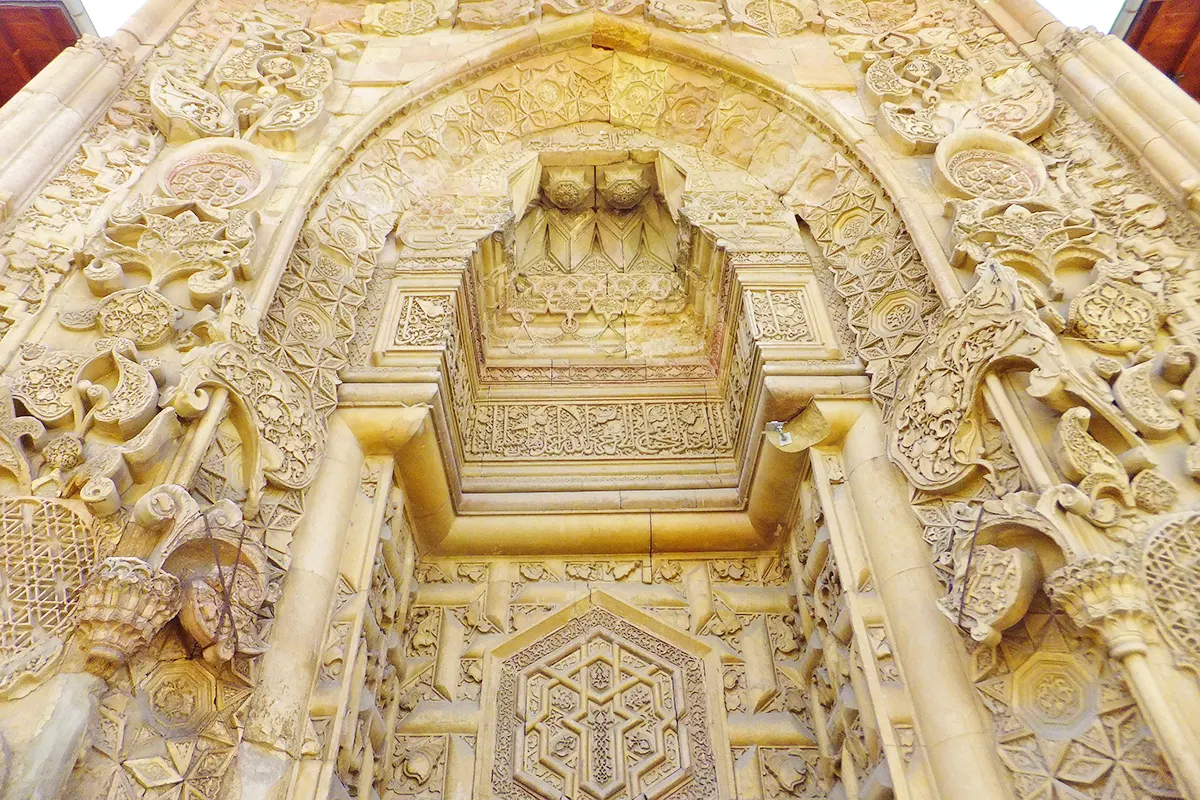
Often referred to by historians around the world as ‘the Alhambra of Anatolia’ for the incredible details of its intricate stone decoration, this impressive 800-year-old temple is mainly visited by tourists from Turkey due to its geographical location, but increasingly by tourists from other countries – mainly from Japan and Germany – who want to see one of the most important religious and historical monuments in this region of Turkey.
Where is the Great Mosque and Hospital of Divriği?
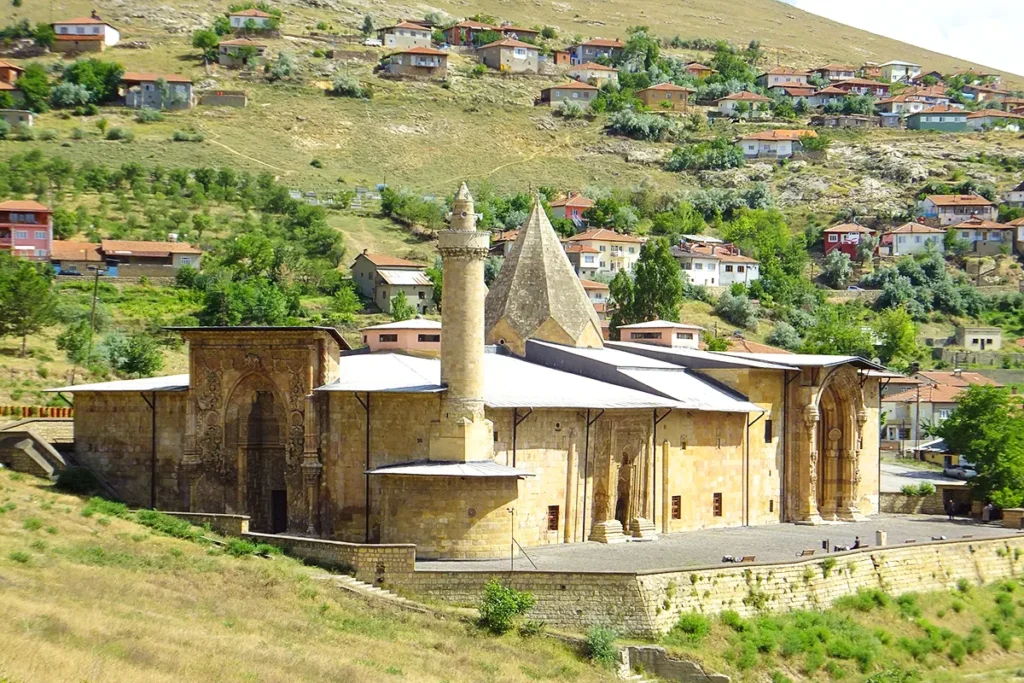
The Great Mosque of Divriği is located in eastern Turkey, in the province of Sivas, within the district of Divriği, on the banks of the Çaltı River. Situated in a mountainous region of Eastern Anatolia, the city of Divriği is far from large urban centres, which has contributed to keep this monument relatively unknown until now, at least outside Turkey.
Origin and historical significance
The city of Divriği was founded in the 9th century by Armenian religious groups and was then called Abrik; it was later named Tephrike and captured by the Byzantine emperor Basil I the Macedonian, who renamed it Leontokome. It remained under Byzantine control, handed over to Armenian vassal kings, until the great military defeat of the Eastern Roman Empire at the Battle of Manzikert in 1071 against the Seljuk Turks, which led to the Turkish tribes occupying the region and taking the city.
It was precisely under the rule of the Turkish tribes in the region that the Great Mosque of Divriği (Divriği Ulu Cami, in Turkish) was built in 1228-1229 by order of Ahmet Shah, then bey (ruler) of the Seljuk principality (beylik, or ‘beylicate’) of Mengücek, who was linked by marriage to the Seljuk Sultanate of Rum, to whom they declared themselves vassals and allies. An adjacent hospital (darüşşifa) was built next to the mosque at the request of his wife Turan Melek and designed by the architect Hurrem Shah. This gave the complex a dual religious and healthcare function, which was very common in the Islamic world at the time.
The Great Mosque covers an area of 1,280 square metres, and a 768-square-metre hospital is attached to the mosque. The complex formed by the Great Mosque and the Divriği Hospital is one of the masterpieces of medieval Islamic architecture. What really sets the Great Mosque of Divriği apart is its incredible stone carvings, especially on its monumental facades, which display a richness of ornamentation and complexity rarely seen in the Islamic world.
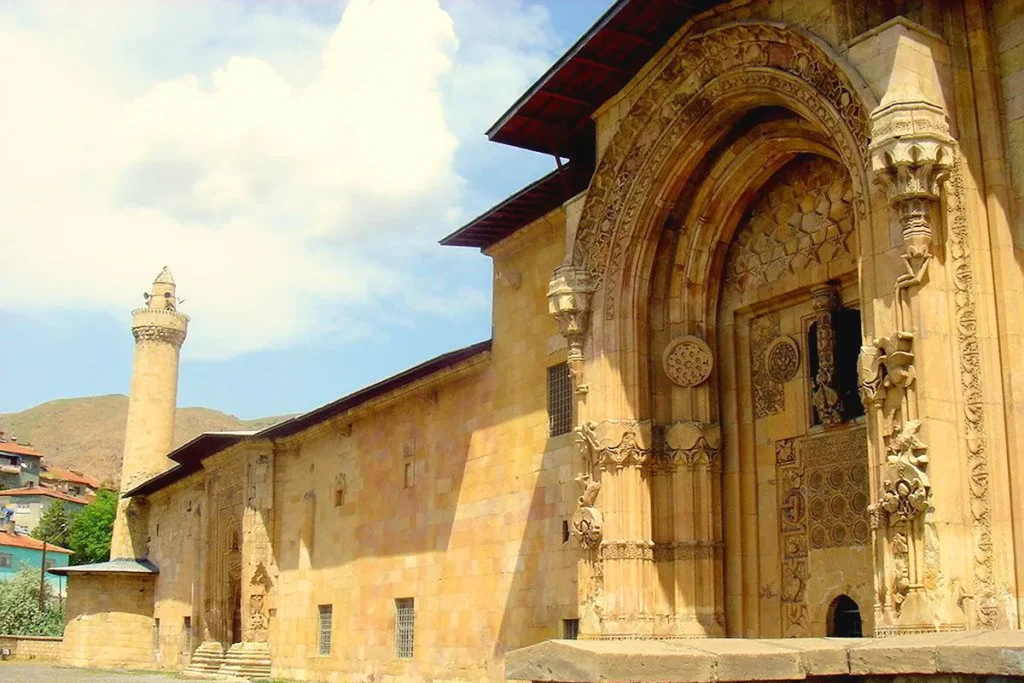
Each of the monument’s ornate portals – the hospital’s crown portal, the north and west portals of the mosque and the Shah Mahfili portal – features unique designs and meticulous detail. It is the exquisite stone carvings, decorations and complex architecture of the monument that place this site among the most important architectural works in Anatolia and led to its inclusion in the UNESCO World Heritage List in 1985.
UNESCO itself refers to the Great Mosque of Divriği saying that ‘this masterpiece of Islamic architecture is characterised as much by the technical perfection of its vaults as by the creativity and exuberance of its ornamentation’. The inscriptions, geometric and floral patterns, and the mastery of the craftsmen who sculpted and decorated this monument, reveal an extraordinary sophistication for their time.
How to get to the Great Mosque of Divriği?
Getting to the Great Mosque of Divriği is not easy, as Divriği is not a mass tourist destination and is located far from the main tourist centres in Turkey. That does not mean that a visit is not worthwhile: quite the contrary, since its existence on the fringes of conventional tourism and the route itself to reach this corner of Anatolia are also part of its hidden charm.
From Istanbul or Ankara, the best option is to fly to Sivas Airport (Sivas Nuri Demirağ Havalimanı). It is a modern but small airport that receives daily flights from the main Turkish cities. From Sivas, Divriği is about 150 kilometres away, which can be covered in three ways:
- Train: the regional train journey from Sivas to Divriği takes approximately 2.5 hours; it is a leisurely trip offering spectacular views of this mountainous region of Anatolia, passing through valleys, mountains and rivers.
- Car: you can hire a car and cover the 180 km distance from the airport in about 3 hours.
- Bus or minibus: there are regular connections from the Sivas bus terminal, although timetables may vary.
Visiting hours and prices
The Great Mosque of Divriği is open to the public every day, approximately from 9:00 a.m. to 6:00 p.m. However, it is important to note that during prayer times, especially on Fridays, access to the interior may be temporarily restricted for non-Muslims.
Admission is free, as it is a public and active religious building, although donations for the maintenance and restoration of the complex are welcome.
Tips for visiting:
- Appropriate clothing: as in all mosques, shoulders and legs must be covered, and women must also cover their hair.
- Photography: photography is allowed, but without flash.
- Guided tours: if you want to appreciate the symbolic and architectural richness of the place, we recommend hiring a local guide or a specialised tour from Sivas.
- Best time to visit: spring and autumn offer pleasant temperatures and clear skies, ideal for enjoying the mountainous surroundings of the area.
Other places of interest nearby
Although the Great Mosque of Divriği is the main attraction, there are other places of great interest in and around Divriği itself, bearing witness to the long and exciting history of the area.
Kesdoğan Castle:
Located on a peak across the Çaltı River, the ruins offer breathtaking panoramic views of the valley and Divriği, although access is difficult. It is actually a watchtower built in the Middle Ages that was part of the defences of Divriği Castle, which we metion below.
Divriği Castle and Mosque:
It is much easier to reach this huge castle, also built under the Mengücek dynasty in 1181 by the architect Megaralı Hasan Bin Firuz. Located on a hill just 300 metres away from the Great Mosque of Divriği, at the top there is a small, recently restored medieval mosque, while the entire hill is surrounded by the walls of the ancient fortress: once consisted of a double wall system, today only part of the inner wall remains, while the main and most visible is the outer wall.
Divriği Glass Terrace:
This impressive glass terrace suspended over the void with a transparent floor – not suitable for those with a fear of heights – offers incredible views of the deep valley carved out by the Çaltı River. From the top, you can also enjoy a privileged view of Divriği and the surrounding landscape. It is not far from the Great Mosque, but it is recommended to go up by car.
Ottoman baths:
In the historic centre of Divriği, just opposite the Great Mosque, there is an old hamam (Turkish bath); this is the Divriği Hamamı (Divriği Bath), an ancient Ottoman bath whose date of construction is uncertain, although it is probably medieval and was restored in subsequent centuries. Built in masonry with some of the floors in marble, this hamam is protected as a site of cultural interest. The place is still in use today, but is for the exclusive use of men.
Sivas:
On the way back from Divriği, it is worth visiting the city of Sivas. It would be impossible to summarise in a few lines everything that this Anatolian city has to offer, known for its Seljuk past and its links to Atatürk and the founding of the Turkish Republic. Among other places, it is worth seeing the Republic Square, the historic medieval Eğri Bridge, the Gök Madrasa Mosque, the Sivas Archaeological Museum, the old gendarmerie barracks, the historic Buruciye Madrasa, and the Ethnography Museum (where Atatürk held the famous Sivas Congress).
Munzur Valley National Park:
If after visiting Divriği you are left wanting to explore more of this corner of Anatolia, for nature lovers it may be a good idea to visit the impressive Munzur Valley National Park (Munzur Vadisi Milli Parkı): from Divriği it is almost 4 hours by car to the east, going even further into Turkey, but you will find what is considered the largest and most biodiverse national park in all of Turkey… Which is no small feat. Just think about it.
As you can see, a visit to the Great Mosque of Divriği has a lot to offer. It is not only the experience of delving into a virtually unexplored corner of Turkey, but also of contemplating the landscapes and discovering the millennial history of Anatolia. A trip to discover the ‘Alhambra of Anatolia’ could be the first step in venturing into one of the most mysterious and surprising places Turkey has to offer.
✈️ If you are travelling to Turkey, we recommend:
🧿 Discover here more recommended products about Turkey
We include affiliate links: if you buy through them, you don’t pay extra money and you help this website.
🧿 TOP TOURS IN TURKEY
VOTE

As a history lover, Pablo Gómez was captivated by Turkey from the first day he visited it in 2006: he got married there, has a house there… and has since become an expert on Turkey’s current affairs. With a long experience in media, he has been at the helm of hispanatolia.com since 2011.