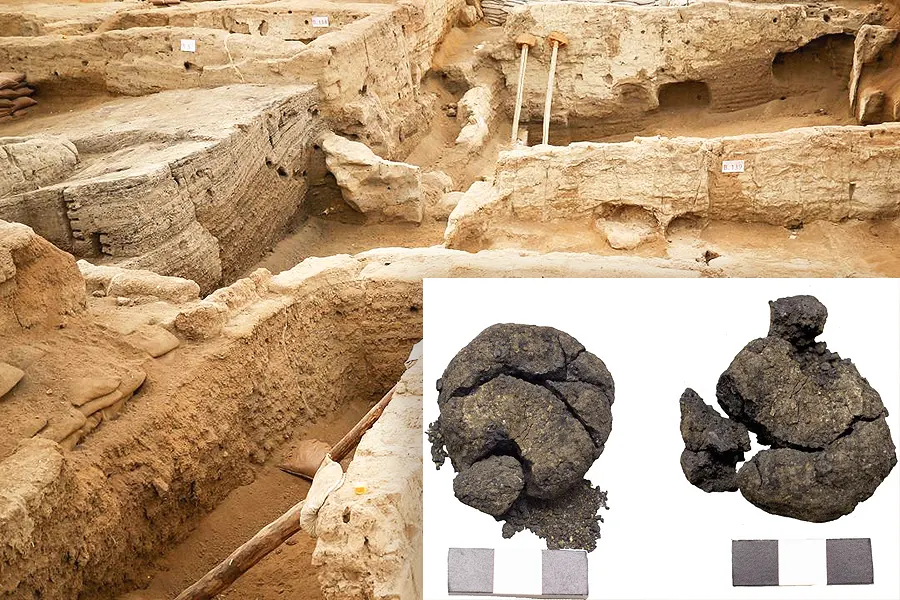
A team of Turkish archaeologists have discovered an 8,600-year-old bread loaf in the Neolithic settlement of Çatalhöyük, located in the Anatolian province of Konya and one of the first urban centres created by mankind, declared a UNESCO World Heritage Site in 2012.
Archaeologists found among the remains of Çatalhöyük, which once had a population of around 8,000, a structure that functioned as an oven and was almost completely destroyed, but in which they found remains of wheat, barley and pea seeds, as well as a spongy residue that, after analysis carried out at the Science and Technology Research Centre of Konya’s Necmettin Erbakan University, was determined to be fermented bread dating back to 6,600 BC.
“The small, round, spongy food remains discovered in the corner of the oven have turned out to be bread after careful investigation. The fact that the structure was covered with fine clay has allowed all these organic remains to be preserved until today. Radiocarbon tests conducted at the TÜBITAK Marmara Research Centre have revealed that our sample can be dated to approximately 6,600 BC,” said excavation director Professor Ali Umut Türkcan.
“We can say that this archaeological finding in Çatalhöyük is the oldest bread in the world. It has the pressure of a finger in its centre; it was not baked, but fermented and still has starch in it. There is nothing like it anywhere else in the world. Çatalhöyük was, in fact, the first in many things,” said Türkcan.
VOTE

EDITORIAL TEAM
🧿 About us
.
Edited and reviewed by:

Pablo Gómez is a specialist in Turkey and has been editor-in-chief of Hispanatolia since 2011. He has been analysing current affairs and geopolitics in Turkey and the surrounding region since 2006.
…
📣 Your ADVERTISING on Hispanatolia
.
🤗 HELP US WITH A DONATION:
💗 Paypal