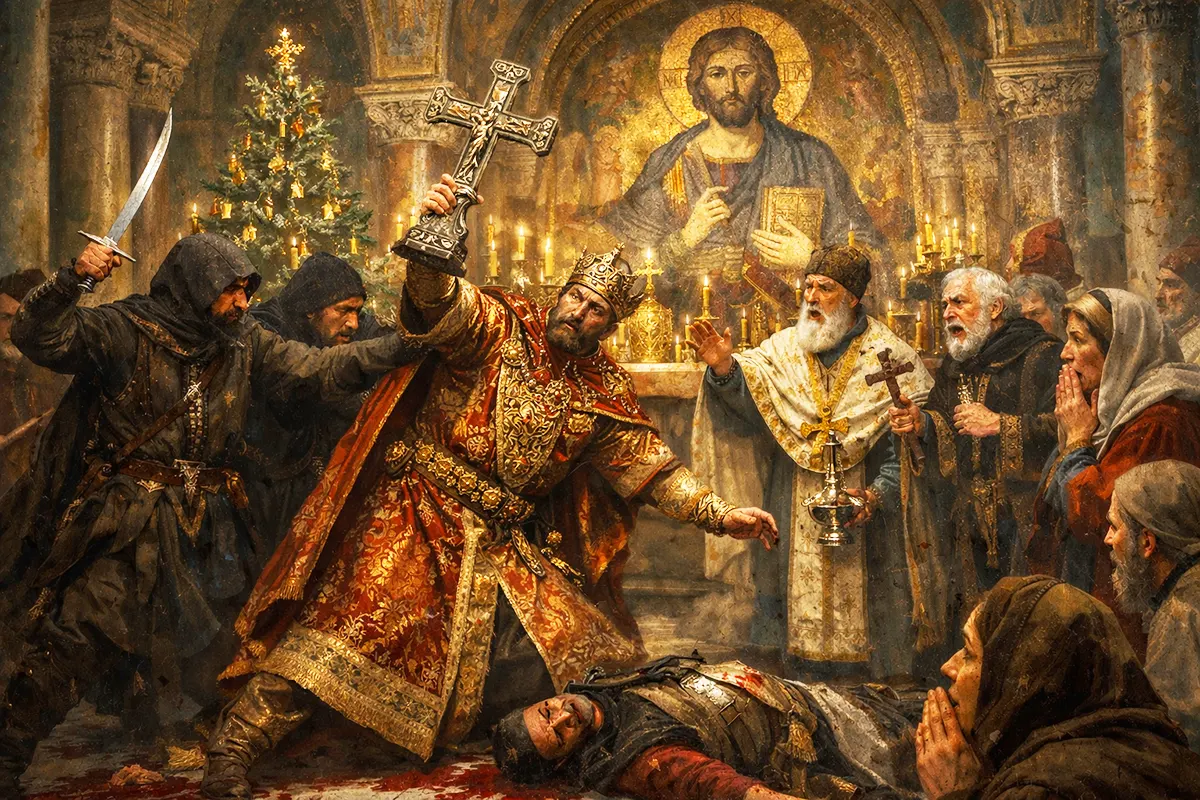
Christmas 820 was to be a day tinged with blood in the heart of the Byzantine Empire that would mark the history of Christianity forever. On that day, when Christians celebrate the birth of Christ, Emperor Leo V the Armenian, ruler of Byzantium since 813, was brutally murdered during the celebration of the Christmas liturgy in the Palatine Chapel of St. Stephen, in the Great Imperial Palace in Constantinople. This is a unique episode in history, as it is the only known – or at least the best documented – case of an emperor killed in a church on 25 December.
Rise to power and iconoclastic politics
Originally from a family of Armenian origin, Leo V, born in 775, had distinguished himself as a general under Emperors Nicephorus I and Michael I Rangabee before ascending the throne after the Battle of Versinikia in 813, when he forced Emperor Michael I to abdicate after he suffered a major defeat by the Bulgarians.
His rule was characterised by external stabilisation – with a 30-year peace sealed with the Bulgarians after defeating the khan Omurtag – and by the reinstatement of iconoclasm, the controversial religious policy that rejected the veneration of sacred images.
This second stage of iconoclasm was formally launched in 815; although Leo V – who believed that his predecessor on the throne had been defeated precisely for worshipping images– applied it less rigorously than in earlier times, it deepened the internal fractures in the Church and in Byzantine society, fomenting active opposition among the most fervently iconophile sectors towards the emperor.
Conspiracy and assassination at Christmas
In the late 820s, the emperor discovered a conspiracy led by Michael the Amorite, one of his closest generals, whom Leo had elevated in the past but whose ambitions and connections had aroused suspicion. Although initially condemned to death by Leo himself, Michael managed to delay his execution until after Christmas Eve, partly through the intermediary of Empress Theodosia. This postponement was ultimately key, as it gave Michael’s supporters time to finalise their plan to end Leo’s reign.
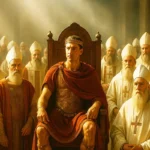
It was during the liturgical service on 25 December 820, while worship was taking place in the imperial chapel of St. Stephen, that a group of conspirators ambushed the emperor as he was praying in front of the chapel. According to the chronicles, the attackers, disguised as clerics or choir singers, first mistakenly attacked the priest officiating at the service, confusing him with the emperor.
Leo, who was unarmed, took advantage of the mistake and the confusion and, in a desperate act of defence, took a heavy cross from the altar and fought fiercely against his attackers, calling for his guard to come to his aid: but the conspirators had blocked the doors to the church. The emperor was alone, and to his fate.
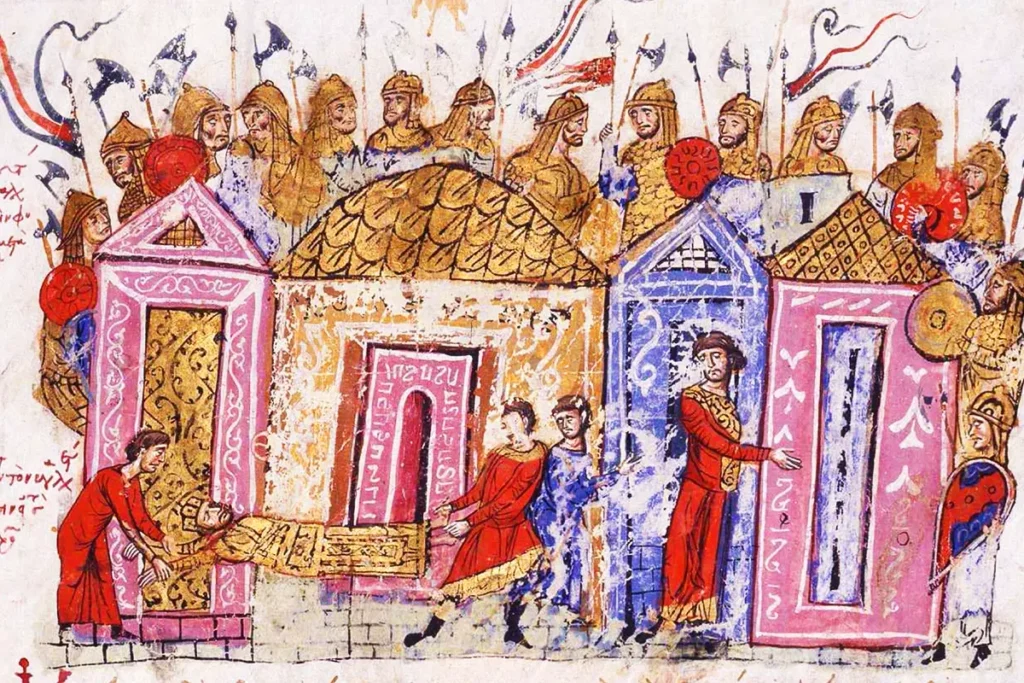
Leo V was finally overpowered: a sword severed his arm, and the emperor fell dead in front of the altar in the presence of the faithful, his body mutilated. Afterwards, his battered corpse was dragged naked to the Hippodrome in Constantinople, where it was exposed to public scorn; the remains were later given to his wife for burial.
The civil war that devastated the empire
With Leo dead, the conspirators released Michael the Amorian from prison and proclaimed him emperor under the name of Michael II – called Michael the Amorian or the Stammerer – marking the beginning of the so-called Amorian dynasty.
This blow to imperial power was consummated without significant resistance in the Roman capital, although the coronation was surrounded by a curious fact: as the late Leo V had hidden the key to the chains that bound Michael II in prison, and there was no time to find a blacksmith, the new emperor was crowned with the iron shackles still attached to his legs.
Retaliation against the family of the deposed Leo V was harsh: his mother and his wife, Empress Theodosia, were exiled to monasteries on the Princes’ Islands; but it was the four sons of the murdered emperor who bore the brunt: all four were subjected to castration – a common practice in Byzantium to eliminate claims to the throne – which was carried out so brutally that one of them died during the procedure.
While Constantinopolitan officials preferred the new emperor, Leo V had many supporters in the army thanks to his military victories against the Bulgars, so the Theme of the Anatolics – which encompassed several regions of central and southern Asia Minor – revolted and proclaimed another imperial rival, who was quickly supported by other themes (Byzantine provinces), sparking a civil war.
The rebellion, which elevated Thomas the Slav – who took the imperial name Constantine – as the new emperor, was one of the largest in the history of the empire and even laid siege to Constantinople itself, forcing Michael II to seek the support of the Bulgars of the khan Omurtag, who inflicted a major defeat on the rebels that led to the capture and death in 823 of Thomas at Arcadiopolis (in the region of Thrace), where he and his followers had sought refuge.
The reign of Leo V’s successor
For the next 4 years Michael II tried to reconcile iconoclasts and iconodules and to consolidate his power. The civil war had seriously damaged the rural economy, especially in the region around Constantinople, and had severely divided and weakened the empire, so Michael II tried to win the confidence of his former enemies by pardoning many of Thomas’ supporters.
The new emperor also sought to gain legitimacy by marrying Constantine VI’s daughter Euphrosyne in 823, although the marriage caused a great scandal as she was a nun; but also because Michael II’s wife, Thekla, had just died. During his reign, the Romans lost the island of Crete and much of Sicily to Muslim armies, and Byzantine naval power in the Mediterranean was greatly diminished. But unlike Leo V, Michael II died a peaceful and natural death.
The assassination of Emperor Leo V in the midst of a Christmas celebration is an extraordinary case in the history of Byzantium, where political violence was rarely unleashed in Christian temples, let alone during religious festivals. Although the history of the Roman Empire is littered with numerous rebellions and usurpations, the assassination of an emperor inside a church at Christmas is a historical rarity that underlines the depth of the religious and political tensions of the time, as the conspirators had no qualms about organising the terrible murder on the feast of Christ’s birth. It is, after all, a symbol of the infighting that shook the empire throughout its history, and which would eventually lead it irrevocably to its destruction.
📚 If you want to learn more about the history of Turkey, we recommend:
🧿 Discover here more recommended products about Turkey
As an Amazon Associate, we earn from qualifying purchases. This comes at no extra cost to you and helps support this website.
VOTE

EDITORIAL TEAM
🧿 About us
.
Edited and reviewed by:

Pablo Gómez is a specialist in Turkey and has been editor-in-chief of Hispanatolia since 2011. He has been analysing current affairs and geopolitics in Turkey and the surrounding region since 2006.
…
📣 Your ADVERTISING on Hispanatolia
.
🤗 HELP US WITH A DONATION:
💗 Paypal