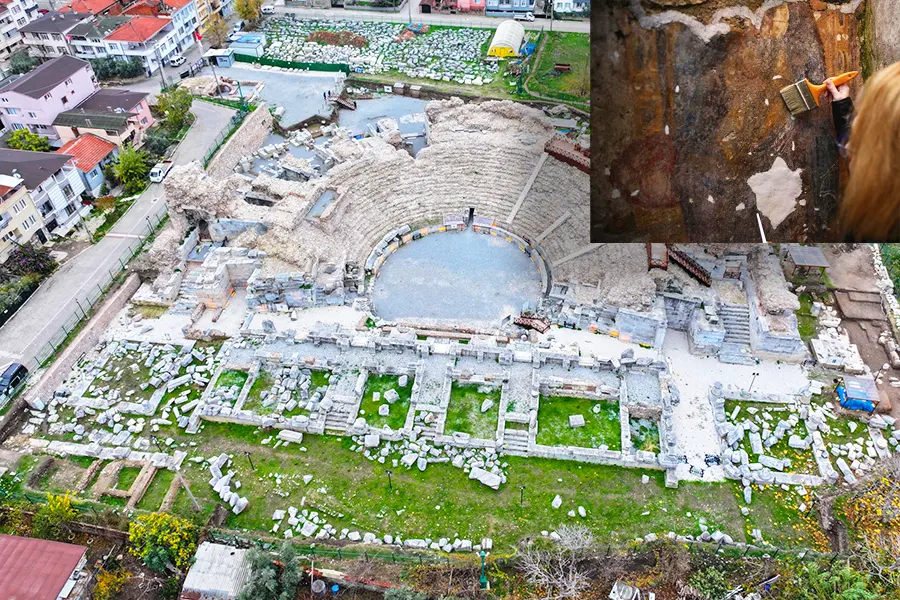
A fresco showing Jesus and Mary holding him in her arms, discovered during archaeological excavations at the ancient Roman theatre in the city of Nicaea, the modern city of İznik in the Turkish province of Bursa, has been restored and can be visited by tourists travelling to the city, which was once the capital of the Roman and Byzantine Empires.
As recently reported by the Turkish news agency Anatolia, archaeologists are currently studying the different uses of the structure of the ancient theatre of Nicaea, where the first council of Christianity was held in 325 AD, presided over by the Roman Emperor Constantine I the Great, which brought together all Christian bishops and scholars to resolve the Church’s religious disputes and establish a common creed for Christianity (the so-called Nicene Creed).
Archaeological excavations and restorations at the site, which began in the 1980s and have continued uninterrupted since 2016 by a team from Izmir’s Dokuz Eylül University, have finally made it possible to open the theatre to visitors since last March, once most of the work on the theatre’s structure was completed. It was in 2005, during the work carried out to the east of the central entrance of the building, that the so-called ‘fresco of Mary and the infant Jesus’ was discovered, which after years of study has now been fully restored.
Created against a white decorative background, the fresco shows the Virgin Mary seated on a large throne and holding the infant Jesus; at 1.42 m high and 78 cm wide, it is considered one of the oldest surviving frescoes of its kind in the world, and is located next to another fresco, 1.5 m high and about 3 m wide, showing Jesus seated to the left of Mary, with his head tilted slightly to the right towards his mother.
A unique theatre in Anatolia
Professor Aygün Ekin Meriç, head of the excavations and an academic at the Department of Archaeology at Dokuz Eylül University, told Anatolia news agency that construction of the theatre began in 111 AD during the reign of the Roman Emperor Trajan. ‘The Roman theatre of İznik is unique in Anatolia; 103 metres wide and 80 metres long, it was entirely erected on a vaulted architecture built on flat ground. Originally three storeys high and built with a vaulted system, it reached a height of 24 metres and could accommodate 10,000 spectators. Its vaulted construction makes it an exceptionally magnificient structure,’ he said.
Meriç also highlighted the different uses that the theatre had from its creation at the beginning of the 2nd century for gladiatorial games, until its final abandonment in the 17th century, when it housed several Ottoman artisans’ workshops after having served as a quarry for the 2,000-year-old wall that surrounds Nicaea.
Thus, while during the 2nd and 3rd centuries the theatre performed its original function and hosted fights of gladiators and other performances popular in antiquity; but after the Council of Nicaea in 325 ‘the site began a transition to a phase of religious use; this transition became especially evident between the 4th and 6th centuries: we have crucial evidence of this period, including frescoes of crosses, garlands and Christian symbols adorning the walls’.
‘Prominent among these is the fresco of Jesus and Mary painted on the walls of the theatre of Nicaea, identified in 2005 by Professor Bedri Yalman. Yalman then covered it up so that it would be preserved; we reopened it and brought it to light,’ said the Turkish professor, who emphasised the special importance of the fresco for the Christian world, being in fact “the earliest example of a fresco showing Mary enthroned and with Jesus in her arms” discovered by archaeology to date.
VOTE

As a history lover, Pablo Gómez was captivated by Turkey from the first day he visited it in 2006: he got married there, has a house there… and has since become an expert on Turkey’s current affairs. With a long experience in media, he has been at the helm of hispanatolia.com since 2011.