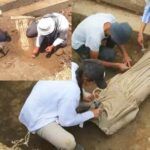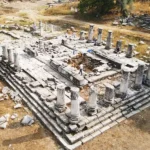
A team of some 30 experts and archaeologists from Turkey and Mongolia have been conducting research since 2020 at the ruins of a palace and a city found in the province of Van in Turkey’s Eastern Anatolia region, where they will now prepare to start archaeological excavation work to unveil the secrets of this settlement built by a Mongol ruler, Hulagu Khan, the first khan of the Ilkhanate of Persia.
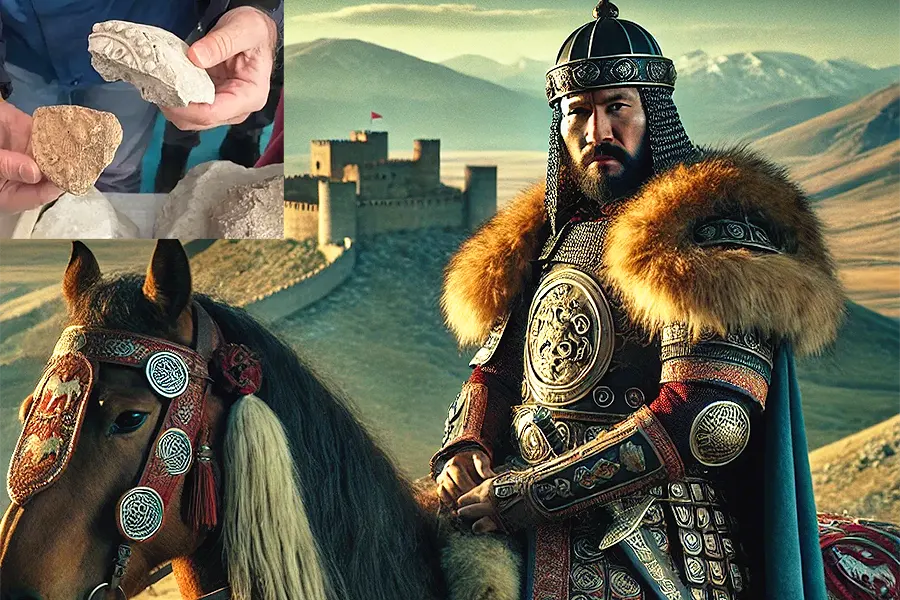
As reported by the Turkish news agency Anatolia, the work began in 2020 at the ruins located in the Çaldıran Plain near the town of Hanköy, supported by the Turkish Ministry of Culture and Tourism’s General Directorate of Cultural Heritage and Museums. There, some 30 experts found figural tiles, pottery remains and ruins of ancient walls made of compacted earth: examples of architecture that historians say are only found in Mongolia. The ruins of a summer palace and a settlement built by Hulagu Khan were also found.
These findings aroused enormous interest in both Turkey and Mongolia, especially after the current Mongolian president Ukhnaagiin Khürelsükh visited the Turkish province of Van, where he examined the archaeological remains in person. Since then, academics from Izmir’s Katip Çelebi University and the Research Institute of Turkology at the Mongolian State University of Education have completed surface surveys at the site, making it ready for the start of archaeological excavations, which are expected to begin next June.
A site connecting the history and archaeology of Turkey and Mongolia
One of the experts working in the area, Munkhtulga Rinchinkhorol, assistant professor at the Department of Islamic and Turkish Archaeology at Katip Çelebi University in Izmir and a member of the Institute of Archaeology of the Mongolian Academy of Sciences, highlighted the great excitement that this discovery has sparked in Mongolia by linking the history of the two countries.
‘The base technology that we have found here is from Central Asia. We are talking about a (construction) technology that was especially widespread in Mongolia. This same technology was also present in Karakorum, the capital of the Mongol Empire… The patterns and dimensions (found in Van) are exactly the same as those in the summer palaces in the eastern part of the Mongol Empire. We are talking about unique materials, which did not exist in this geography (in Anatolia). This place will develop historical and archaeological relations between the two countries, and will become a bridge between the two nations,’ the professor said.
Archaeologists estimate that the palace discovered in eastern Anatolia was built between 1260 and 1265 under the rule of the first khan of the Ilkhanate of Persia, whose influence on the history, trade, administration and culture of the entire region was enormous. Under the rule of Hulagu Khan, nicknamed ‘the terror of Islam’, his armies swept through Damascus and Baghdad, the two great centres of Islamic power at the time, ending the so-called Golden Age of Islam (8th-13th centuries) and the Abbasid Caliphate, making the Mamluk Sultanate of Egypt rise as the new leading Muslim power in the region. The Ilkhanate was in turn devastated by the Black Death and disintegrated after the death in 1335 of the last khan, Abu Sa’id Bahadur Khan, who died childless due to the disease.
VOTE

As a history lover, Pablo Gómez was captivated by Turkey from the first day he visited it in 2006: he got married there, has a house there… and has since become an expert on Turkey’s current affairs. With a long experience in media, he has been at the helm of hispanatolia.com since 2011.