The Council of Nicaea marked a turning point in the history of Christianity and in the spiritual organisation of the world that inherited the end of the Roman Empire. Today, 1700 years later, the small and peaceful Turkish town of İznik – the ancient Nicaea – is once again the centre of world attention thanks to the forthcoming visit of Pope Leo XIV, a gesture charged with symbolism that invites us to rediscover the city where the doctrinal course of a religion in full expansion was decided.
Understanding what happened there in 325, why it was so decisive and how its legacy has come down to us is essential for any traveller or believer wishing to understand the deep roots of Christianity.
Where is Nicaea?
Ancient Nicaea – the modern-day Turkish city of İznik – is located in northwestern Turkey, in the province of Bursa, about 130 kilometres south of Istanbul. The city sits on the shores of Lake İznik, a tranquil natural setting surrounded by mountains and olive groves that contrasts with the enormous historical and spiritual importance of the place.
Its Roman and Byzantine walls, which still stand spectacularly around much of the city as witnesses to its historic grandeur, as well as the remains of ancient submerged basilicas and ancient imperial gates, make İznik one of the most important destinations for religious tourism and Christian archaeology in Turkey.
Nicaea: a city of empires
Founded around 315 BC by Antigonus I Monophthalmos – one of the ‘successors’ after the death of Alexander the Great – as Antigoneia on the ruins of an earlier Greek colony, its strategic position in western Anatolia soon made it an enclave coveted by the Hellenistic kingdoms and later by Rome itself. After Antigonus’ defeat at the Battle of Ipsos in 301 BC, Lysimachus captured the city and renamed it Nikaia in honour of his recently deceased wife.
When the entire region of Bithynia and Nicaea itself fell under Roman rule in 72 BC, the name Nikaia was transliterated into Latin as Nicaea. The city prospered as an administrative and military centre thanks to its location in the middle of important trade routes. However, it was under the Byzantine Empire that it reached its greatest importance: not only did it host decisive councils for Christianity, but it was also an important administrative and military centre and became the capital of the Empire of Nicaea between 1204 and 1261, when the Crusader armies took and sacked Constantinople. As it welcomed exiles from the Byzantine imperial court, the city underwent a remarkable cultural and architectural development, becoming one of the epicentres of medieval Byzantine art.
After the recovery of Constantinople and the restoration of the Byzantine Empire in 1261, Nicaea lost its importance, and Byzantium proved unable to halt the rise of the nascent Ottoman emirate in the region. The defeat of Emperor Andronicus II Palaeologus at the Battle of Pelecanum in 1329 marked the beginning of the end of Byzantine control in Asia Minor, and Nicaea fell to the Ottomans after a long siege in 1331. Thereafter the city was renamed İznik (transliterated from the Greek isNikea, ‘in the city’) and was temporarily even the Ottoman capital. A famous craft tradition flourished here: İznik ceramics, famous for their turquoise-blue colour and floral motifs, which decorate mosques and palaces throughout the Islamic world.
Why was the Council of Nicaea convened?
In 325 AD, the Roman Emperor Constantine I the Great convened the first ecumenical council in the history of Christianity in Nicaea to stop a deep doctrinal crisis that threatened the unity of the new religion. The central conflict revolved around Arianism, a doctrine preached by Arius, a priest of Alexandria, who denied the consubstantiality of Christ with God the Father. For Arius, the Son was a creature created by the Father and therefore subordinate.
The tensions caused by this teaching divided bishops, communities and entire cities, leading to unrest and revolt. According to historical sources, Christianity was on the verge of an irreparable fracture, so – given the gravity of the situation – the Council of Nicaea was convened to resolve the dispute and establish a common doctrine that would prevent further schisms.
What did Constantine the Great seek to achieve by convening the council?
Although according to some historical sources Constantine had converted to Christianity after the battle of the Milvian Bridge (312) – other historians claim that he did not convert until almost his death – his motivation for convening the council was not solely religious. Above all, the emperor sought to ensure the political and spiritual unity of the Roman Empire through the new and thriving religion of Christianity, despite the fact that at this time Christians generally accounted for less than 20% of the total population of the Empire.
In Constantine’s eyes, the growing doctrinal disputes within the Christian Church posed a direct risk to the stability of the empire. He therefore sought to bring together the most influential bishops of the day – it is estimated that they attended between 220 and 318, according to various ancient sources – and put a definitive end to the Arian controversy. Its aim was clear: that the Christian faith, unified and centred around the figure of the emperor and the Empire, would eventually become the religious binding force for an empire as vast as it was diverse.
Decisions of the Council of Nicaea on the Christian creed
The council produced fundamental decisions that marked Christian theology forever. Among the most important decrees were:
- The formulation of the Nicene Creed, which affirms that the Son is ‘consubstantial’ (homoousios) to the Father, thus rejecting the Arian thesis.
- The formal condemnation of Arius and the order to destroy his theological writings.
- The setting of a common date for the celebration of Easter, independent of the Jewish calendar.
- Various disciplinary rules on the organisation of the Church, the ordination of clergy and liturgical matters.
The Nicene Creed – which begins ‘I believe in one God, the Father almighty, maker of heaven and earth, of all things visible and invisible. I believe in one Lord Jesus Christ’ – became the doctrinal basis of Christianity in both East and West. It was undoubtedly the most momentous decision of the council, because it defined the divine nature of Christ and established a theological framework shared by most Christian churches even today.
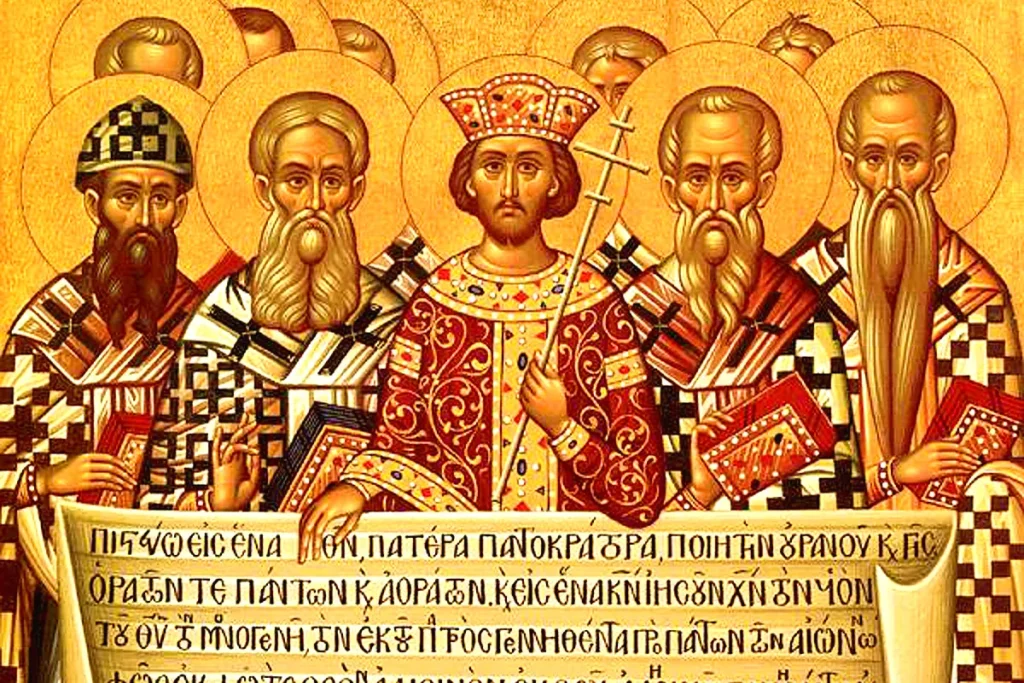
Consequences of the Council of Nicaea
The impact of the council was enormous. The main historical and religious consequences were:
- The consolidation of Christianity as a strong force in the Roman Empire.
- The strengthening of the authority of ecumenical councils as a mechanism for resolving doctrinal disputes.
- The progressive marginalisation of Arianism, which, although it persisted for centuries, was excluded from official doctrine.
- Above all, the creation of a unified Christian identity, essential for the spread of Christianity in Europe, Asia and Africa.
From Nicaea onwards, councils became the key instrument for defining orthodoxy and resolving theological conflicts: a model that would later be repeated at Constantinople, Ephesus or Chalcedon.
Were there more councils at Nicaea?
Yes. The importance of Nicaea did not end in 325. In 787, the city hosted the Second Council of Nicaea, which was instrumental in the re-establishment of image worship and the final defeat of iconoclasm.
The Council of Nicaea II was a decisive council for Christian art, as it confirmed the legitimacy of icons and their devotional use in temples and monasteries. Nicaea was thus forever inscribed in history as a city that was instrumental in shaping not only doctrine, but also art within Christianity.
Why is Pope Leo XIV travelling to İznik (Turkey)?
Pope Leo XIV’s visit to İznik, scheduled for 28 November 2025, will be the new Pontiff’s first and coincides with the 1,700th anniversary of the Council of Nicaea, an event of enormous symbolic value for Christianity. The new Pope‘s aim is:
- Commemorate one of the most important doctrinal milestones of the Church.
- To encourage dialogue between the Catholic and Orthodox Churches, both heirs of the Nicene legacy.
- To recognise the Christian heritage present in Turkey, especially in historic cities such as İznik, Antioch and Ephesus.
- To underline the importance of inter-religious coexistence in a country where Christian, Islamic and Jewish influences have coexisted for centuries.
It is hoped that with this historic visit of the Pope, İznik will become an important destination for religious tourism worldwide, attracting pilgrims from all over the world.
Some interesting facts about the Council of Nicaea
- According to many historians, the council meeting took place in the now defunct imperial palace of Nicaea itself, located very close to the lake, which the emperor Constantine had made available due to the lack of space in other churches. Today, however, many experts believe that several meetings may have been held in the present-day basilica submerged in Lake İznik.
- According to ancient sources, Constantine attended the council dressed in imperial purple and presided over the theological sessions, thus seeking to give authority to the council and to force the bishops to reach a final agreement.
- Some accounts mention that, in the midst of the most tense theological debates, ‘intense’ verbal confrontations took place; tradition even has it that St. Nicholas of Mira – the origin of the Santa Claus legend – even slapped Arius, although this episode is probably legendary and did not actually happen.
- Many attending bishops had survived Diocletian’s persecutions just two decades earlier, some with visible physical marks. The persecutions against Christians ended after the – misnamed – Edict of Milan in 313.
- The Council of Nicaea first introduced the term homoousios, meaning that God the Father and God the Son are of the same substance and nature, which became a cornerstone of later Christian theology.
Must-visit places in İznik (Nicaea)
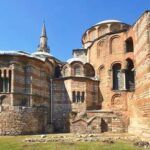
For those wishing to visit İznik to take advantage of its popularity due to the Pope’s visit and to follow in the footsteps of the Council of Nicaea, the city offers several must-see sites. The most emblematic is the Church of Hagia Sophia of Nicaea, rebuilt in Byzantine times and the site of the Second Council of Nicaea in 787, which was modified after the Ottoman conquest and is now a mosque, but still retains architectural elements of great spiritual and historical value.
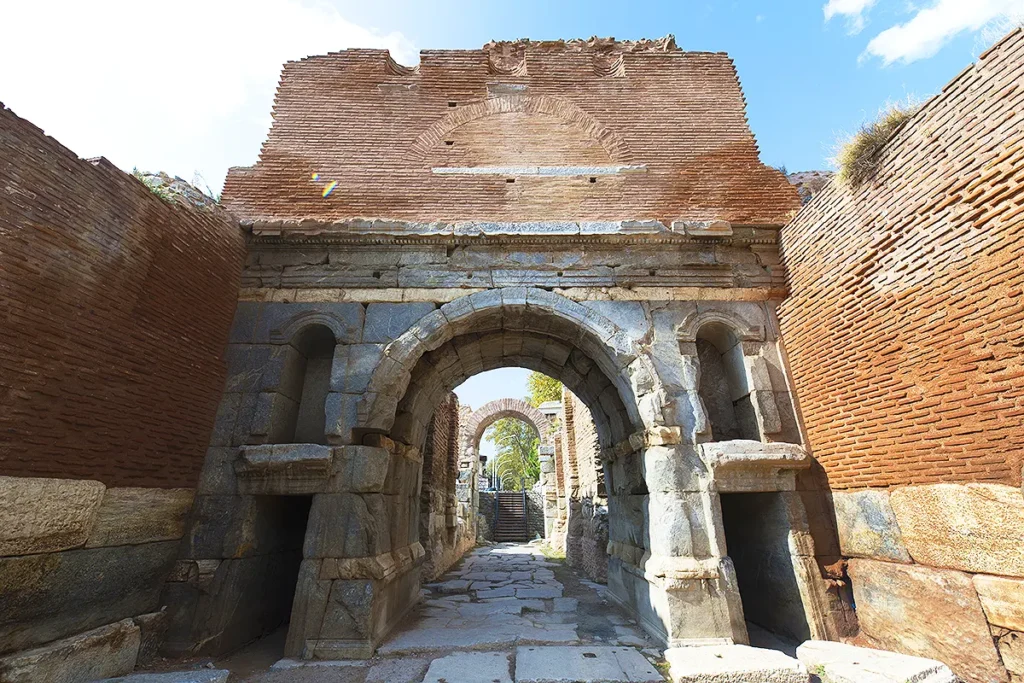
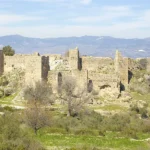
A few metres away are the Roman and Byzantine walls, one of the best preserved defensive structures in all of Anatolia, with monumental gates such as the Istanbul Gate and the Lake Gate, evoking the grandeur of the city in antiquity. On the shores of Lake İznik you can also visit the remains of the submerged basilica, flooded after an earthquake in the 8th century and today one of the most unique Christian archaeological sites in Turkey.
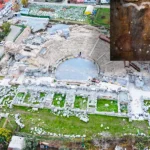
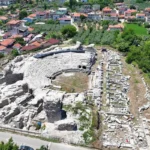
The tour is completed by the ancient Roman theatre – with an architecture unique in all of Anatolia and where it is believed that meetings of the Council of Nicaea were also held – and the Museum of İznik, as well as the local pottery workshops, where the famous İznik tile pieces are still made, direct heirs of the artisan splendour that followed the Byzantine era.
İznik (Nicaea) – a small Turkish town on the shores of a beautiful lake – may not be the most famous in the world; but the Pope’s visit could help restore it not to its former glory, but certainly to its rightful place in the history of the Roman and Byzantine world and, above all, of Christianity.
📚 If you want to learn more about the history of Turkey, we recommend:
🧿 Discover here more recommended products about Turkey
We include affiliate links: if you buy through them, you don’t pay extra money and you help this website.
VOTE

EDITORIAL TEAM
🧿 About us
.
Edited and reviewed by:

Pablo Gómez is a specialist in Turkey and has been editor-in-chief of Hispanatolia since 2011. He has been analysing current affairs and geopolitics in Turkey and the surrounding region since 2006.
…
📣 Your ADVERTISING on Hispanatolia
.
🤗 HELP US WITH A DONATION:
💗 Paypal