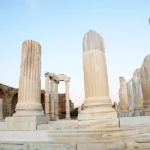
Excavations at the ancient city of Sillyon in the Serik district of Antalya province, in southern Turkey, have uncovered the main street used during the Hellenistic, Roman, Byzantine, Seljuk, Beylik and Ottoman periods as part of efforts to uncover the history of a place that resisted the conquest of Alexander the Great himself.
Founded on a high hill around 2000 BC to defend itself against its enemies, the ancient city of Sillyon has long undergone extensive excavations that have now uncovered the kilometre-long main street, revealing structures and features belonging to the different civilisations that settled here: Greeks, Romans, Byzantines, Byzantines, Turks, Seljuks and Ottomans. Sillyon’s strategic location made it virtually impregnable, so much so that Alexander the Great himself was unable to conquer it in his campaign against the Persian Empire in Asia, having to abandon its siege in 333 BC.
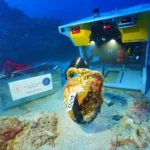
Murat Taşkıran, head of the archaeological excavations at Sillyon and professor at Pamukkale University, told the Anatolia news agency that an international team of around 50 experts from Turkey and abroad are taking part in the excavations; in addition to archaeological work, interdisciplinary studies of geoarchaeology, zoology, palaeoarchaeology, geophysics and geology are also being carried out at the Sillyon ruins.
“The main street starts at the bottom and continues upwards to the acropolis, with a length of 1 kilometre and a width of between 4 and 10 metres. The main street was in continuous use from the foundation of the city until the late period, and has the particularity of preserving traces of all periods. Its inhabitants established a security checkpoint on the street, which has a different structure to prevent it from penetrating the city’s defences,” said the professor.
Ottoman mosques next to Roman tombs
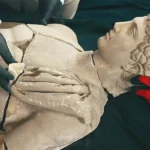
According to Taşkıran, the street has the characteristic of being a “cultural street” that encompasses all civilisations. Another of the most important features of this street is the necropolis, which has tombs located on both sides of the street in an area of about 300 metres: “In the street we can see Hellenistic, Roman and Byzantine tombs . During the current excavations, we identified 220 tombs belonging to the Seljuk period in Anatolia. We found that it was a Turkish-Islamic cemetery, and we even discovered that a baby had been buried in one of the tombs,” said the expert.
“Sillyon’s main street is a historical crossroads. Walking along it, you can see an Ottoman mosque, an Ottoman fountain that still spouts water, a Roman tomb, groups of Seljuk tombs, sacred areas, inscriptions, statue bases, the gates of the city walls and vestiges of different eras. You will see the mosque built by the Seljuks, the shops of the Roman period and the cisterns. In other words, history is revealed in this street in all its vitality,” said the archaeologist.
📚 If you want to learn more about the history of Turkey, we recommend:
🧿 Discover here more recommended products about Turkey
We include affiliate links: if you buy through them, you don’t pay extra money and you help this website.
VOTE

EDITORIAL TEAM
🧿 About us
.
Edited and reviewed by:

Pablo Gómez is a specialist in Turkey and has been editor-in-chief of Hispanatolia since 2011. He has been analysing current affairs and geopolitics in Turkey and the surrounding region since 2006.
…
📣 Your ADVERTISING on Hispanatolia
.
🤗 HELP US WITH A DONATION:
💗 Paypal