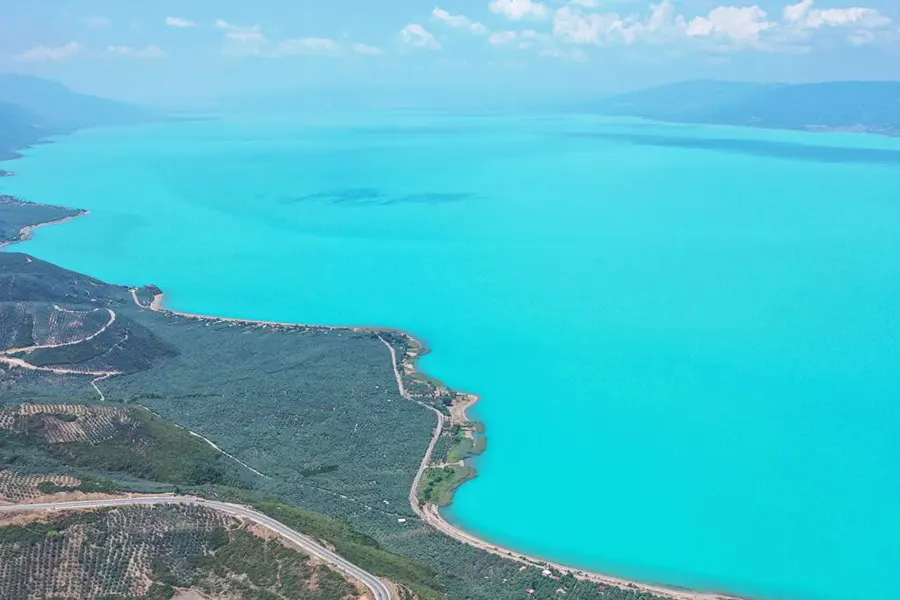
Turkey’s famous Lake İznik, the fifth largest natural lake in the country and named after the city of İznik, the ancient Nicaea which was the Roman, Byzantine and Ottoman capital, has been dyed turquoise by a completely natural phenomenon which has triggered a tourism boom in the area, attracting all kinds of curious onlookers but especially photography lovers.
Located in the Marmara region in the province of Bursa, and covering an area of 300 square kilometres, the lake has acquired a unique appearance due to a phenomenon that has also occurred on other occasions in the Bosphorus Strait of Istanbul, and is due to the proliferation of a type of phytoplankton that, because of the high temperatures, rises to the surface from the bottom of the lake in search of oxygen.
In statements made to Turkish media by Mehmet Kağan, Mayor of İznik, he stressed that this natural phenomenon has a great contribution for local tourism: ‘This unusual beauty of our lake contributes greatly to the promotion of İznik. Our citizens and guests enjoy this beautiful view’.
Turkey’s Lake İznik is also home to a submerged Byzantine basilica, which was discovered in 2014 about 20 metres from the shore of the lake, under its waters, and which came to light due to the lowering of the water level caused by the drought. The city of İznik, the ancient city of Nicaea, still retains much of its Roman walls and many traces of its Roman and Byzantine past, and since 2024 has been included in the UNESCO World Heritage nomination list.
VOTE

EDITORIAL TEAM
🧿 About us
.
Edited and reviewed by:

Pablo Gómez is a specialist in Turkey and has been editor-in-chief of Hispanatolia since 2011. He has been analysing current affairs and geopolitics in Turkey and the surrounding region since 2006.
…
📣 Your ADVERTISING on Hispanatolia
.
🤗 HELP US WITH A DONATION:
💗 Paypal