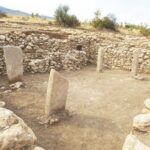
Archaeological excavations carried out in recent years at the ruins of the ancient Roman city of Satala, located in the northeastern Turkish province of Gümüşhane, have uncovered the remains of the only surviving fortress of the Roman Empire‘s defence lines on its eastern frontier, shedding light on the history of what is also the only Roman legion camp discovered in Anatolia.
The excavations, which are being carried out in the village of Sadak in the Kelkit district (about 150 km south of Trebizond, modern Trabzon), began six years ago and so far archaeologists have been able to unearth numerous remains that are rewriting the history of this region in the time of the Roman Empire; the excavation team, led by the director of the Bartın University Applied Archaeology and Research Centre, Şahin Yıldırım, has unearthed artefacts dating back as far as 5,000 years.
It was here that the famous Roman Emperor Trajan established the Legio XV Apollinaris and ordered the construction of a castra stativa (permanent camp), where this Roman legion was based until the 5th century; around it grew the city of Satala, and before its walls the Persians were defeated in 530 AD. The importance of this fortified position for the defences of the Roman Empire is reflected in the fact that up to five emperors visited this site in the course of history.
In fact, the Eastern Roman Emperor Justinian I decided to reinforce the walls of Satala, as it was key to defend the eastern frontier against the incursions of the Persian Empire, which finally succeeded in conquering the city in 607.
The ruins of Satala fell into oblivion until they were discovered in the 19th century by British explorers; today you can see – in addition to the remains of the Roman fort – the ruins of the ancient city walls, an amphitheatre and a multi-arched structure initially thought to be an aqueduct, but now thought to be a Christian basilica dedicated to St Eugene. There are also many inscriptions in Greek and Latin.
A history going back thousands of years
“The main work we have carried out this year has been in the Roman legion fort, and in the area where the tombs are located (…). In addition, we have carried out studies on the architecture of the buildings of the Roman fort where these legionaries were located. During our research, we have found that the remains belong to the early 2nd century A.D. We have also discovered remains of buildings and tombs dating back to the Urartian period, and even older,” said Yıldırım.
“We believe that the importance of this site will increase with the studies that will be carried out here for the next years. It also has great potential for tourism. We plan to continue working here and bring the history of the Roman Empire to light. If we build a visitable area and a museum, we will increase the fame of Satala,” the expert said.
VOTE

As a history lover, Pablo Gómez was captivated by Turkey from the first day he visited it in 2006: he got married there, has a house there… and has since become an expert on Turkey’s current affairs. With a long experience in media, he has been at the helm of hispanatolia.com since 2011.