When we think of the conquest of the Persian Empire by Alexander the Great, we are often unaware of how small decisions and decisive moments shaped the fate of the Macedonian ruler and prevented the entire risky campaign to conquer Persia from ending in a major disaster; this is precisely what happened at the Battle of the Granicus, the first battle that Alexander fought after landing in Asia Minor.
In the spring of 334 BC, shortly after crossing the Hellespont, the young Macedonian king found himself face to face with a large army assembled by the Persian satraps on the banks of the River Granicus. On the other side of the river lay the first challenge of an ambitious campaign that would ultimately transform the history of the Near East and the ancient world forever.
The Battle of the Granicus was Alexander’s first major clash with the forces of the Achaemenid Empire and also a demonstration of the drive that led Alexander to defeat and surprise all his rivals, and which on numerous occasions led the monarch himself to put himself on the front line of battle. In fact, it was possibly at the Granicus that Alexander came closest to losing his life; and yet, what could have ended in tragedy and death ultimately opened the gates of Asia Minor to the Macedonians and undermined the foundations of Darius III’s empire.
An invasion of Persia conceived by Philip II of Macedonia
Something that many people are unaware of, even those with a keen interest in history, is that the decision to invade Persia was not Alexander’s doing. His father, Philip II of Macedonia, had transformed the Macedonian kingdom into the leading military power in the Greek world and had set in motion preparations for an expedition against the Achaemenid Empire. After defeating Athens and Thebes at the Battle of Chaeronea in 338 BC, Philip promoted the Corinthian League and organised the forthcoming war against Persia as a pan-Hellenic campaign.
In fact, a sizeable Macedonian force had already crossed into Asia as an advance guard for the invasion of Persia when death took Alexander the Great’s father by surprise: the assassination of Philip in 336 BC disrupted those plans and unexpectedly placed a young Alexander, barely twenty years of age, on the throne – a young man whom many on both sides of the Aegean regarded as weak and inexperienced. Consequently, before turning his attention to the East, the new king had to consolidate his authority in Macedonia and quell the rebellions that had broken out in Greece and the Balkans.
Once his power was secure, Alexander resumed his father’s plan to invade the Achaemenid Empire. Officially, the expedition was justified as a war of retaliation against Persia for the invasions of Greece carried out during the Greco-Persian Wars, more than a century earlier; but the venture also had clear political and territorial objectives: to wrest the Great King’s domains from him and to build a new empire in the region under Macedonian hegemony. It should be noted here, however, that Philip II’s plans were limited solely to the conquest of Asia Minor – the Persian Empire, given its vast size, was considered unconquerable – and that, at least until the Battle of Issus, Alexander also envisaged a conquest confined to what is now Anatolia.
Alexander crosses the Hellespont
In 334 BC, Alexander crossed the Hellespont, now known as the Dardanelles, at the head of an army consisting mainly of Macedonians and Greek allied contingents. The exact figures vary according to ancient sources, although modern estimates of the entire expedition generally put his forces at around 20,000 men, including more than 4,000 heavy cavalry and some 12,000 armoured soldiers, mainly Macedonian phalanxes (as well as some 3,000 hypaspists).
The landing in Asia Minor carried enormous symbolic significance. Alexander was taking the war into the very heart of the Persian Empire itself and, according to the tradition handed down by ancient authors, to reinforce this symbolism he visited Troy and paid homage to Achilles, the hero of the Iliad with whom he felt a special kinship.
Whilst the invading Macedonian army was taking its first steps through north-western Anatolia, the Persian governors of the region began to concentrate their forces. However, Darius III did not go in person to halt Alexander, as he considered it to be a minor invasion that did not require his presence. Consequently, the first line of defence for Asia Minor was left in the hands of his satraps and local commanders.
Among these commanders, Memnon of Rhodes stood out; an experienced Greek military officer in the service of the Achaemenid Empire who probably understood the danger posed by the Macedonian army better than many Persian leaders, and who therefore tried to warn them of what they were up against.
The plan that might have stopped Alexander
Before the Battle of the Granicus, the Persian commanders met to decide how to respond to the Macedonian invasion. According to ancient accounts, Memnon proposed avoiding a head-on battle and adopting a scorched earth strategy: destroying crops and supplies and retreating before the Macedonians, leaving them without the means to sustain themselves.
It was a potentially devastating proposal for Alexander. His army relied on a supply line that was far too long for the time and therefore needed to obtain food and resources from the territories through which it was advancing. A Persian retreat accompanied by the systematic destruction of supplies, fields and crops would have forced the Macedonian king to venture ever deeper into enemy territory in search of sustenance, with his forces weakened by hunger and demoralised, leaving them at the mercy of the Persians.
But the Persian satraps rejected that strategy. Many viewed Memnon with suspicion because he was a Greek in the pay of Darius III and believed that this Hellenic man was merely seeking to prolong the war to boost his standing with the Great King of Persia; furthermore, from the Persian perspective, their rulers saw themselves as protectors of their subjects and could not conceive of the idea of sowing destruction in the lands they governed; finally, they regarded the plan to retreat in the face of an enemy they considered inferior as an intolerable display of weakness and cowardice.
The Persian forces therefore decided to concentrate their forces near Zelea – an ancient city near the present-day coast of the Marmara Sea – and chose the Granicus River as their defensive position, a watercourse in north-western Anatolia which still exists today as a historic site and is usually identified with the present-day Biga Çayı (Biga Stream).
Two armies facing each other
Accurately reconstructing the forces present at the Granicus is difficult. Ancient sources provide differing figures, some of which are clearly exaggerated. Although the Macedonian army has often been portrayed as numerically inferior to that of its enemies, the Encyclopaedia Iranica points out, precisely, that the actual size of the Persian army cannot be established with certainty and considers it possible that the two forces were roughly comparable in strength.
Some modern reconstructions estimate that there were around 10,000 Persian horsemen and several thousand Greek mercenaries, whilst others suggest different figures. What is important from a tactical point of view is that the Persians possessed a powerful cavalry and a force of professional infantry, composed largely of Greeks fighting in the pay of the Great King.
Alexander, for his part, had at his disposal one of the most sophisticated military formations of his time: the Macedonian phalanx, armed with its long sarissas, some 7 metres in length, as well as light infantry, allied troops and a formidable force of heavy cavalry, amongst whom the Hetairoi (“Companions”) clearly stood out: the Macedonian mounted elite whom Alexander would repeatedly deploy in numerous battles as a shock force to break through decisive points in the enemy lines.
How did the battle begin?
One of the greatest problems faced by historians when reconstructing the Battle of the Granicus is that it is not even clear how the clash began, as the main ancient sources do not agree. The account handed down by Arrian and Plutarch presents a dramatic scene: Alexander is said to have reached the river late in the day, and his veteran general Parmenion is said to have advised him to wait until the following morning, as attacking immediately would have meant crossing the river under enemy pressure and then climbing up the opposite bank.
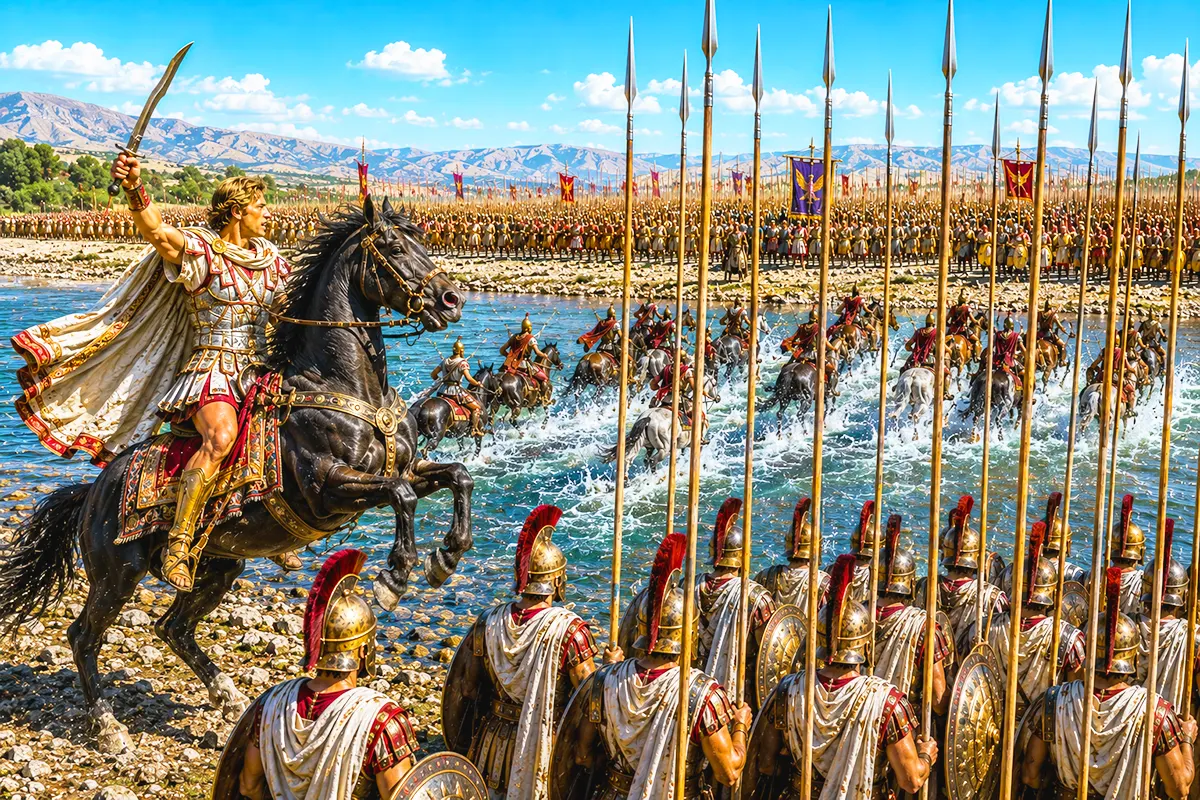
Alexander, however, being the impetuous young man he was, rejected the advice of the prudent general who had served his father. Plutarch records the famous reply in which the Macedonian king told him that the Hellespont itself would be ashamed if, having crossed it without difficulty, Alexander were now afraid of the little river Granicus. So the Macedonian monarch ordered an attack and personally led the crossing of the river.
However, Diodorus of Sicily offers another version; according to his account, the Macedonians crossed the river during the night and then attacked at daybreak. Some modern historians consider this reconstruction more plausible and question the spectacular account of a head-on cavalry charge crossing the river directly, which seems sheer madness.
It is a fact that much of what we know about the battle comes from authors who wrote long after the events and who, in turn, relied on ancient sources that have since been lost. Be that as it may, this and other details of the Battle of the Granicus remain to this day a matter of debate.
Alexander’s risky manoeuvre
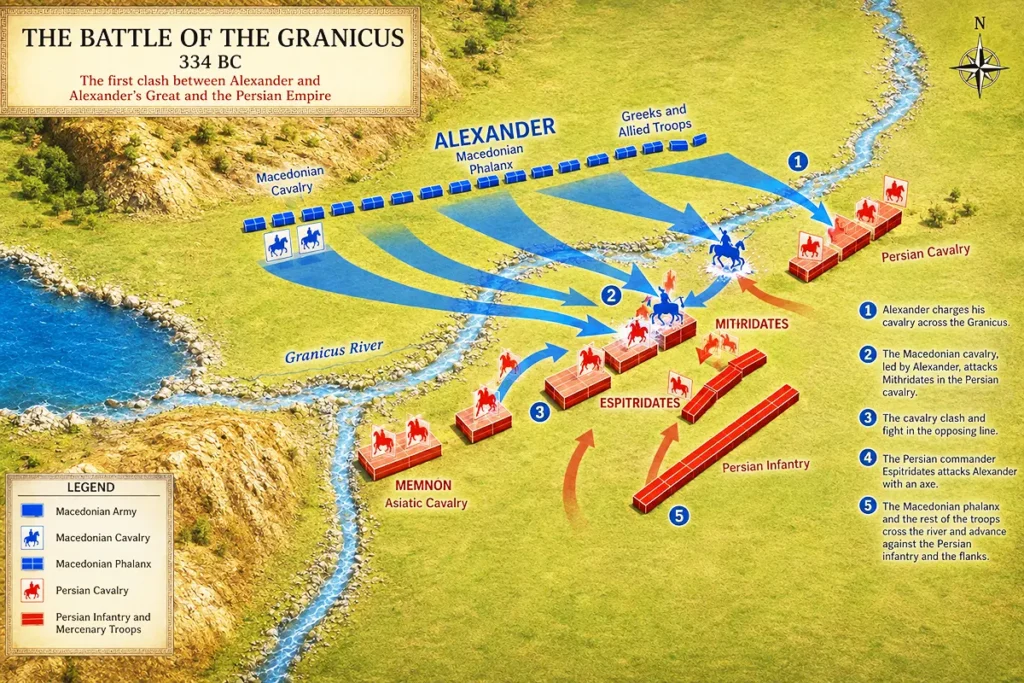
If we stick to Arrian’s traditional account, the Persian cavalry occupied high ground on the eastern bank of the river, whilst the Greek mercenaries in the service of Persia remained in the rear. Alexander deployed Parmenion on the left wing and personally took command of the right wing, where a large part of his elite cavalry was stationed.
The king is said to have initially sent an advance force towards the river: a diversionary manoeuvre that forced the Persians to concentrate their forces at that point and created the conditions necessary to carry out the main attack. Then, Alexander sprang into action.
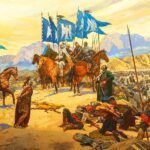
Followed by the Companions, he crossed the river at an oblique angle to prevent his troops from emerging in a vulnerable column, which led to a fierce hand-to-hand cavalry battle breaking out on the opposite bank. This was not the familiar cinematic image of two masses of horsemen charging cleanly into one another, but rather horses and men fighting in a confined and difficult space, whilst the Macedonians attempted to gain sufficient ground on the opposite bank to be able to deploy the rest of their forces.
Thanks precisely to their long spears, the Macedonian phalanxes held a significant advantage in the clash and enabled Alexander’s soldiers, little by little, to begin breaking the Persian resistance.
When Alexander was on the verge of death
Despite this spectacular and daring manoeuvre, the most famous and well-known moment of the battle featured the Macedonian king himself. Alexander – as was his custom – was fighting on the front line and his position was easily recognisable, so the Persian commanders realised that killing Alexander could bring the battle and the entire campaign to an immediate end.
According to Arrian, Alexander personally confronted several Persian nobles during the mounted skirmish, first charging at Mithridates, son-in-law of Darius III, whom he knocked from his horse and killed with a spear thrust to the face. Alexander was then drawn into another dangerous confrontation with the Persian commanders Resaces and Espitridates.
Resaces, seeing Mithridates’ death, struck the king’s helmet with his great curved sword, damaging both the king’s helmet and his armour; however, the Macedonian king managed to escape unharmed and struck him down with another spear thrust, this time to the chest. Espitrídates, taking advantage of the fact that the Macedonian king was still dazed, then set about attacking the monarch from behind, raising his axe to deliver the final blow, when Cleitus the Black intervened and severed his arm at the very last moment, thus saving Alexander’s life.
Later tradition would turn this episode into one of the most famous moments in Alexander’s life, although it should be noted that ancient sources offer differing accounts of the exact details and protagonists of this episode, and it is difficult to reconstruct with absolute certainty how it unfolded.
In any case, the incident demonstrates the extent to which the campaign to conquer Persia might have ended practically as soon as it had begun. The fact is that Alexander did not direct the battles from a safe position at the rear: his conception of command required him to be physically present at the decisive points of the battle, a behaviour that undoubtedly inspired his soldiers and earned him well-deserved fame… but which also exposed the entire Macedonian plan to the risk of his king’s accidental death.
The collapse of the Persian cavalry
The deaths of several Persian commanders and the mounting Macedonian pressure eventually broke the enemy cavalry’s resistance, and when the Persian horsemen began to retreat from their positions along the river, the battle entered a second phase.
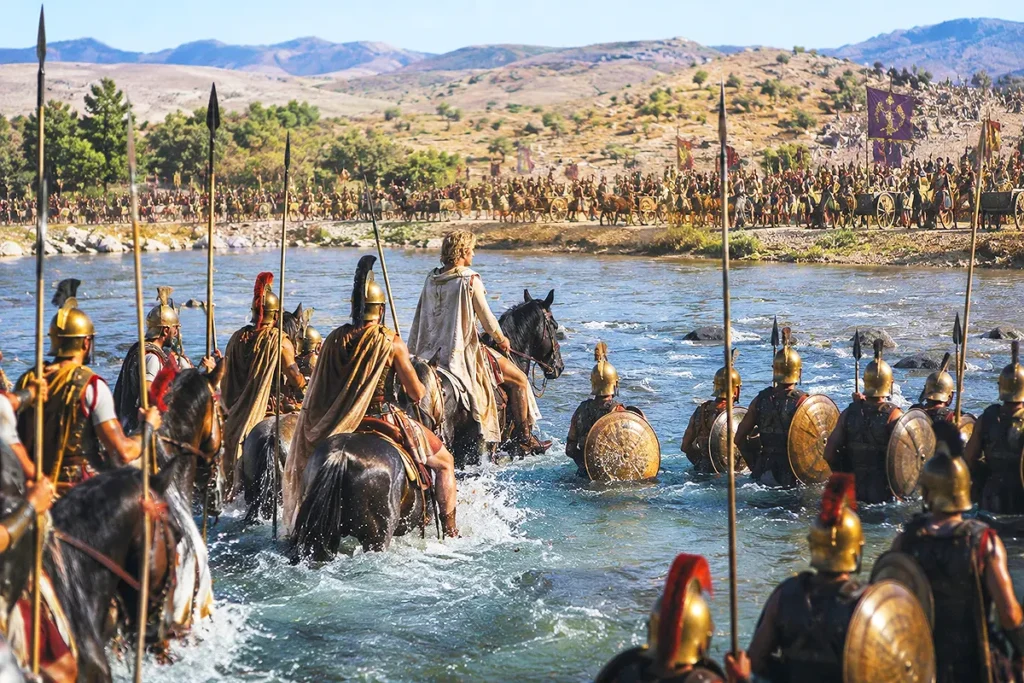
Alexander did not devote all his efforts to pursuing them. His attention then turned to the Greek mercenaries serving Persia, who were positioned in the rear and who, surrounded and no longer supported by the cavalry, had found themselves in an extremely precarious situation.
Their fate was particularly cruel. Surrounded by the Macedonian forces, most were killed in the fighting — massacred — whilst others were taken prisoner. Ancient sources give varying figures, but the tradition recorded by Arrian maintains that around 2,000 Greek mercenaries were sent as prisoners to Macedonia to perform hard labour.
The severity of Alexander’s actions stemmed from his desire to send a political message. The Macedonian king was leading what had officially been presented as a punitive expedition by the Greeks against Persia; he therefore portrayed those mercenaries as traitors, as men who had fought against their own compatriots in exchange for Persian money which, as Alexander himself and others suspected, was also behind his father’s murder.
How many actually died in the battle?
At this point, we come to another aspect on which there is likewise no consensus: the casualty figures. Ancient authors provide very different figures, and there is a clear tendency to exaggerate the Macedonian victory, minimising Alexander’s losses and inflating those suffered by his adversaries.
Plutarch cites extraordinarily high figures from Diodorus for the Persian losses, whilst Arrian gives a much lower toll for the Macedonians. Generally speaking, it is accepted that there were several hundred dead among Alexander’s ranks, whilst Persian casualties numbered in the thousands… But to be honest, there is no way of verifying these figures with any precision.
It does seem clear that the losses were particularly severe amongst the Persian aristocracy and commanders present on the battlefield, which contributed to the collapse of Persian resistance: several commanders were killed during the fighting, and this exacerbated the disorder that ensued following the defeat; and it is well known that, in antiquity, the heaviest casualties occurred not during the battle itself, but when a defeated army fled in disarray, pursued by its enemies.
Not all the Persian nobles died in the battle. Arsites, satrap of Hellespontic Phrygia and one of those responsible for the region’s defence, initially survived but, according to tradition, subsequently committed suicide upon realising he was unable to halt the Macedonian advance and fearing the punishment of Darius III.
Alexander also turned his own dead into instruments of political propaganda. He commissioned a monument at the Sanctuary of Zeus at Dion (Macedonia), traditionally attributed to Lysippos, which depicted Alexander himself alongside 25 Companions killed in the initial charge on horseback; and sent 300 sets of Persian armour to Athens, which were offered to Athena on the Acropolis and accompanied by the famous inscription that expressly excluded the Spartans, due to their refusal to recognise Macedonian hegemony over Greece and to join the campaign against Persia.
The dispatch of the Persian armours to Athens conveyed a carefully crafted message: the campaign was not to be seen merely as a personal conquest by the Macedonian king, but as a victory for all Greeks over Persian power. Macedonian propaganda thus linked the expedition to the painful memory of the Greco-Persian Wars and the invasions launched by Darius I and Xerxes, more than a century earlier, against Greece.
But behind that pan-Hellenic rhetoric, we must not forget that a far more complex reality existed: the Greeks fought on both sides. Alexander had Hellenic contingents in his army, whilst Persia also employed thousands of mercenaries from the Greek world. The Battle of the Granicus was, therefore, not only a war between empires but also a confrontation within the political and military sphere of the Eastern Mediterranean itself.
Asia Minor surrenders to the Macedonians
The strategic consequences of the Battle of the Granicus were immediate. The Persian defeat destroyed much of the force that the satraps could rapidly muster to defend north-western Asia Minor, and left the Persian cities and administrative centres in the region in a highly vulnerable position.
Following the battle on the Granicus, the city of Sardis surrendered to Alexander without putting up a fight, and the Macedonian army continued to advance, conquering the Greek cities along the western coast of Asia Minor. Ephesus also opened its gates to him, although other cities on the Aegean coast presented greater difficulties.
The war, however, was far from over. Memnon survived the disaster and continued to organise the Persian resistance. In Miletus and, especially, in Halicarnassus, the Macedonians would encounter considerable opposition. Furthermore, Persia retained a potentially decisive advantage: its fleet. The Achaemenid naval dominance directly threatened Alexander’s communications with Europe and his supply lines, and there was even a risk that its ships might bring the war back to Greek territory.
The Persian Great King Darius III enters the scene
Up until the Granicus, Alexander had essentially faced provincial forces. Darius III was not present at the battle and had not yet personally mobilised the enormous resources available to the Great King. But that was about to change.
The speed of the Macedonian advance showed Darius that he could not deal with this invasion by treating it merely as a raid that the western satraps would be able to contain. Alexander had come to Asia to stay.
In 333 BC, Darius raised an army and personally marched against Alexander. The two monarchs met face to face for the first time at the Battle of Issus, which was fought near the present-day Turkish city of Alexandretta (in Turkish İskenderun, a name derived precisely from İskender, ‘Alexander’), where Alexander secured a second, even more spectacular victory.
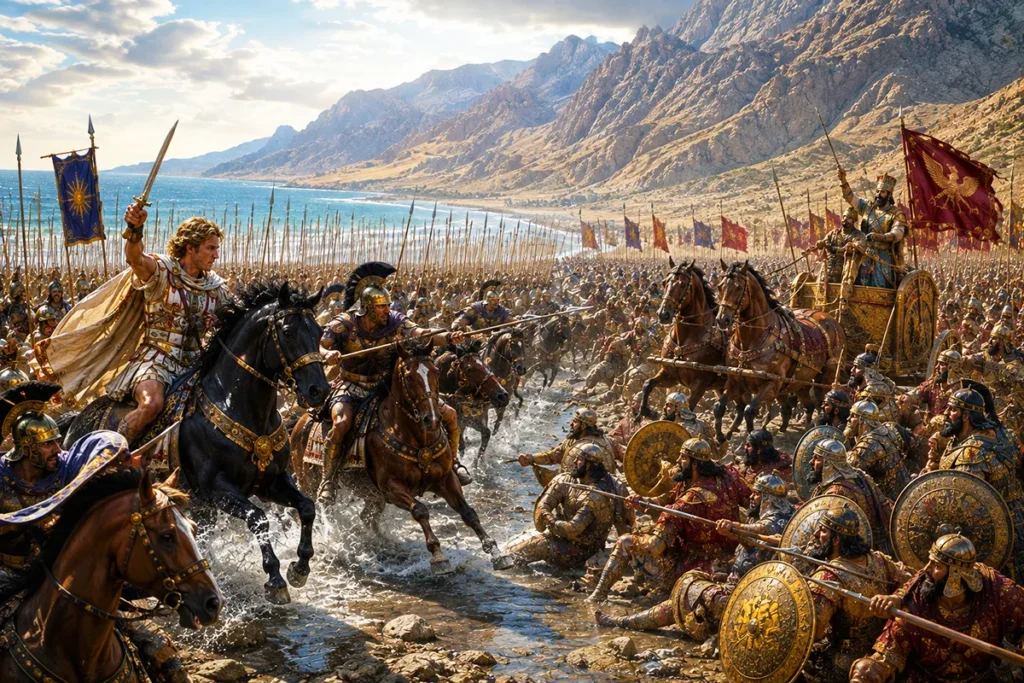
Two years later, they would face each other again at Gaugamela, not far from what is now Mosul in northern Iraq. The defeat suffered here by Darius III was total: the Great King – who had assembled at Gaugamela a colossal force recruited from every corner of the empire – saw his ability to defend the heart of Persia destroyed, and was forced to flee whilst Alexander occupied Babylon, Susa and Persepolis.
The Granicus: the battle that changed history
Seen from this perspective, knowing all the victories and conquests that followed, the victory at the Granicus may seem simply the first chapter of an inevitable conquest. But it was not.
By the end of May 334 BC, Alexander’s future empire did not yet exist. The Macedonian had only just landed in Asia, was dependent on vulnerable lines of communication, and his funds and supplies were meagre compared to the vast human, economic and territorial resources of the Persian Empire, which were vastly superior to those of Macedonia. Furthermore, as we have seen, during the battle itself, Alexander came very close to dying – on more than one occasion, in fact, although Cleitus the Black’s intervention is the best known.
Had any of the attempts to kill the Macedonian king succeeded, the history of the eastern Mediterranean would probably have taken a very different course. Macedonia could, of course, have chosen another king; but Alexander would have died without a clear heir – as indeed happened years later – unleashing chaos and uncertainty throughout the kingdom. Moreover, whoever the new Macedonian monarch might have been, he would have found it difficult to match the extraordinary combination of political ambition, military prowess and personal charisma that Alexander possessed, and which held that expedition together over the following years.
The Battle of the Granicus was, therefore, much more than a mere victory on the battlefield. It demonstrated that the effective army created by Philip II and now led by his son, Alexander the Great, was capable of defeating the fearsome Persian forces on their own territory. It provided much-needed morale, prestige and resources for the campaign against Persia in its early stages, weakened the defences of Asia Minor and confirmed to allies and enemies alike that the young Macedonian monarch was an adversary who could not be ignored. Let us therefore never forget that before Issus or Gaugamela, a modest river in north-western Anatolia was the scene of an uncertain battle, the outcome of which set in motion one of the most extraordinary campaigns of conquest in history.
📚 If you want to learn more about the history of Turkey, we recommend:
🧿 Discover here more recommended products about Turkey
As an Amazon Associate, we earn from qualifying purchases. This comes at no extra cost to you and helps support this website.
VOTE

EDITORIAL TEAM
🧿 About us
.
Edited and reviewed by:

Pablo Gómez is a specialist in Turkey and has been editor-in-chief of Hispanatolia since 2011. He has been analysing current affairs and geopolitics in Turkey and the surrounding region since 2006.
…
📣 Your ADVERTISING on Hispanatolia
.
🤗 HELP US WITH A DONATION:
💗 Paypal