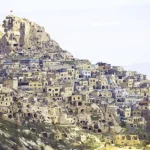
Derinkuyu is the largest underground city in the world, located in the Cappadocia region of central Turkey. Excavated in soft volcanic rock, this impressive structure reaches a depth of more than 85 metres and has at least 20 levels, of which only the first eight are accessible to the public.
It is estimated that this immense underground city could house up to 20,000 people along with their animals and provisions, functioning as a safe haven during times of conflict. And although today it can be visited in part, many mysteries persist about its origins and history, and the real reasons that led to its construction. Join us and discover all its secrets.
What is Derinkuyu and where is it?
Derinkuyu is an underground city carved into the volcanic rock of Cappadocia, in the heart of Anatolia. With a depth of approximately 85 metres and a capacity to house 20,000 people, it is considered the largest underground city in the world.
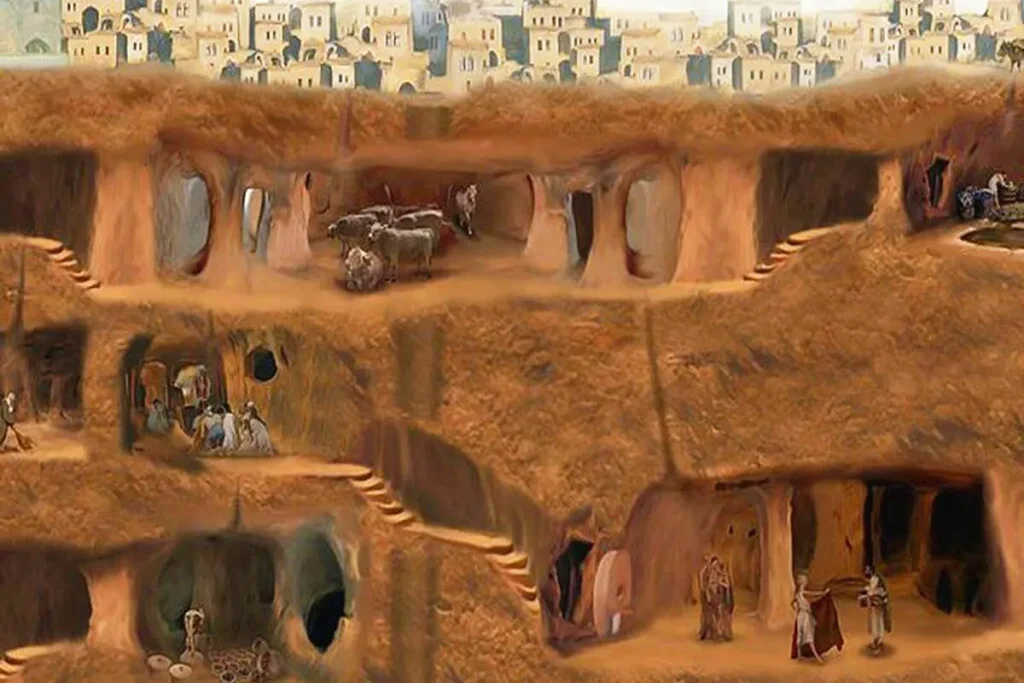
Located in the historical region of Central Anatolia, this archaeological wonder is part of a complex system of tunnels and chambers that includes stables, churches, cellars, kitchens, water cisterns and dwellings. Its name, Derinkuyu, means ‘deep well’ in Turkish, referring to its enormous depth but also to its impressive ventilation shafts, some of which reach more than 55 metres in depth.
The city forms part of a vast network of more than 200 underground cities that are believed to exist throughout the Cappadocia region, of which only some 36 have been discovered to date, although none of them reach the dimensions or complexity of Derinkuyu. It is also suspected that many of them were connected to each other by secret tunnels, creating a vast network of underground cities that stretched across the entire region.
Who discovered Derinkuyu?
The discovery of the underground city of Derinkuyu was by accident and quite recent. In 1963, a local resident was carrying out renovations on his house when, while knocking down a wall, he found a mysterious passageway; he went inside and discovered that it led to an enormous network of tunnels and chambers carved into the rock.
The Turkish authorities were alerted and began archaeological excavations that revealed the true magnitude of this underground construction. After several years of cleaning and consolidation work, part of the city was opened to the public in 1969, quickly becoming one of the main tourist attractions in Cappadocia along with the famous balloon tours.
The curious thing is that, although the official discovery dates from the 20th century, the inhabitants of the region had always known about the existence of these cavities, which they used for centuries as warehouses or temporary refuges. However, no one could have imagined that, beneath their feet, an immense underground city was hidden.
Who built the Derinkuyu underground city? A bit of history
Although its construction has traditionally been attributed to Byzantine Christians, archaeological evidence suggests that Derinkuyu’s origins are much older. The history of the underground city of Derinkuyu in Cappadocia goes back at least to the middle of the Iron Age, around the 8th century BC, according to some archaeological evidence.
Other objects discovered by archaeologists even suggest that the first signs of human occupation in the area date back to the Hittites (an Indo-European people who dominated central Anatolia between the 17th and 12th centuries BC), who possibly began the first excavations around 1200 BC, creating the first network of caves to protect themselves from the Phrygians. Later, the Phrygians themselves (8th century BC) and the Persians (6th century BC) expanded the complex.
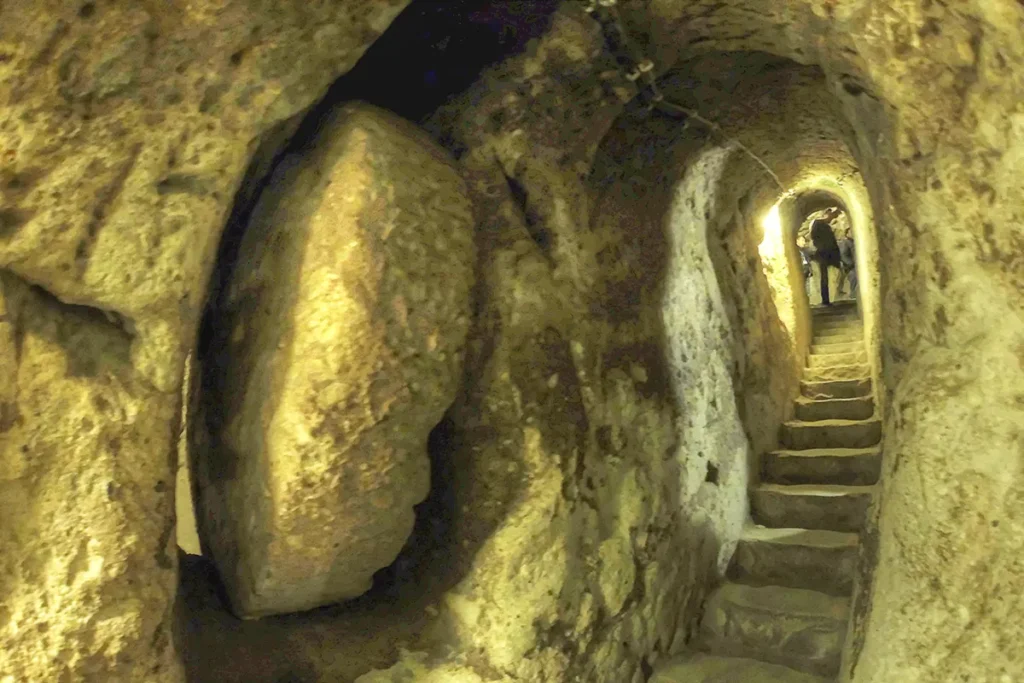
However, there seems to be a consensus that its greatest expansion actually took place between the 8th and 12th centuries AD, when the Byzantines used it as a refuge against the Arab invasions, turning it into a true underground city, adding chapels, cellars, water wells and cisterns, living and dining rooms, and sophisticated defence systems that included revolving stone doors (huge discs of rock, up to 1.5 metres in diameter and weighing half a tonne).
The chronicles of the time mention how the inhabitants of Cappadocia ‘disappeared underground’ every time the invaders arrived. And the fact is that during periods of invasion, Derinkuyu served as a temporary refuge where its inhabitants could hide for weeks or even months. The city had everything necessary for survival: food stores, animal pens for livestock, wine and oil presses, and even a rudimentary sewerage system.
The most surprising thing is the advanced engineering employed, especially considering that they worked with rudimentary tools. The builders also designed a perfectly functional ventilation system, as well as sloping tunnels to prevent flooding and mechanisms to block access in case of invasion.
How did people breathe in Derinkuyu?
Indeed, one of the greatest achievements of Derinkuyu is its ventilation system, which allowed thousands of people to live underground for long periods without worrying about a lack of oxygen. The city has more than 50 air shafts strategically distributed, some of which reach depths of more than 55 metres.
These shafts fulfilled several functions:
- Ventilation: they allowed for the constant circulation of fresh air.
- Water supply: some reached underground aquifers.
- Communication: they also served as conduits for transmitting messages between levels.
The builders designed the tunnels with a slight incline to prevent smoke from the kitchens and torches from accumulating in the living areas. Recent studies have also shown that the temperature inside Derinkuyu remains constant throughout the year (between 13-15°C, while outside the temperature in summer approaches 35°C), making it livable in both winter and summer.
The greatest mystery of Derinkuyu
Despite exhaustive research, the truth is that Derinkuyu still holds many mysteries…
How was life underground coordinated?
No written records have been found to explain the social organisation inside Derinkuyu and other large cities built underground in Cappadocia, where the population could live for months.
Were there connections with other underground cities?
Some tunnels in Derinkuyu seem to lead to the underground city of Kaymaklı (located 10 km away), although they are blocked, which suggests the existence of an entire network of tunnels and routes under the subsoil of the region
What techniques did they use to excavate the tunnels and vaults?
The uniformity and precision of the tunnels and the techniques used to ventilate the vaults and connect them suggest advanced engineering knowledge for the time, even for Byzantines.
Who built Derinkuyu?
Until now there have only been theories about who the first builders of this underground city could have been: we know who inhabited it from approximately one thousand years before our era, but it is not clear who designed it for the first time.
Why was it definitively abandoned?
According to some historical studies, the last occupation of Derinkuyu and other underground cities dates from the beginning of the 20th century, during the turbulent period of the First World War before the birth of the Turkish Republic. However, by then only the upper levels were still in use, while the deepest levels – and many other cities built underground – had already fallen into oblivion.
What was it really used for?
It seems clear that Derinkuyu and other underground cities were used in past centuries to hide the population; but it is believed that the underground cities built throughout Cappadocia had the capacity to house more than a million people… A population that the region does not even have today. Some theories suggest, in fact, that underground cities like Derinkuyu were not originally used to hide from invasions, but to protect themselves from environmental disasters outside.
How do you get to the underground city of Derinkuyu in Cappadocia?
Derinkuyu is located about 30 km south of Göreme, the tourist epicentre of Cappadocia. The options for getting to Derinkuyu are:
Own/hired car:
This is the most flexible option. From Göreme take the D302 road towards Nevşehir and then the D765. The journey takes about 40 minutes. There is free parking next to the entrance. The price of hiring a car in Göreme is approx. €40-75/day (depending on the model, the rental agency and the season).
Taxi:
A comfortable and fast option. If you don’t want to drive on the region’s roads or wait, you can take a taxi on a direct route from Göreme to Derinkuyu. The one-way journey takes about 35 minutes and the price, according to the taximeter, is around 4 €.
Public bus:
From Göreme station, minibuses (dolmuş) leave for Nevşehir, where you can take another one to Derinkuyu. The journey takes approximately one and a half hours in total and costs around €9.
Organised tour:
This is the most comfortable option, but also the most expensive. Normally this type of tour includes transport in an air-conditioned vehicle and a local guide, with prices around 120 € per person.
TIP: combine your trip to Derinkuyu with a visit to Kaymaklı (another underground city just 10 km away) to compare both.
How much does it cost to get into Derinkuyu?
The current price of admission (2025) is 13 euros, although Turkish citizens who use the museum card can buy admission for 60 liras (1.4 €). Admission is free if you purchase the Museum Pass Cappadocia card (65 €), which is valid for 3 days from your first visit to a museum in the region, and gives access to multiple attractions in Cappadocia.
Opening times for Derinkuyu
- Days open: every day.
- Opening times: 8:00 – 20:00
- Last admission: 30 minutes before closing.
- Contact email: nevsehirmuzesi@ktb.gov.tr
Best time to visit:
- Early morning (8:00-10:00) to avoid groups and queues.
- During the week, especially outside the high season (July-August).
Duration of the visit:
Between 1 and 2 hours (depending on the pace). The narrowest tunnels are only 1.20 m high x 0.70 m wide, so it is not suitable for people with reduced mobility or severe claustrophobia.
What can be seen inside this underground city?
The tourist route covers less than half of the complex (approximately 45% of the structure, 8 of the 18 levels discovered), but it is enough to appreciate its magnitude. The general structure of the different levels that can be visited is as follows:
- First level: animal stables (the closest to the surface).
- Second level: cruciform church with altar and baptistery.
- Third level: communal kitchens with stone ovens.
- Fourth level: food stores and wine presses.
- Fifth level: meeting room with high ceilings.
- Sixth level: water cisterns and filtration system.
- Seventh level: defensive tunnels with revolving doors.
- Eighth level: residential area with family rooms.
Other places of interest in the surrounding area
Cappadocia offers many attractions that can be combined with a visit to Derinkuyu:
- Underground city of Kaymaklı (10 km): the second largest underground city, with 4 levels open to the public.
- Göreme Valley: with impressive rock formations (‘fairy chimneys’) and cave churches.
- Uçhisar Castle: a natural fortress with the best panoramic views.
- Ihlara Valley: an impressive 14 km canyon with hidden Byzantine churches.
- Zelve Open Air Museum: an ancient abandoned rock village.
Recommended itinerary:
It is advisable to visit the underground cities of Derinkuyu and Kaymaklı in the morning, and to reserve the afternoon for visiting other highlights, such as the Göreme Valley. If you also want to enjoy a balloon tour, remember that they take off very early, at dawn.
Is it worth visiting Derinkuyu? Some advice
Absolutely. A visit to Derinkuyu is a truly unique experience combining history, mystery and adventure, and one that is unforgettable for those who have been there. However, bear in mind that the visit includes narrow spaces and areas with steep or poorly lit routes, so if you suffer from any kind of claustrophobia or mobility problems, the visit will be limited.
Tips for visiting Derinkuyu
- Appropriate clothing:
- Non-slip footwear (the floor is uneven and damp)
- Light jacket (the constant temperature is 13-15°C)
- Comfortable clothing (you have to bend down in some sections)
- Recommended equipment:
- Small torch or mobile phone with torch (there is little lighting).
- Bottle of water (to quench your thirst if necessary).
- Camera/smartphone with good low-light photography capability.
- Accessibility:
- Not suitable for wheelchairs.
- People with mobility problems should limit themselves to the first levels.
- Large bags/backpacks are not recommended due to the risk of getting stuck in certain passages.
- Visiting with children:
- Suitable for children over 6 years old (under supervision).
- It is not recommended to bring pushchairs.
The underground city of Derinkuyu is much more than a tourist attraction in Turkish Cappadocia: entering it is a journey into the past that connects you with the civilisations that inhabited this region for millennia and that populated this place. Its perfect engineering, combined with the great mystery that still surrounds its origins, make it an absolutely essential visit for any traveller exploring Turkey. Delve into the depths of history: Derinkuyu awaits you.
✈️ If you are travelling to Turkey, we recommend:
🧿 Discover here more recommended products about Turkey
We include affiliate links: if you buy through them, you don’t pay extra money and you help this website.
🧿 TOP TOURS IN CAPPADOCIA
VOTE

EDITORIAL TEAM
🧿 About us
.
Edited and reviewed by:

Pablo Gómez is a specialist in Turkey and has been editor-in-chief of Hispanatolia since 2011. He has been analysing current affairs and geopolitics in Turkey and the surrounding region since 2006.
…
📣 Your ADVERTISING on Hispanatolia
.
🤗 HELP US WITH A DONATION:
💗 Paypal