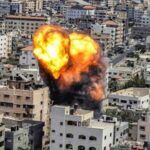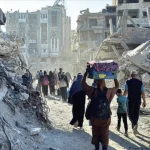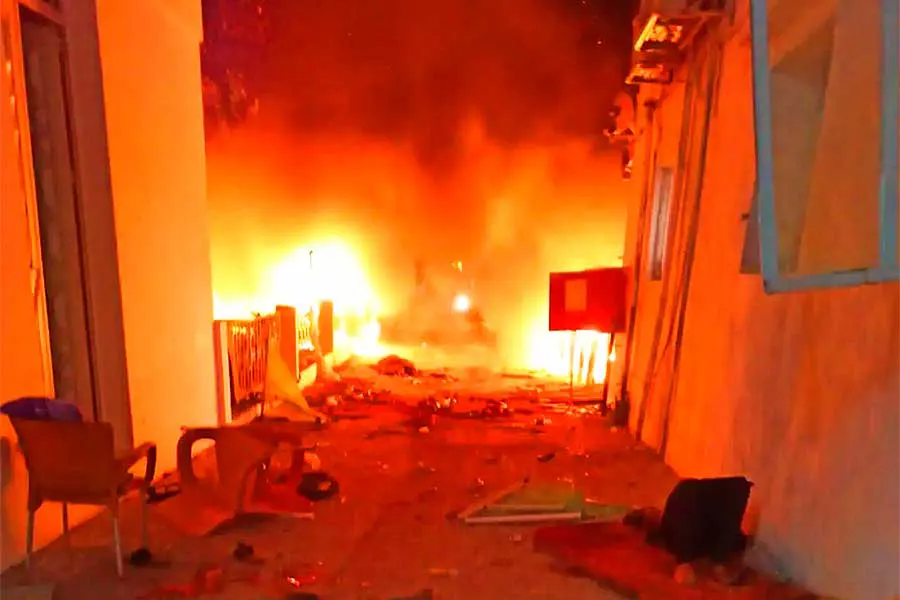
The recent bombing of Gaza’s Baptist Hospital, which left 471 dead according to Palestinian sources, has shocked the world and put the spotlight on Israel’s response to Hamas’s brutal offensive on Israeli territory, with hundreds of daily bombings that have already claimed the lives of some 4,400 Palestinian civilians, most of them children. In the absence of an independent international investigation, both Hamas and the Israeli army accuse each other of causing the massacre; however, several Turkish experts believe the evidence points to Israel.
Speaking to the Anatolia news agency, Engin Yiğit, a retired Turkish military officer, explained after analysing the images that the absence of an impact crater in the hospital points to the use of an MK-84 bomb weighing about 910 kg equipped with JDAM (Joint Direct Attack Munition) guidance, which gives it great precision. “This guidance kit (JDAM) attached to the bomb turns it into a smart projectile and gives it a precision strike capability,” said Yiğit, who added that the detonation fuse can be designed to explode in mid-air. “Bombs with proximity fuses or sensors may not create craters when they explode. The attack on the hospital in Gaza could have been similar. The bomber can establish at what height the bomb will explode,” he said.

“Israel’s version is unrealistic”
Murat Aslan, a scientist at the SETA research centre and associate professor at Hasan Kalyoncu University in Turkey, agreed with the theory of a mid-air explosion, which would contradict some versions that pointed to a rocket causing a fire when it exploded. “In attacks on populated areas, fuses can be timed to explode 50-100 metres above the ground before hitting the target. This increases the destruction. By examining the area affected by the explosion and the debris on the ground (…) it can be theorised that the shell was timed to explode prematurely in the air and cause a greater impact,” he explained.
As for the Israeli claim that the massacre was caused by a rocket fired by Islamic Jihad from inside Gaza, Aslan considers it unrealistic: “If a rocket of that power, capable of causing such extensive damage, was launched (from Gaza), Israel’s Iron Dome defence system would have been activated. It would be very difficult for Islamic Jihad to launch such a precision attack, even from the West Bank, without being intercepted by the Israeli defence system. And if the calibre of the rocket is reduced, then the killing of (approximately) 500 people is not possible,” the expert added, insisting that rockets launched from Gaza do not use guidance and follow an inclined trajectory, so “a vertical descendant trajectory over the hospital is highly unlikely” for this type of rocket.
Aslan also dismissed another Israeli version that the brutal shelling of the Gaza hospital could have been caused by a howitzer: “This is not realistic, given the range that would be required. A shell has a radius of 30-50 metres. And in any case, it could not cause such a high number of casualties“. For this Turkish expert, the most likely hypothesis is that the shell used in the attack on the hospital was launched by an aircraft: “Therefore, the possibility is growing that it was an MK-82 type bomb, which Israel has used before and which can be made smart with a guidance kit”. “To reach a final conclusion it would be necessary to examine the munition fragments, and study the area. But this is difficult given the current situation,” he concluded.
VOTE

As a history lover, Pablo Gómez was captivated by Turkey from the first day he visited it in 2006: he got married there, has a house there… and has since become an expert on Turkey’s current affairs. With a long experience in media, he has been at the helm of hispanatolia.com since 2011.