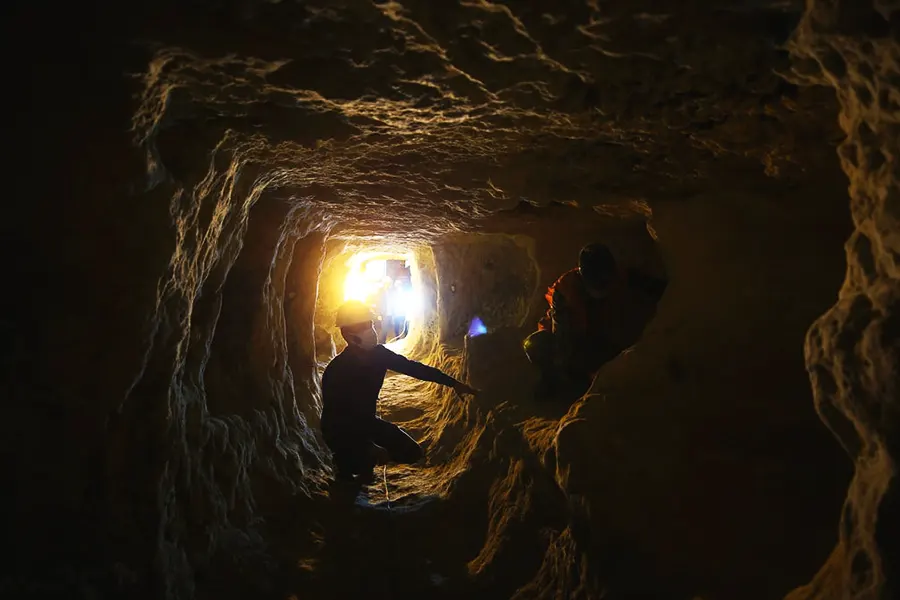
A 5,000-year-old underground city recently discovered in Mardin in southeastern Turkey will be open to tourists later this year after the first archaeological excavations are completed, unearthing a fabulous underground structure used by countless civilisations throughout history and now considered to be the largest system of man-made underground galleries and caves in the world.
What began in 2020 with the discovery of a simple cave during renovation work in the historic centre of the city of Midyat, ended up revealing an immense underground city built millennia ago as it became clear that the cave was part of a larger system, as tunnels were found connecting to other caves. The first archaeological excavations started four years ago at the Matiate site unearthed an area of 8,223 square metres and a 120-metre-long system of tunnels, estimated to be at least 5,000 years old. But the complex of tunnels and caves is bigger, much bigger.
In cooperation with the Turkish Ministry of Culture and Tourism, the Mardin Museum and the Midyat Municipality, excavation and restoration work has focused on two sites in the Ulu Cami neighbourhood and the Estel area in the historic centre of Midyat. In the city unearthed underground, temples, silos, water wells, cellars, rooms, workshops, cisterns, tombs and a large number of connecting tunnels have so far been found, as well as all kinds of objects, from jewellery and coins from different periods to tools, lamps and even human and animal bones.
What makes this underground city different from those of Cappadocia?
What makes Matiate different from other underground cities found in Turkey, such as those found throughout the Cappadocia region, is that its civil structures are located on the surface, which historians believe shows that there was a gradual transition from life underground to an above-ground urban settlement here – as opposed to the process in Cappadocia, where underground structures were built starting from above-ground settlements – establishing a clear horizontal terrace structure.
“We want to open the first and second phases (of the excavations) to tourism this year. The underground city (of Matiate) at Midyat will open to tourists in 6 to 7 months, and it will be one of the largest in the world. Even though we cannot yet accept visitors for security reasons, there is already a great interest in visiting it,” said the mayor of Midyat, Veysi Şahin, who pointed out that Turks, Kurds, Arabs, Muslims, Assyrians and Yazidis have lived together for centuries in this region.
Gani Tarkan, director of the archaeological excavation at Matiate, stated that the earliest occupation of this underground city in southeastern Turkey dates back to the third millennium BC, beginning in the Bronze Age and continuing for centuries without interruption at least until the Middle Ages. “We have unearthed numerous artefacts from the Roman Empire period, including coins, oil lamps, bottles, bracelets and other everyday objects. We have also found a large amount of pottery from the Middle Ages,” said Tarkan, who also stressed that only about 7% of the huge underground structure at Matiate, which is believed to cover some 40 hectares, has been unearthed.
VOTE

EDITORIAL TEAM
🧿 About us
.
Edited and reviewed by:

Pablo Gómez is a specialist in Turkey and has been editor-in-chief of Hispanatolia since 2011. He has been analysing current affairs and geopolitics in Turkey and the surrounding region since 2006.
…
📣 Your ADVERTISING on Hispanatolia
.
🤗 HELP US WITH A DONATION:
💗 Paypal