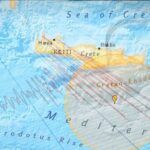
Santorini suffered its strongest earthquake so far late yesterday, measuring 5.3 on the Richter scale and felt in the Greek capital Athens and Izmir, on the west coast of Turkey, which is already preparing emergency plans for a possible eruption. The quake, which occurred at a depth of 17 km beneath the earth’s crust, was followed two hours later by another of magnitude 5.
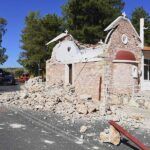
According to international media reports, neither quake caused any major injuries or damage, but they are a stark reminder that seismic activity around Santorini continues. According to data from the Seismological Laboratory of the University of Athens, more than 12,800 earthquakes have been detected in the Aegean between 26 January and 8 February in a region between the islands of Santorini, Amorgos, Ios and Anafi, which remain on alert and where schools have been closed.
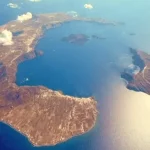
These tremors have in turn caused frequent landslides and rock falls on the cliffs of Santorini – an island that is actually the remains of a large volcanic caldera following a major eruption 3,500 years ago – and some unwary tourists have even been seen trying to take photographs on these cliffs in the midst of the earthquakes, putting their lives at risk.
Scientists no longer rule out major earthquake
More than 11,000 residents of Santorini – which has about 15,500 inhabitants – have already left the island because of the frequency and intensity of the earthquakes. Seismologists, who had begun to show some optimism in recent days that the earthquakes were decreasing in intensity, are now concerned that they are getting worse, and are no longer ruling out a major quake in the region, which has not experienced a seismic swarm of this intensity since records began in 1964.
Speaking to public broadcaster ERT, Kostas Papazachos, professor of seismology at the Aristotle University of Thessaloniki, said the quakes are likely to continue for at least most of February. ‘Let’s hope for gradual progress towards a de-escalation. We have to have a little patience and wait,’ said the seismologist, who admitted that – contrary to the discourse held until recently by the Greek scientific community – the possibility of a major earthquake has not been ruled out.
While most experts in Greece attribute the earthquake swarms Santorini is experiencing to plate tectonics and several active faults in the Aegean, many scientists in Turkey are warning that what is happening on the island could foreshadow a volcanic eruption. It is a fact that Santorini sits on top of a large dormant volcano that last erupted in 1950, so Turkish authorities and experts are already working on the hypothesis of what will happen if the Santorini volcano erupts, and measures are already being taken for the possible arrival of a tsunami or clouds of gases and ash on Turkish shores.
VOTE

EDITORIAL TEAM
🧿 About us
.
Edited and reviewed by:

Pablo Gómez is a specialist in Turkey and has been editor-in-chief of Hispanatolia since 2011. He has been analysing current affairs and geopolitics in Turkey and the surrounding region since 2006.
…
📣 Your ADVERTISING on Hispanatolia
.
🤗 HELP US WITH A DONATION:
💗 Paypal