Turkey has drawn up an action plan in response to the wave of earthquakes that have been shaking the Aegean for weeks around the Greek island of Santorini (also affecting neighbouring islands such as Amorgos, Anafi and Ios) and which have led the Greek government to declare a state of alert and to extend the closure of schools as a precautionary measure in the face of a succession of earthquakes which, according to Turkish scientists, could be the prelude to a volcanic eruption in the region.
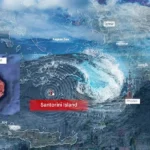
According to Turkish daily Hürriyet, the meeting organised on Saturday was attended by representatives of the Turkish Disaster and Emergency Management Agency (AFAD) as well as experts from the General Mineral Research and Exploration Agency (MTA), the Kandilli Earthquake Research Institute and the Turkish State Meteorological Service, as well as a number of scientists and researchers. The meeting focused in particular on the potential risks that the coastal regions of Turkey would face in the event of a major earthquake, tsunami or volcanic eruption on the island of Santorini, as well as the measures to be taken to mitigate their consequences.
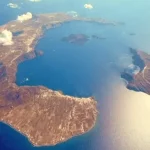
As a result of the seismic swarm that has been occurring for days in the central Aegean, as of 7 February, 761 earthquakes with a magnitude greater than 3 have occurred in the vicinity of Santorini, with the largest measuring 5.2 on the Richter scale. ‘The earthquakes are increasing approximately 25 km northeast of the island of Santorini, at depths varying between 5 and 25 km. The closest quake to our shores was 140 km away. The earthquakes are concentrated in the region of the Kolumbo volcano, a submarine crater 6.5 km northeast of the island of Santorini, in the arc of volcanic islands in the southern Aegean,‘ a statement released after the experts’ meeting said.
‘As a result of a possible eruption, hazards such as the transport of fine-grained volcanic ash material by wind, or a tsunami that could occur after the earthquake, as recorded in historical records, could reach Turkey,’ the statement said, adding however that “the last known volcanic eruption in the region took place in 1950”. ‘There is a small possibility that the current seismic activity could trigger volcanic activity. However, in 2011-2012, seismic activity of similar intensity was experienced in the region for 14 months and did not lead to any volcanic activity,’ the text added.

Plans in case of an earthquake or eruption on Santorini
Faced with the possibility of a large earthquake generating a tsunami in the Aegean, or a volcanic eruption, the meeting agreed that the Directorate General of Meteorology will produce a daily report to analyse the possible distribution and direction of volcanic gases and ash that could be ejected if the Santorini volcano erupts. Other agreed measures include:
- Deployment of a mobile siren system in the provinces of İzmir, Aydın and Muğla to alert the population in case of a tsunami or other emergency.
- Establishment of a permanent committee of experts to continuously monitor and assess the evolution of the phenomena around Santorini.
- Activation of a system of SMS alerts to citizens’ phones in case of imminent emergency.
- Reinforcement of emergency staff and equipment assigned to the Aegean coastal provinces of İzmir, Aydın and Muğla.
- Integration of Kandilli and AFAD tsunami and emergency warning systems to send immediate automatic warnings to citizens in at-risk areas.
Sea recedes in Istanbul
Meanwhile, in recent hours, experts have again denied that the receding seas observed in the last days in coastal areas of the Marmara and Aegean regions are related to a possible earthquake.
In areas such as Silivri, west of Istanbul, citizens have been alarmed after noting a coastal retreat of about 150 metres, while in Seferihisar (Izmir) the sea has receded by about 100 metres; but experts insist that these phenomena are linked to winds and tides, and are not caused by plate tectonics or by what is happening in Santorini.
‘Earthquake swarms can trigger a volcanic eruption’
Despite scientists in Greece linking the earthquake swarm around Santorini solely to active faults in the region, a report jointly produced by AFAD and MTA and published on 5 February claimed that the current seismic activity in the Aegean can cause a volcanic eruption.
The report recalls that Santorini and its surrounding region form a system of active volcanoes and that the 1950 eruption of the Santorini volcano was followed by a tsunami that reached the Turkish coast, also stressing that seismic movements may be caused not only by plate tectonics, but also by activity in an underground magmatic chamber: ‘Therefore, earthquake swarms such as those that have occurred in recent days should be watched very carefully from both perspectives… There is a possibility that the current seismic activity may trigger possible volcanic activity.’
VOTE

EDITORIAL TEAM
🧿 About us
.
Edited and reviewed by:

Pablo Gómez is a specialist in Turkey and has been editor-in-chief of Hispanatolia since 2011. He has been analysing current affairs and geopolitics in Turkey and the surrounding region since 2006.
…
📣 Your ADVERTISING on Hispanatolia
.
🤗 HELP US WITH A DONATION:
💗 Paypal