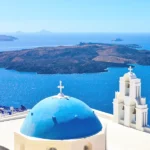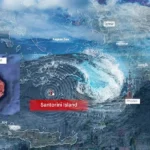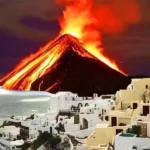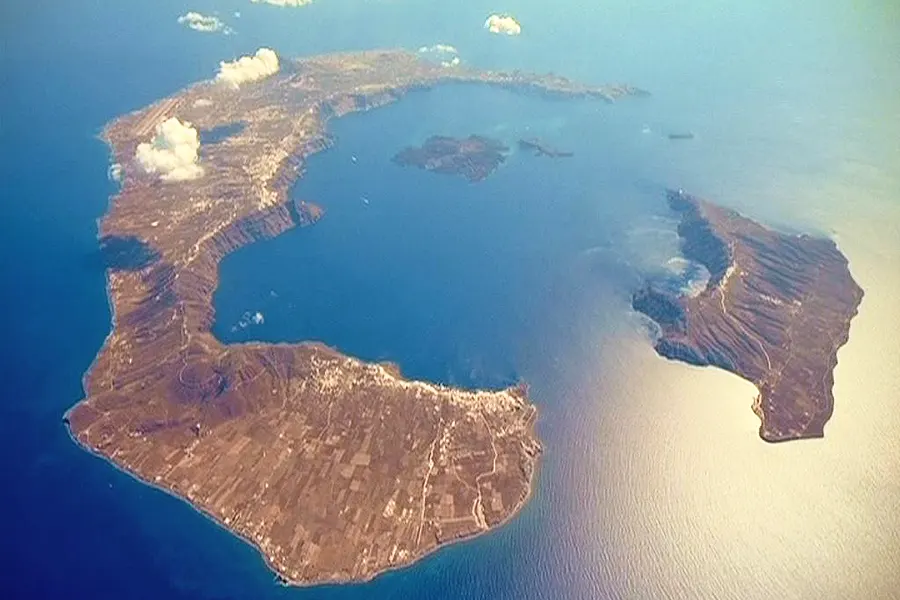
The recent wave of earthquakes in the Aegean that have hit the island of Santorini in particular, with hundreds of tremors exceeding 5.0 on the Richter earthquake scale, has triggered panic among the inhabitants of this tourist island, once a huge volcano that erupted almost 4,000 years ago.
While Greek scientists believe that this wave of earthquakes is caused by tectonic activity, Turkish experts have long argued that plate tectonics alone cannot explain the phenomenon and that magma movements have been detected that could indicate a forthcoming eruption in the region. So what would happen if the Santorini volcano erupts?
Speaking to the DHA news agency, Professor Doğan Yaşar, a member of the Environment, Biodiversity and Climate Change Working Group of the Turkish Academy of Sciences (TÜBA), explained that if Santorini erupts, the consequences would affect not only the Aegean region but the entire planet, leading to a drastic increase in droughts.
So far more than 600 earthquakes of varying intensity have been recorded since 28 January in the vicinity of Santorini, at depths of between 5 and 25 km, and have also been felt in Turkey, raising the same concerns as in Greece, where the government in Athens has declared a state of high alert. Yaşar noted that while some scientists have spoken of a volcanic eruption in the region that could generate earthquakes and even tsunamis, these are phenomena of local consequences only, and would probably not be the most serious.
A major global drought and rainfall shortage for 3 to 4 years
‘The real big consequence is that it would cause an intense drought. Volcanic eruptions cause extraordinary droughts, depending on their size. Tsunamis and earthquakes are regional, but droughts affect the whole planet at the same time. And droughts mean economic crises, famine and wars’.
The expert recalled that there are dozens of active volcanoes around the world, some of them very large: ‘In 1991 the Pinatubo volcano in the Philippines erupted. It was the biggest eruption in 130 years in the world. The air temperature suddenly dropped by 0.5 degrees, and our dams emptied. In Turkey, we had to buy electricity for the first time from Bulgaria. In the United States and Europe, they had to take measures to save water,’ Yaşar recalled.
Turning to the present, and after citing this example, the Turkish professor pointed out that the volcano on the island of Santorini is 15 times bigger than Pinatubo. ‘The island of Santorini is (according to various theories) the place where the civilisation of Atlantis collapsed. Before the volcano erupted around 1600 BC, the island was a centre of trade in the Mediterranean; ships from the Black Sea, Russia, Egypt and the Mediterranean unloaded their goods on the island. It was the richest city of the time: all money and trade passed through it. But after the volcanic eruption, a third of the island was submerged… The biggest volcanic eruption in the last 10,000 years after the Tambora eruption, is Santorini,’ the professor said.

Delving into the consequences for the global climate if the Santorini volcano erupts, Yaşar said there would be a shortage of rainfall for a period of three to four years, triggering famine and wars and making water a precious resource. ‘This would mean that water needs would have to be met by groundwater. That’s why we should not touch groundwater: an (emergency) reserve should always be kept for 2 or 3 years. Unfortunately, this is something we are not doing. There are an estimated 550,000 wells in Turkey alone, 120,000 of them illegal,’ the expert lamented.
🏛️ TOP TOURS IN GREECE
VOTE

As a history lover, Pablo Gómez was captivated by Turkey from the first day he visited it in 2006: he got married there, has a house there… and has since become an expert on Turkey’s current affairs. With a long experience in media, he has been at the helm of hispanatolia.com since 2011.