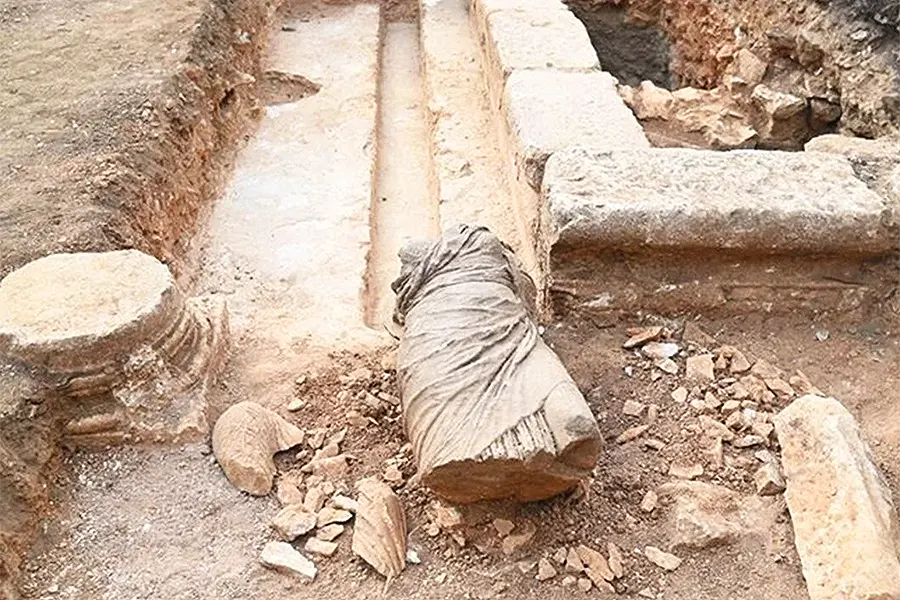
The ruins of the ancient city of Sardis and the burial mounds of Bin Tepe, historical remains located in the western Turkish province of Manisa, are now a World Heritage Site following a unanimous decision by the UNESCO World Heritage Commission during its 47th session held in Paris on 6 July.
Turkey’s own Minister of Culture and Tourism, Mehmet Nuri Ersoy, made the news official on social media, confirming that the ruins of Sardis and Bin Tepe have now become “our 22nd cultural treasure included in the UNESCO family” and highlighting the enormous historical and cultural value of this site, the ancient capital of the kingdom of Lydia and considered to be the first place in the world where money was minted, around 560 BC.
“With its 20-metre thick defensive walls and a vast necropolis area covering 7,500 hectares, Sardis and the Bin Tepe tumuli now stand on the world stage as symbols of Lydian heritage,” the minister said. “This extraordinary site, now recognised as part of the common heritage of mankind, continues to captivate visitors with its mystique, especially now that it is part of our night museum initiative,” Ersoy stressed.
Sardes and Bin Tepe have been on UNESCO’s tentative list since 2013, standing out as a unique testimony to a civilisation that has now disappeared. Founded by the Lydian king Giges (680-644 BC) as the capital of the ancient kingdom of Lydia, the city was the final scene of the Battle of Timbrea, which occurred in 547 BC between King Croesus of Lydia and Cyrus II, King of Kings of the Persian Achaemenid Empire, who eventually conquered the capital and put an end to Lydian rule in Asia Minor. After the fall of the Lydian Empire, Sardis (or Sardes) became the capital of the Persian satrapy of Lydia, and later an important centre of Hellenistic and Roman culture.
“Sardis was the capital of the Lydians, a powerful Iron Age civilization (8th-6th centuries BCE) known for its wealth and early coinage production. The city had a unique urban structure with fortified walls, terraces, and distinct zones, including settlements, sanctuaries, and cemeteries. The cemetery of Bin Tepe features some of the largest tumulus tombs in the world. The Lydians developed a distinct language and religious system and were widely mentioned in Greek, Roman, and European texts. After their fall, Sardis remained significant under Persian, Greek, Roman, and Byzantine rule” UNESCO explains of Sardis, now a World Heritage Site.
🧿 TOP TOURS IN TURKEY
VOTE

EDITORIAL TEAM
🧿 About us
.
Edited and reviewed by:

Pablo Gómez is a specialist in Turkey and has been editor-in-chief of Hispanatolia since 2011. He has been analysing current affairs and geopolitics in Turkey and the surrounding region since 2006.
…
📣 Your ADVERTISING on Hispanatolia
.
🤗 HELP US WITH A DONATION:
💗 Paypal