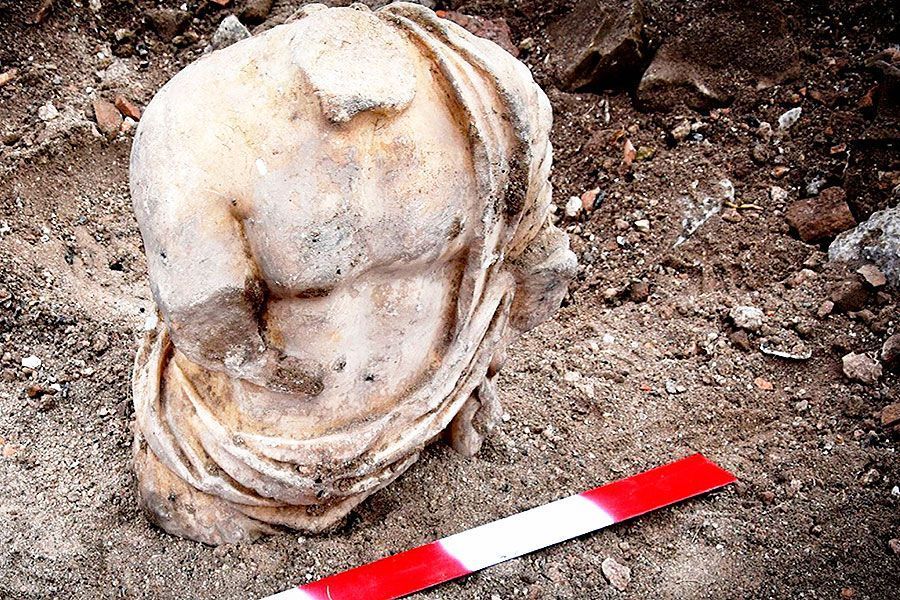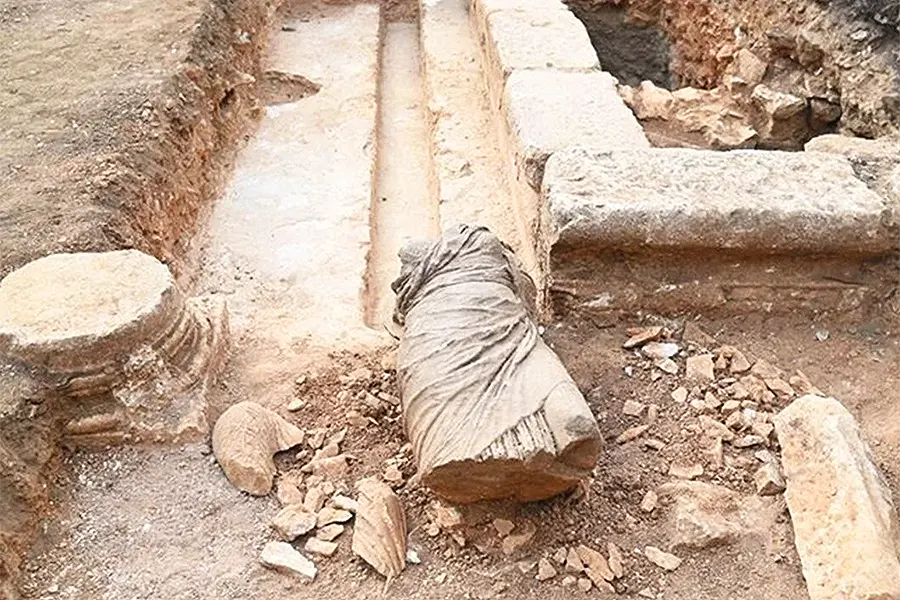
A team of Turkish archaeologists has discovered a statue showing the torso of a woman in the ruins of the ancient city of Anemurium, located just outside the modern city of Anamur in the Turkish province of Mersin. The 1,800-year-old statue, which was found next to a structure archaeologists call the “Harbour Baths”, is believed to represent an important person during the Roman Empire, when Anemurium (also called Animurium or Anemuryum) was a thriving Roman city on the Mediterranean coast of Asia Minor.
Experts believe that the statue – which shows a well-preserved, clothed female torso – collapsed and was buried during a major earthquake that shook the region some 1,500 years ago, which, along with Persian and later Arab invasions, led to the progressive abandonment of the city. For now, archaeologists do not agree on whether the figure, which appears dressed in two typical Greek costumes of the time (a chiton underneath and a himation on top), represents a goddess, an empress, or a woman belonging to a wealthy family that was noted for its philanthropy towards the poor.
“The ancient city of Anemurium is located in the Anamur district of Mersin, approximately 10 km away from the city centre, where discoveries are mainly from between the 2nd and 6th centuries AD. It is like a time capsule. As soon as you enter here, you go back in time to 1,800 years ago. We know for sure that the city existed 2,500 years ago. It is also said to date back to the Hittites, although we have no data on this yet,” said Professor Mehmet Tekocak, an archaeologist at Konya’s Selçuk University and head of the excavation.
“This is an area next to the Port Baths. Initially we started excavations in this structure (…) Later we started excavations here to understand whether there was a relationship with the baths in this annexed area, and we came across very interesting ruins and findings,” said the archaeologist about the site in Anemurium where the statue was found. “We believe that this place could be a nymphaeum, a fountain monument from the Antiquity. And we have brought to light a beautiful statue of a woman that decorated this monument. Her head, arms and feet have not yet been found, although we later discovered one of the arms. We are continuing our search (…) and if we find them, we will see for the first time the silhouette, the image of someone who lived here 1,800 years ago“.
VOTE

EDITORIAL TEAM
🧿 About us
.
Edited and reviewed by:

Pablo Gómez is a specialist in Turkey and has been editor-in-chief of Hispanatolia since 2011. He has been analysing current affairs and geopolitics in Turkey and the surrounding region since 2006.
…
📣 Your ADVERTISING on Hispanatolia
.
🤗 HELP US WITH A DONATION:
💗 Paypal