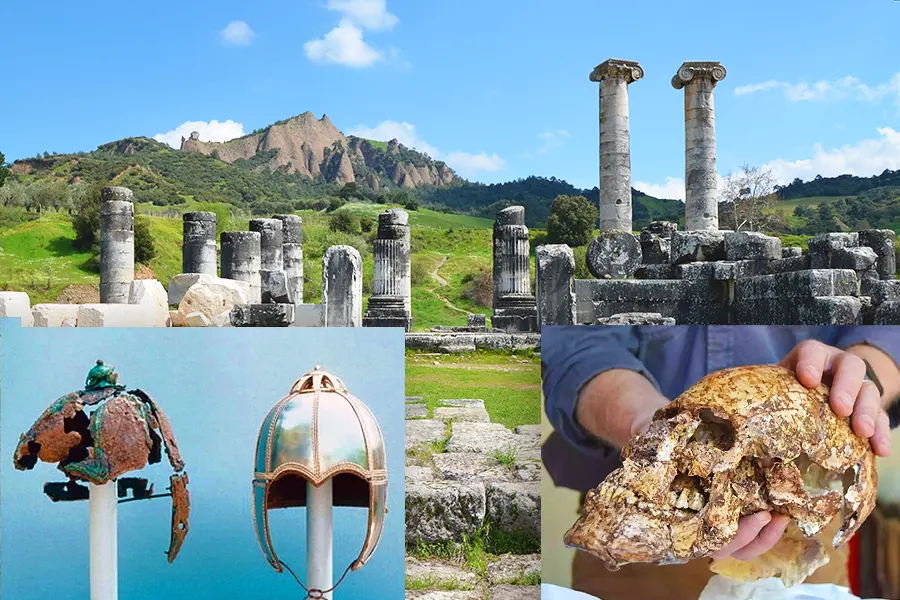
Remains of a major battle against the Persians some 2,500 years ago in western Anatolia that marked the end of the Kingdom of Lydia have been found by a team of archaeologists in the ancient city of Sardis, located in the province of Manisa in western modern-day Turkey. The findings include the skeletal remains of at least two soldiers who fought in the battle, as well as several weapons they used in combat.
The discovery, reported in numerous Turkish media, was made by a team of archaeologists led by Nick Cahill, a historian at the University of Wisconsin (USA), during archaeological excavations in Sardis, the former capital of the Kingdom of Lydia. The team found under an ancient wall unearthed half a century ago and which has been excavated this year skeletal remains of two young soldiers with marks of wounds from swords and other weapons, particularly on the head and arms.
‘This year we have unearthed the skeletons of two soldiers during excavations at the monumental wall. We believe that the skeletons of soldiers, found in the Persian destruction layer (of Sardis) at the base of the wall, belonged to two men between 20 and 25 years of age. The skeletons show wounds from swords and similar weapons. We believe that these soldiers were thrown onto the remains of the walls, without being buried or given a proper ceremony after the battle,’ Cahill explained.
‘One of the soldiers was holding a stone in the palm of his hand, and that’s how we unearthed it,’ added the archaeologist, who believes the stone belonged to a slingshot used as a ranged weapon of war. Since both soldiers were thrown away and not buried, it seems that they were Lydian soldiers who were defeated by the Persians during the battle. ‘They were probably not Persian soldiers, but rather defeated Lydian soldiers,’ said the expert, who noted that an iron helmet of Lydian manufacture was also found with the skeletons.
Remnants of the Persian rule in Anatolia
‘These bones and other artefacts show traces of Persian rule – which had a significant impact on the history of western Anatolia – and the destruction wrought by the Persians on magnificent cities,’ Cahill said. ‘Our examination of the skeletons of the soldiers has revealed that their arm bones are very compressed, indicating that they were wearing very heavy armour. An iron helmet has also been found, which is now in the Manisa Museum. One skeleton has a broken arm, probably caused by a weapon, while the soldier was defending himself,’ the archaeologist commented.
Sardis (or Sardes) was the capital of the Kingdom of Lydia and the final scene of the Battle of Thymbra, which took place in 547 BC between King Croesus of Lydia and Cyrus II, King of Kings of the Achaemenid Persian Empire. After both sides suffered heavy losses at the earlier Battle of Pteria, Croesus assembled a large army to meet the Persian invasion of his kingdom on the plain of Thymbra, just outside the Lydian capital; despite having at least twice as many soldiers to face the Persians, the army of Cyrus II was victorious and the Lydians had to retreat to the citadel of Sardis, where after a two-week siege they were defeated. The city and the Kingdom of Lydia fell to Persia, which thus took control of the whole of Anatolia (modern Turkey) until the arrival of Alexander the Great.
📖 If you want to learn more about Turkey, we recommend:
We include affiliate links: if you buy through them, you don’t pay extra money and you help this website.
VOTE

As a history lover, Pablo Gómez was captivated by Turkey from the first day he visited it in 2006: he got married there, has a house there… and has since become an expert on Turkey’s current affairs. With a long experience in media, he has been at the helm of hispanatolia.com since 2011.