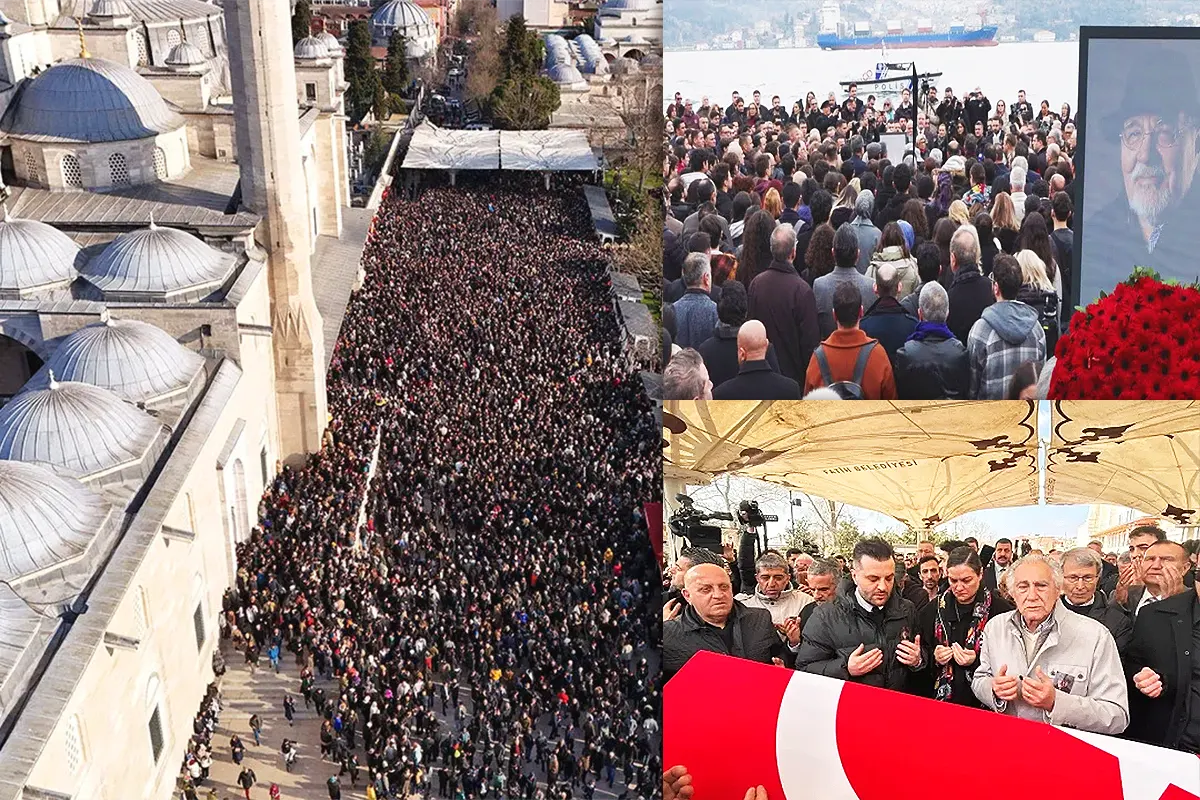
A ceremony held yesterday at Galatasaray University in Istanbul, Turkey, served to bid farewell to the renowned historian İlber Ortaylı, who is recognised worldwide as one of the leading figures in the study of Ottoman history, and who died on 12 March at the age of 78 in a hospital in the city where he was receiving treatment.
The memorial service for İlber Ortaylı took place at Galatasaray University, where the historian worked for years, and was attended among others by his daughter Tuna Ortaylı, Galatasaray football club president Dursun Özbek, academics, students, and numerous figures from the fields of politics, art and sports in Türkiye.
According to Turkish media reports, numerous security measures were deployed at the event in view of the large number of citizens who formed long queues to offer their last farewell to the professor. The family of the deceased expressly requested that no flowers be sent, and asked instead that those wishing to do so make donations to the Turkish Education Foundation.
Following the ceremony at Galatasaray University in Istanbul, a religious funeral was held in the Muslim rite at the Fatih Mosque – an Ottoman imperial mosque located in the Fatih district of Istanbul’s historic peninsula – shortly after the evening prayer. The coffin, draped with the Turkish flag, was carried on the shoulders of his relatives to the courtyard of the mosque, in a ceremony attended by hundreds of people who packed the place.
A Crimean Tatar refugee turned teacher
Born on 21 May 1947 in a refugee camp in Bregenz, Austria, to a Crimean Tatar family fleeing Stalin’s persecution, Ortaylı moved to live with his parents in Istanbul when he was only two years old, and from an early age showed a keen interest in languages and cultures. He studied at Ankara University and completed his postgraduate studies in Chicago and Vienna. In 1978 he successfully defended his doctoral thesis on Ottoman local administration, and a year later he was awarded the title of associate professor.
Throughout his long and prolific career, Ortaylı taught at prestigious universities such as Oxford, Cambridge and Princeton, and headed the Department of Administrative History at Ankara University between 1989 and 2002. He later joined Galatasaray University, and also taught at Bilkent University in the Turkish capital. From 2005 to 2012, he was also the director of the Istanbul’s Topkapı Palace, the former residence of the Ottoman sultans.
A life devoted to a passion: the history of the Ottoman Empire
Ortaylı’s contribution to the study of Turkish and Ottoman history is immense, to the extent that during his lifetime he became one of the most respected intellectuals in the country – as demonstrated during his massive farewell – not only for his profound knowledge of history, but also for his ability to bring knowledge and passion for history to the general public. Whether on television, in lectures or in debates, his unique style of speaking and recalling historical events appealed to experts and laymen alike and transported his listeners to another era.
For İlber Ortaylı, history – as he said on more than one occasion – was not just a succession of dates, but a living account of the past. Many in Türkiye became interested in history not by reading scholarly books, but by listening to ‘İlber Hoca’ (Professor İlber), as he was popularly known.
Among his most influential and recommendable works, which not only provide an insight into Turkey’s past, but also into the figure of this unique historian, is “İmparatorluğun en uzun yüzyılı” (“The Longest Century of the Empire“), which analyses the profound, complex and fascinating transformations that the Ottoman Empire underwent in the 19th century as it attempted to modernise and leave behind its old political, social and economic structures.
Much of his work did indeed focus on the Ottoman administration and its relationship with Europe; however, it would be a mistake to think that Ortaylı was a ‘local’ and pigeonholed historian who limited himself to studying the history of his country. In addition to Turkey, he studied in depth other regions such as Central Asia, Europe, Russia and the Middle East. For him, the history of a nation or a region was not an isolated event, but a collection of civilisations and peoples that interacted, influenced and confronted each other over the centuries.
This particular vision of İlber Ortaylı also marked his analysis and interpretation of Ottoman history, which this Turkish historian understood not only as a political structure, but also as a civilisational space where languages, religions and cultures coexisted in a complex mosaic. During his lifetime, he left a deep impression on those who knew, read and listened to him; and now, his absence undoubtedly leaves a gaping hole that will be difficult to fill. R.I.P.
📚 If you want to learn more about the history of Turkey, we recommend:
🧿 Discover here more recommended products about Turkey
As an Amazon Associate, we earn from qualifying purchases. This comes at no extra cost to you and helps support this website.
VOTE

EDITORIAL TEAM
🧿 About us
.
Edited and reviewed by:

Pablo Gómez is a specialist in Turkey and has been editor-in-chief of Hispanatolia since 2011. He has been analysing current affairs and geopolitics in Turkey and the surrounding region since 2006.
…
📣 Your ADVERTISING on Hispanatolia
.
🤗 HELP US WITH A DONATION:
💗 Paypal