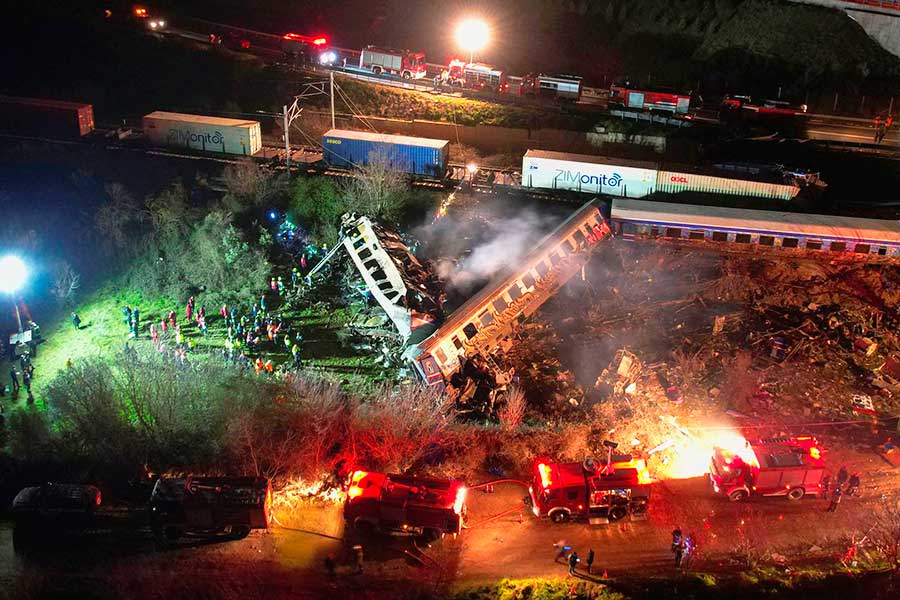
The government of Greece faces a vote of no confidence over the railway disaster of 2023 – when two trains collided, causing 57 deaths (mostly students) – days after hundreds of thousands of people took to the streets last Friday demanding justice for the victims on the second anniversary of what is considered the worst rail accident in the history of the country.
According to news agencies, more than 80 MPs from left-wing opposition parties presented on Wednesday a motion of no confidence against the government of Greek Prime Minister Kyriakos Mitsotakis during the parliamentary debate on the disaster, claiming that the government has lost its legitimacy after the mass protests that paralysed the country days ago, accusing the executive of not assuming its responsibility in the train accident and not addressing the serious safety problems facing the national rail network.
The vote of confidence will be held on Friday, although the government – with 156 seats out of a total of 300 in the Greek parliament – is expected to survive the vote. Mitsotakis assured to the parliament today that the accusations of the opposition parties threaten the political stability of Greece at a critical moment on an international level, something that ‘would be fatal’, and announced that his government plans to modernise the railway network by 2027, transferring the management of network maintenance to a foreign company.
Yesterday, a total of 277 MPs voted in favour of setting up a commission to investigate the handling of the disaster by the then minister Christos Triantopoulos, accusing him of dereliction of duty. The families of the victims of the tragedy accuse the current government of obstructing any investigation into the political responsibilities behind the tragedy, and maintain that authorities tried to cover up the evidence of what happened.
The 2023 rail disaster remains an open wound in Greek society, as well as clear evidence of the state of the Greece‘s railway network, with an infrastructure that is obsolete and has been abandoned for decades and suffers from chronic safety deficiencies, as revealed in an independent report published last week: deficiencies that remain unaddressed today, and threaten to cause another tragedy, at any moment.
VOTE

EDITORIAL TEAM
🧿 About us
.
Edited and reviewed by:

Pablo Gómez is a specialist in Turkey and has been editor-in-chief of Hispanatolia since 2011. He has been analysing current affairs and geopolitics in Turkey and the surrounding region since 2006.
…
📣 Your ADVERTISING on Hispanatolia
.
🤗 HELP US WITH A DONATION:
💗 Paypal