Increasing seismic activity in the Aegean, with more than 400 quakes – the largest measuring 4.8 on the Richter scale – recorded since 28 January in the region, has sparked panic especially on the Greek islands, where thousands of people are leaving by plane or boat as experts from both Greece and Turkey try to pinpoint the cause of these earthquakes to determine whether they are a warning of a major catastrophe.
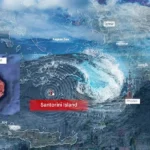
Greek and Turkish media reported that in just six days more than 400 tremors of between 3.5 and 4.8 magnitude have been recorded centred on a location between the Greek islands of Santorini and Amorgos, in the heart of the Aegean Sea, prompting Greece to declare a state of high alert. More than a hundred earthquakes have been recorded in the last 48 hours alone, and scientists confirm that seismic activity is not decreasing, but increasing.
‘The earthquakes have shown increasing activity about 25 km northeast of the island of Santorini, at depths of between 5 and 25 km. The closest earthquake to the coast of our country occurred at a distance of 140 km,’ Turkey’s Disaster and Emergency Management Agency (AFAD), which is also monitoring this wave of earthquakes with concern, reported on Sunday. ‘In 2011-2012 there was a similar intense seismic activity in the same region, which lasted for 14 months but did not cause any volcanic activity,’ the Turkish agency added.
Emergency meeting of the government in Greece
Local media in Greece reported multiple tremors throughout the weekend in the region and especially at night, leading thousands of people to sleep outdoors for fear of earthquakes while many locals and tourists on the islands, especially on Santorini, are opting to flee by boat or plane. Greek authorities have ordered schools to close on Monday and asked people to avoid gathering in crowds in enclosed spaces and to stay away from damaged buildings and other dangerous structures.
In response, Greek Prime Minister Kyriakos Mitsotakis called an emergency meeting late yesterday, attended by ministers and experts, to assess the risk of a major earthquake and potential measures to be taken to deal with a catastrophe in the region; despite this, an expert in geology and plate tectonics, Efthymios Lekkas, said on Greek public broadcaster ERT on Monday that he believes any earthquake of more than magnitude 6 is out of the question.
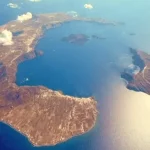
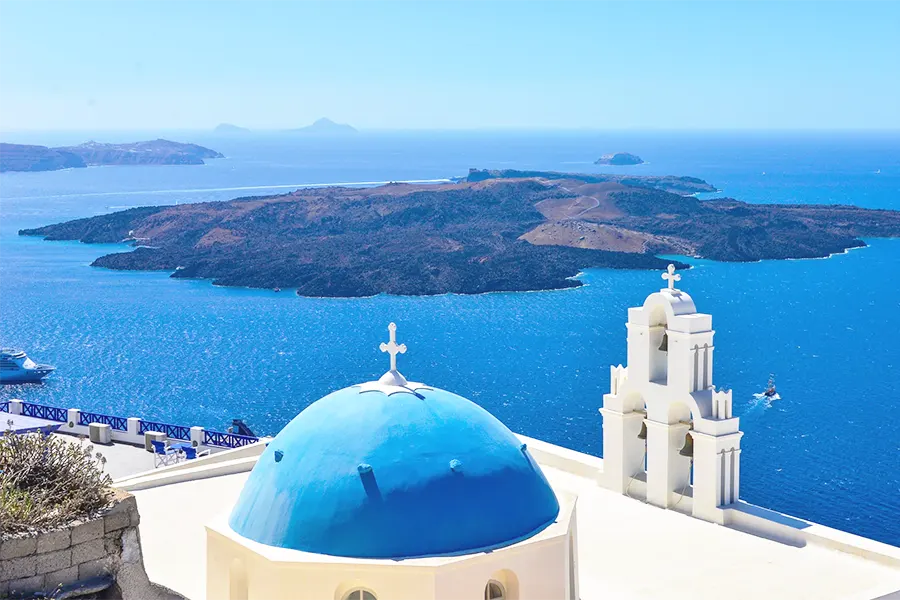
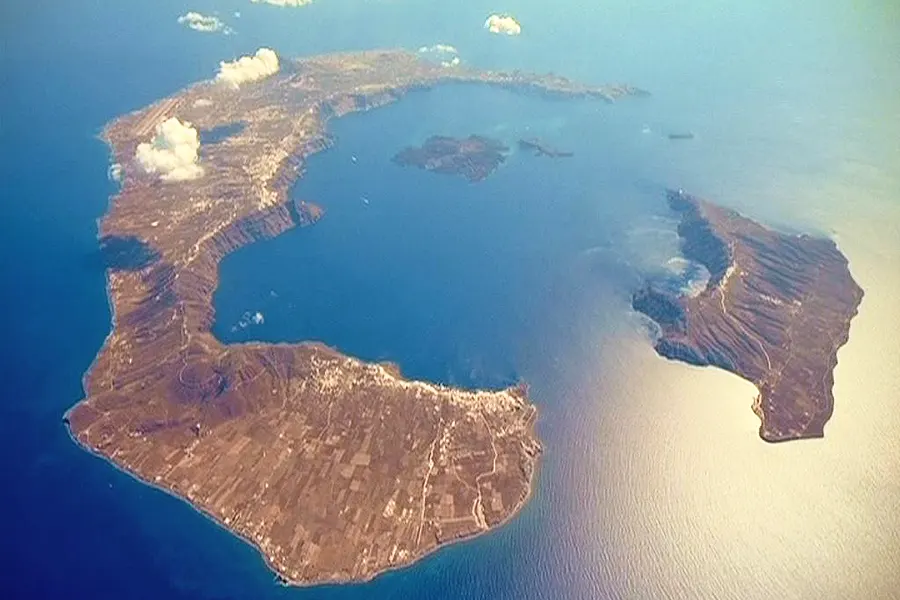
At the centre of this growing concern is the island of Santorini, called Thera in Greek, which is actually the remains of the caldera of a large volcano following one of the largest volcanic explosions in history, similar to Krakatoa, occurred in 1627 BC and that destroyed almost the entire original island.

Greek scientists maintain that the activity now being detected in the region is of tectonic, rather than volcanic, origin; however, there is concern about the presence of Kolumbo, an underwater volcano near Santorini that last erupted in 1650 and is currently the most active underwater volcano in the Aegean: a study published in 2024 warned of the presence of a previously undetected magma-filled chamber.
‘These earthquakes are not normal’
Speaking to the Turkish news agency Anatolia, Professor Hasan Sözbilir, director of the Centre for Earthquake Research at Izmir’s Dokuz Eylül University, stressed that it is not normal that more than 400 tremors have been recorded in the region since 28 January, and referred to the explanation given by Greek scientists that the wave of earthquakes is of ‘tectonic origin’, saying that for several experts in Turkey, including himself, volcanic activity is indeed causing at least part of the earthquakes detected in recent days.
‘There are many volcanoes in the region. The wave of earthquakes is occurring just north of the Santorini volcano. Therefore, the activity may also be of geothermal origin, and there could even be activity related to the upward movement of magma. In other words, it is very difficult to explain this with plate tectonics alone,’ Sözbilir said, recalling that between the coasts of Greece and Turkey there are a large number of volcanoes, a significant number of which are still active.
The prelude to a major fault rupture in the Aegean?
‘The earthquakes we are experiencing now will not affect Turkey very much; even if there was a magnitude 7 earthquake, the west coast of Turkey would not be affected (by the earthquake), but there is a risk of a tsunami. In Bodrum, there was a tsunami of 1-2 metres after the 1956 earthquake (on the island of Amorgos). Therefore, we can conclude that the current wave of earthquakes is a result of the activity of the volcanoes together with the fault lines around Santorini,’ said the Turkish expert, who nevertheless ruled out a major earthquake in the region for now, and attributed the images appeared on social media of receding water on the shores of the Gulf of Izmir to natural phenomena, probably related to the tides.
However, other experts such as Abdussamet Arslan, director of the Centre for Earthquake Research and Disaster Management at Ankara’s Gazi University, believes instead that there is a high probability that this is the prelude to a major fault rupture in the Aegean affecting Greece and Turkey: ‘If the Hellenic Arc fault (south of Crete) ruptures, it could produce an earthquake of 7 or 7.5. We should take precautions in the cities in the southwest of our country,’ he warned.
VOTE

EDITORIAL TEAM
🧿 About us
.
Edited and reviewed by:

Pablo Gómez is a specialist in Turkey and has been editor-in-chief of Hispanatolia since 2011. He has been analysing current affairs and geopolitics in Turkey and the surrounding region since 2006.
…
📣 Your ADVERTISING on Hispanatolia
.
🤗 HELP US WITH A DONATION:
💗 Paypal