The ancient city of Anazarbus, now known as Anavarza, is a fascinating place for those who love history and want to explore Anatolia and the ancient region of Cilicia beyond the usual destinations. In this article we will tell you about the location of the impressive Anavarza Castle in Turkey, its origins and history, the curiosities surrounding it, how you can see it… and why it is so worth a visit.
Where is Anavarza Castle?
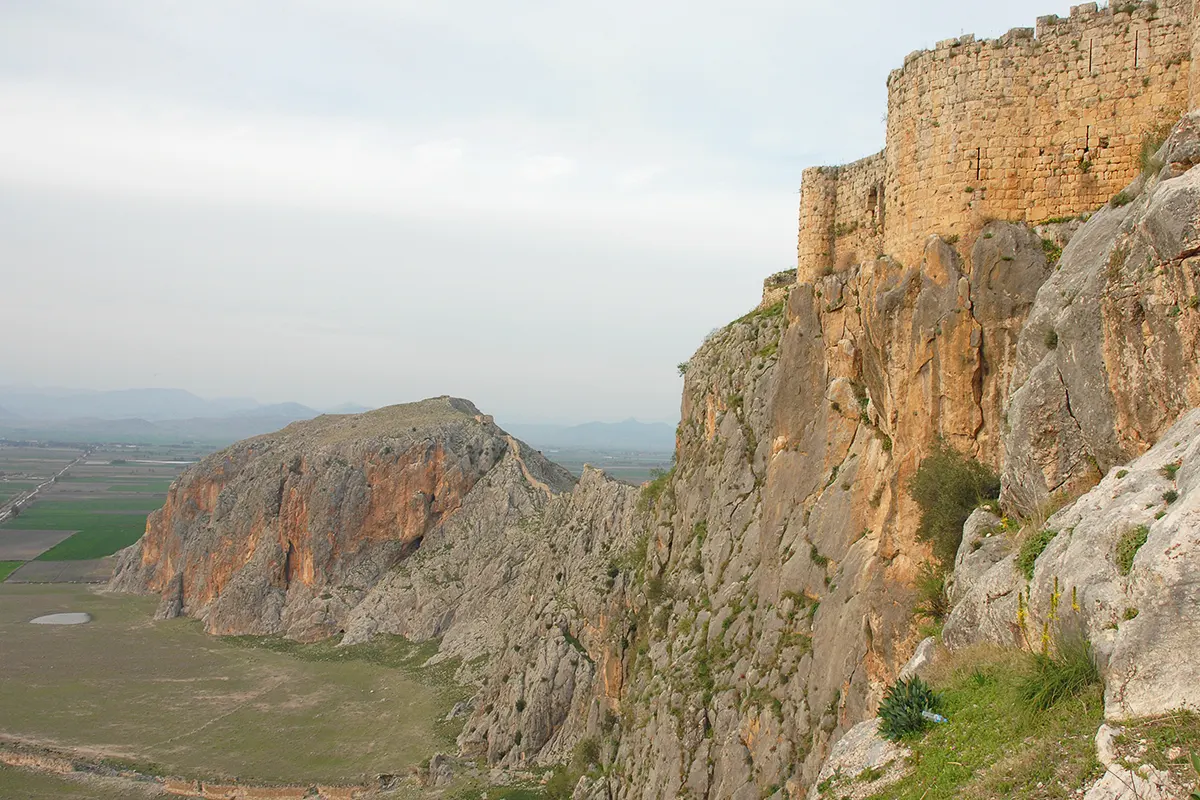
The castle is located in the province of Adana, in the historical region of Cilicia, in the municipality of Kozan, near the village of Dilekkaya. The rocky promontory rises some 150-200 metres above the plain of Çukurova (the ancient Cilicia Pedias) and overlooks the surrounding landscape.
You can locate the castle about 28-30 km south-southeast of the city centre of Kozan. At the foot of the fortress, in the village of Dilekkaya itself, on the way up to the castle you will find numerous archaeological remains as well as the ruins of the ancient Roman stadium and theatre, which were part of the ancient city of Anazarbus and once animated the life of the inhabitants of this strategic city located in the heart of the Cilician plain, key to the military and economic dominance of the region.
Main features of this historic fortress
Anavarza Castle has a number of architectural, locational and preservation features that make it one of the major Late Antique and medieval landmarks in the region. These include the following:
- It was designed to dominate the town of Anazarbus, located at the foot of the promontory.
- The castle walls have a north-south length of approximately 4 km and are crowned by some 20 bastions.
- It was built on a hill with steep vertical drops on the western flank, which reinforced and facilitated its natural defensive function.
- Inside, two enclosures can be distinguished: a large outer courtyard to the south and a smaller enclosure to the north, defended by a Crusader-era tower, which is the one with the best-preserved structures.
- It contains remains from different periods: Roman, Byzantine, Muslim, Crusader, Armenian, Mamluk, and so on. For example, most of the fortress is of Armenian construction, including a small basilica of the Armenian King T’oros I built in the early 12th century.
- The fortress commands views of both the ancient city and the Cilician plain, which gives an insight into the strategic importance of the site.
- In terms of urban features of the city defended by the fortress, the ancient Anazarbus had a 3rd-century triumphal arch, a decumanum with a double row of columns (34 m wide by 2,700 m long) and several monumental structures, much of the remains of which can still be seen today.
In short, Anavarza Castle is not just an isolated ruin, but is part of a monumental and urban ensemble of what was once one of the largest and most prosperous cities in all of Anatolia.

History of Anavarza (Anazarbus)
The history of the ancient city of Anazarbus and its castle is long, complex, and spans more than two millennia.
Origins and Roman period
The settlement has pre-Roman origins, although documentation is sketchy. After the Roman general Pompey’s campaign against Cilician pirates, the region was conquered and reordered by Rome and in 19 AD the town was founded under the name of Kaisareia, in honour of Augustus.
It is not clear how it acquired its present name. According to one historian of the time, when the city was destroyed by an earthquake, Emperor Nerva sent a senator (Anazarbus) to the region to oversee its reconstruction, and he eventually gave it its name. However, other historians mention the city by that name decades earlier.
At the end of the 2nd century Anazarbus acquired great importance: in AD 198 and 203 the emperor Septimius Severus gave it the honorary title of ‘neokoros’, and it was an important military centre in a region that often faced threats from the Persians. In the early 5th century, under the reign of Emperor Theodosius, he made Anazarbus the capital of the province of Cilicia Secunda.
Byzantine period
The city was given various names during this period, including Caesarea ad Anazarbum and Justinopolis, the latter in honour of the Emperor Justin I. In 526 it was devastated by an earthquake, rebuilt by Emperor Justinian I the Great and renamed in his honour Justinianopolis, although the old name of Anazarbus remained in use. Between the 9th and 10th centuries, due to its strategic position, it was the subject of continuous disputes between Byzantine and Muslim armies.
Medieval period: Armenians, Crusaders and Mamluks
The fortress-city was integrated into the Armenian kingdom of Cilicia under T’oros I in the early 12th century, who named it his capital, already named at this time as Anazarva. The castle we see today retains many elements from this period. The city was finally destroyed by the Mamluks of Egypt in 1374 and abandoned.
Recent history
After its abandonment, the fortress and the town were relegated to oblivion. The area has been excavated since 2012 by Turkish archaeologists and has been inscribed on UNESCO’s tentative list as a candidate for World Heritage Site status.
Anavarza / Anazarbus curiosities and legends
- One theory suggests that the name “Anazarbus” (or Anazarba/Anavarza) may derive from the old Persian nez-arba meaning “invincible”.
- It was the birthplace of Pedanius Dioscorides, a Roman physician and botanist who wrote De Materia Medica, a pharmacopoeia book that was a reference throughout the Middle Ages.
- The double row of columns in the main street of the ancient city (34 m wide, 2,700 m long) is the largest in the ancient world, an indicator of the monumentality of Anazarbus.
How to get to Anazarba
To get to Anavarza Castle, you should bear the following in mind:
- Ideally you should have your own vehicle or hire a transfer/tour from Adana or Kozan, as public transport to the area is difficult. There is a parking area for visitors.
- Starting from Adana city, take the D-400 towards Ceyhan, and shortly before you get there take a detour north on the D-817 to the village of Ayşehoca, where you’ll turn off a few kilometres east to Dilekkaya.
- Bear in mind that the way up to the castle from the village is steep and rocky, so it’s essential to be in relatively good shape and wear comfortable, sturdy shoes; if it’s summer, it’s advisable to avoid the hottest hours and, in any case, bring a hat, sunscreen and plenty of water.
- If you’re coming from Istanbul or the Mediterranean coast, you could include Anazarbus as part of a half-day trip from Adana – to which you can also fly– or a longer tour of the ancient region of Cilicia.
Timetables and tips for visiting the ruins
The visiting hours for the archaeological site of Anavarza, including the museum/interpretation centre located in the village, are as follows:
- 1 May – 1 October: 09:00 – 19:00 hours.
- 2 October – 31 March: 09:00 – 17:00 hours
Ticket sales end 30 minutes before closing time. Closed on Saturdays and Sundays. You can get more information and details by emailing: adanamuzesi@ktb.gov.tr
The visit to the fortress is free. To make the most of your visit to this historic site, we advise you to plan your visit in advance and start early in the morning to avoid the hottest hours of the day, especially in summer. Start your visit by climbing up to the fortress, and leave the tour of the ruins of the ancient city in the village at the foot of the promontory for later, when the heat and fatigue have taken their toll. You can take a break in one of the village’s bars.
Other places of interest in the vicinity
A visit to Anavarza can be integrated into a wider tour of the ancient historical region of Cilicia. Here are some places that will complement your experience very well:
- The municipality of Kozan itself, with its impressive medieval castle and its history linked to the Armenian kingdom of Cilicia.
- The Çukurova Plain: the landscape that, in its heyday, dominated the city of Anazarbus with its fortress, ideal for understanding the strategic role of this enclave.
- Other Armenian or Crusader castles and fortresses in Cilicia: for example Yılankale, an interesting and well-preserved 13th-century Armenian fortress in Ceyhan, which will give you an insight into the defensive network of the region in the Middle Ages.
- Minor Roman and Byzantine archaeological sites in the province of Adana: pools, theatres, mosaics… The region has an enormous archaeological and historical heritage.
- Local gastronomy: Adana’s cuisine has a well-deserved reputation throughout Türkiye, and a stay here can be a golden opportunity to enjoy regional dishes such as the famous Adana kebab.
Anavarza Castle in Turkey is a living testimony to the history of Cilicia, a place where cultures, empires and landscapes converge that deserve to be known, and which remains a mystery to many people in the West. If you want to travel to Turkey discovering places that don’t appear in the big tourist brochures – and especially if you are passionate about history – the ancient city of Anazarbus/Anavarza is a must-see destination on your list of favourite places to visit.
📚 If you want to learn more about the history of Turkey, we recommend:
🧿 Discover here more recommended products about Turkey
We include affiliate links: if you buy through them, you don’t pay extra money and you help this website.
🧿 TOP TOURS IN TURKEY
VOTE

EDITORIAL TEAM
🧿 About us
.
Edited and reviewed by:

Pablo Gómez is a specialist in Turkey and has been editor-in-chief of Hispanatolia since 2011. He has been analysing current affairs and geopolitics in Turkey and the surrounding region since 2006.
…
📣 Your ADVERTISING on Hispanatolia
.
🤗 HELP US WITH A DONATION:
💗 Paypal