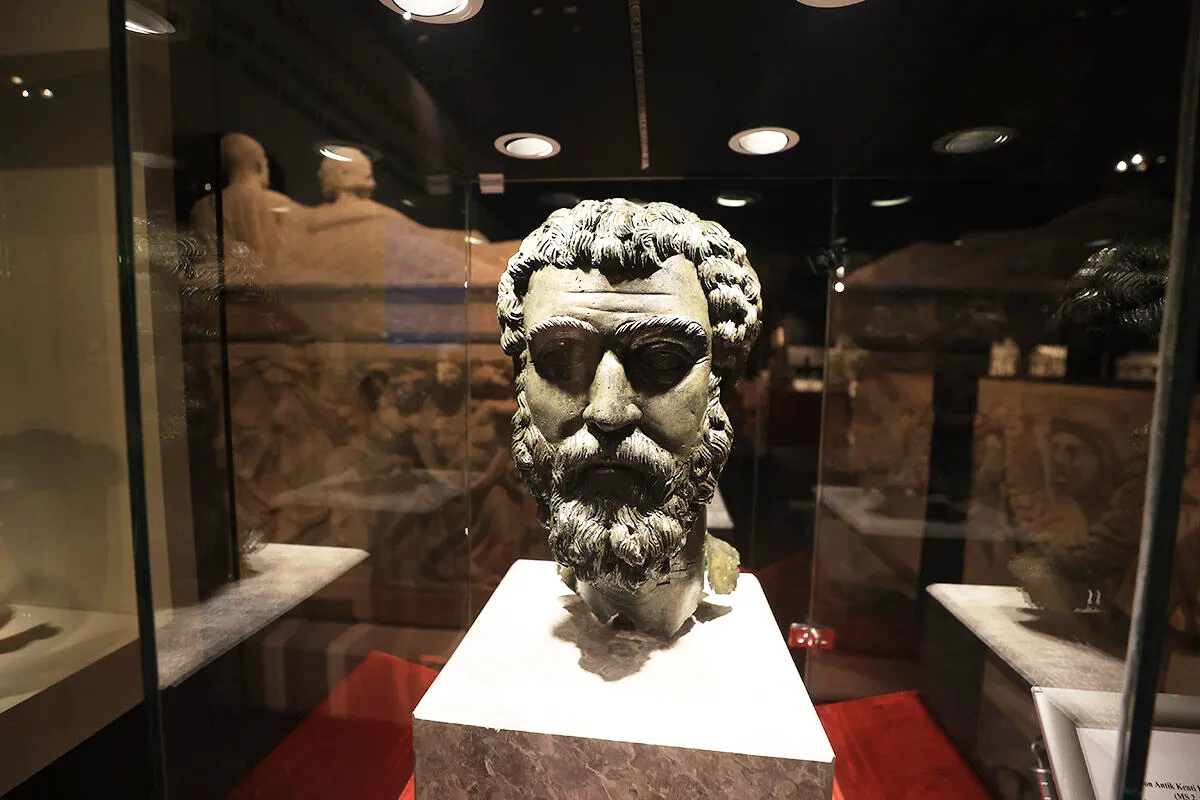
A head of the Roman emperor Septimius Severus stolen more than half a century ago has returned to Turkey along with 48 other terracotta objects that were on display at the Glyptotek Museum in Copenhagen, all of them mostly from the ruins of the ancient Roman city of Bubon, from where Turkey also recently recovered a statue of the Roman emperor Marcus Aurelius exhibited in the Cleveland Museum (Ohio, USA).
Bubon, located in the ancient region of Lycia – today the Turkish province of Burdur – suffered particularly during the 1960s from numerous lootings and illegal excavations, which led to many artefacts of great historical value being stolen and taken out of the country illegally to be sold to museums and collectors abroad. The city was home to a Sebasteion, a sanctuary dedicated to the rulers of the Roman Empire, among other monuments.
The head of the Roman emperor has been returned to Turkey after an exhaustive investigation confirmed its origin in the ruins of Bubon and that the object was taken out of the country illegally. According to the Turkish Minister of Culture and Tourism, Mehmet Nuri Ersoy, it was the renowned Turkish archaeologist Jale İnan who made the main contribution to identifying the emperor’s head, which led the Danish museum to return it to the Turkish authorities for ‘ethical reasons’.
‘After so many years, everyone now wants to see the head and the body reunited. We have begun the recovery process to ensure proper restoration,’ the minister said in statements reported by the Turkish media. Ersoy also highlighted that Turkey has also managed to recover the statues of other Roman emperors and prominent historical figures from the Roman period, including a statue of Lucius Verus and two busts attributed to the emperor Caracalla.
For his part, the ambassador of Denmark in Ankara, Ole Toft, expressed his satisfaction at the return of the head of the Roman emperor Septimius Severus to Turkey, assuring that it was the Glyptotheque Museum in Copenhagen itself that decided to return it once it was confirmed that it had been stolen. Toft also pointed out that 350,000 tourists from Denmark visited Turkey in 2024, of which 200,000 travelled to Antalya. Therefore, Turkey has always been an attractive destination for Danish tourism, he said.
VOTE

EDITORIAL TEAM
🧿 About us
.
Edited and reviewed by:

Pablo Gómez is a specialist in Turkey and has been editor-in-chief of Hispanatolia since 2011. He has been analysing current affairs and geopolitics in Turkey and the surrounding region since 2006.
…
📣 Your ADVERTISING on Hispanatolia
.
🤗 HELP US WITH A DONATION:
💗 Paypal