Istanbul’s Galata Tower is one of the most iconic landmarks of the Turkish metropolis, offering an unparalleled panoramic view of the Bosphorus, the Golden Horn and the entire vast expanse of Istanbul. Located in the Galata district of Beyoğlu, this medieval tower has witnessed centuries of history and rises majestically over the city skyline just a few metres from the famous Galata Bridge. Let’s learn a little more about the history of this iconic Istanbul landmark, a UNESCO World Heritage Site candidate, and how to visit it if you travel to Turkey.
Main features of the tower
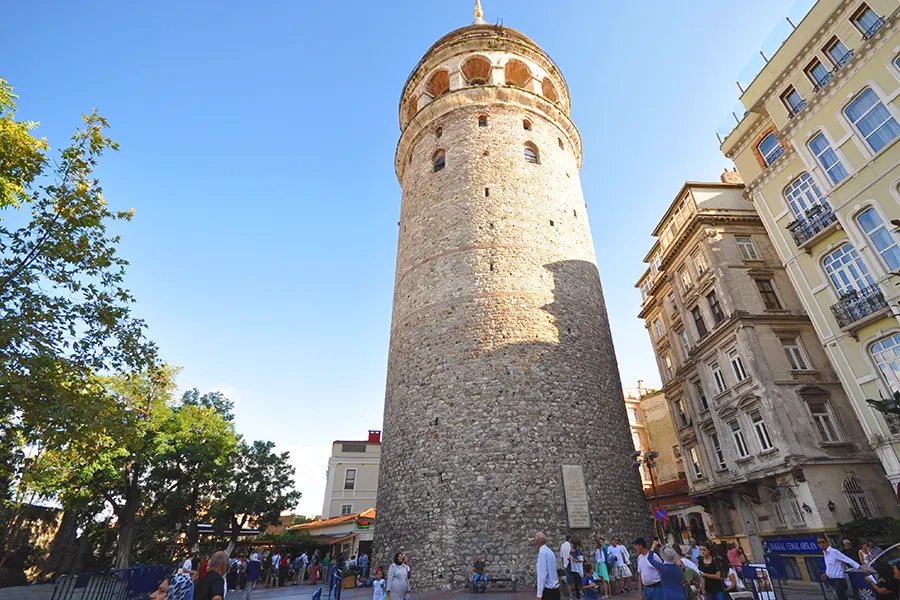
The Galata Tower is 66.9 metres high (62.59 m without the spire) and has a diameter of 16.45 metres. Built of stone, it stands out for its sturdiness and imposing presence. It has nine storeys and, thanks to its strategic location and its own architectural design, it is a unique experience for visitors who wish to enjoy the breathtaking views of Istanbul from its panoramic terrace.
History of the Galata Tower
The history of the Galata Tower dates back to the 14th century. Originally known as the ‘Tower of Christ’ (Christea Turris), it was built in 1348 by the Genoese, who controlled the Galata quarter – located across the estuary of the Golden Horn outside the walls of Constantinople – and used the tower as a key element of their defensive system against external threats. It was, in fact, the tallest construction in the entire system of towers and fortifications surrounding the Genoese citadel of Galata.
However, this stone tower had been preceded by an earlier, smaller, wooden structure called Megalos Pyrgos (Great Tower), built by the Byzantines in the 6th century, which controlled the northern end of the huge iron chain that served to close the entrance to the natural harbour of the Golden Horn during sieges of the city. This original tower, which stood on a different site from the present-day Galata Tower, was completely destroyed during the Fourth Crusade, when European crusader knights treacherously seized Constantinople and brutally sacked it in 1204.
While during the Byzantine Empire the tower played a crucial role as part of the system of fortifications protecting the Byzantine capital, after the fall of Constantinople in 1453 the tower passed into the hands of the Ottoman Empire, which used it for a variety of purposes. After the conquest, the tower was used throughout the 16th century as a prison for prisoners of war, but later became a fire-watch tower (the same function as the Beyazıt Tower in the old part of the city), given its height and strategic position dominating the panoramic view of the entire city.
During the 18th and 19th centuries, the tower was heavily damaged by several fires and by the earthquakes that regularly shook the ancient Constantinople, forcing the Ottoman rulers of the city to carry out multiple renovations and reconstructions. In the 19th century, in order to facilitate the urban expansion of the city through the Beyoğlu and Beşiktaş districts, most of the old fortifications surrounding the old Galata quarter were demolished, but the Galata Tower was preserved because of its function as a watchtower. A major storm in 1867 completely destroyed the conical roof of the tower, which remained without it until the end of the 20th century.
After the fall of the Ottoman Empire and the birth of the new Turkish Republic, a major restoration of the Galata Tower took place between 1965 and 1967 to preserve the structure and open it to the public as a tourist attraction; it was then that its traditional conical roof was rebuilt and the original wooden interior structure was replaced with a concrete one. A restaurant-cafe was installed at the top, surrounded by a viewing platform from which a breathtaking 360° panoramic views of the Turkish metropolis can be seen.
Since then, the Galata Tower has become an icon of the modern city of Istanbul, attracting millions of tourists every year. Today, there are two lifts to the top of the tower, although it is also possible to take the stairs to the top.
Interesting facts about Istanbul’s Galata Tower
The Galata Tower is not only an Istanbul’s iconic monument steeped in history; it is also surrounded by fascinating curiosities and legends:
The first flight in history:
One of the most famous stories is that of the Ottoman aviator Hezarfen Ahmed Çelebi, who – according to Ottoman historian Evliya Çelebi – during the 17th century flew across the Bosphorus from the Galata Tower to Üsküdar (on the Asian side of Istanbul) using artificial wings he built himself. This event is now considered one of the first attempts at human flight in history.
The Pact of Love:
There is a local legend that if a couple climbs the tower for the first time together, they will end up getting married. This legend has caused many loving couples to visit the tower trying to secure their future together.
Multiple uses:
During its long history, the tower has had all sorts of functions: from a prison for prisoners of war, to a place of refuge during fires and disasters; it has also been a storage place for military equipment and food.
Literary inspiration:
The Galata Tower has been mentioned in several literary works, both local and international, and is a recurring symbol in Turkish poetry and prose.
Centuries of transformations:
Over the centuries, the tower has undergone several architectural transformations, adapting to the needs and styles of each era. From its original Genoese structure to the Ottoman and modern renovations, the Galata Tower as we see it today is but the sum of centuries of accumulated changes in its structure, materials and functions.
Film roles:
The Galata Tower has appeared in several films and TV series, both Turkish and international, establishing itself as a cultural and tourist icon representing Istanbul and its rich history.
Exhibition centre:
Today the tower not only serves as a lookout point, but also functions as a space for art exhibitions and cultural events: a way of uniting history with modernity.
How to get to the Galata Tower?
Getting to Istanbul’s Galata Tower is easy thanks to its location in the centre of the city. It is easily accessible on foot from the centre of Istanbul, crossing the Galata Bridge from Eminönü in the direction of İstiklal Avenue, a journey that takes about 20 minutes. Another option is to take the T1 tram to Karaköy station, and then walk up the steep Bankalar Caddesi street. It is also possible to get to the vicinity of the tower on the M2 metro line, stopping at Şişhane station.
Opening hours and fees to visit the Galata Tower
The Galata Tower is open every day of the week from Monday to Sunday. Opening hours are from 8.30am to 11pm (the ticket office closes one hour before the monument, at 10pm), although it is advisable to check opening times before planning your visit. As for fares (which are the same for both local and foreign tourists), the general admission fare costs €30, but it is possible to get a significant discount if you buy the Istanbul Museum Pass, which allows you to visit 13 museums during 5 days for €105.

What can you see and do at the Galata Tower?
After its recent extensive restoration in 2020 to be transformed into a museum, Istanbul’s Galata Tower has become not only a place to get breathtaking panoramic views of Istanbul, but also an important landmark for history lovers. Inside, all kinds of objects and artefacts from all periods of Istanbul’s history are on display, as well as other exhibits.
Other places of interest in the nearby
Although away from the Sultanahmet area, the area around the Galata Tower is full of interesting places to explore. Just a few minutes away is the famous Istiklal Avenue, lined with shops, restaurants and cafes. On the way up to İstiklal from Galata, you will also come across the Galata Mevlevi Museum (Galata Mevlevihanesi Müzesi), which offers exhibitions on the ancient Sufi Mevlevi religious order and live demonstrations of the Sema dance.
The Istanbul Museum of Modern Art and the Karaköy neighbourhood, known for its vibrant art scene and gastronomy, are also other nearby places worth seeing after your visit to the Galata Tower.
Tips to visit Istanbul’s Galata Tower
To make the most of your visit to the Galata Tower, here are some useful tips:
- Choose the best hour: while it is true that many guidebooks recommend visiting early to avoid queues (the tower is a popular attraction and can fill up quickly), our recommendation is always to visit in the late afternoon, about an hour before sunset, to enjoy amazing sunsets from the top of its observation terrace.
- Buy your tickets in advance: precisely to avoid long queues, it is best to buy your tickets online before your visit. You can do so on this website.
- Wear comfortable shoes: climbing up the steep streets of Beyoğlu to the tower requires some effort, especially on hot days, so it is advisable to wear suitable footwear.
- Choose a clear day: as one of the Galata Tower’s great attractions is its magnificent views, try to visit on a day with good weather and clear skies.
- Explore the surrounding area: don’t limit yourself to just the tower, the streets of this neighbourhood are full of life and curious nooks and crannies, so it’s worth exploring the surrounding area once you have finished your way up to Galata.
Istanbul’s Galata Tower is a must-see for anyone visiting this unique city between two continents. Its history, impressive architecture and panoramic views make it one of those places you can’t miss if you travel to Turkey and Istanbul. We hope we have helped you to enjoy more this beautiful monument, thanks to all the information and tips we have given you. İyi yolculuklar!! (Have a good trip!!)
✈️ If you are travelling to Turkey, we recommend:
🧿 Discover here more recommended products about Turkey
We include affiliate links: if you buy through them, you don’t pay extra money and you help this website.
🧿 TOP TOURS IN ISTANBUL
VOTE

EDITORIAL TEAM
🧿 About us
.
Edited and reviewed by:

Pablo Gómez is a specialist in Turkey and has been editor-in-chief of Hispanatolia since 2011. He has been analysing current affairs and geopolitics in Turkey and the surrounding region since 2006.
…
📣 Your ADVERTISING on Hispanatolia
.
🤗 HELP US WITH A DONATION:
💗 Paypal