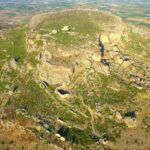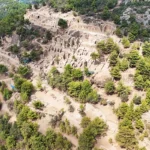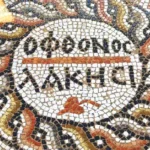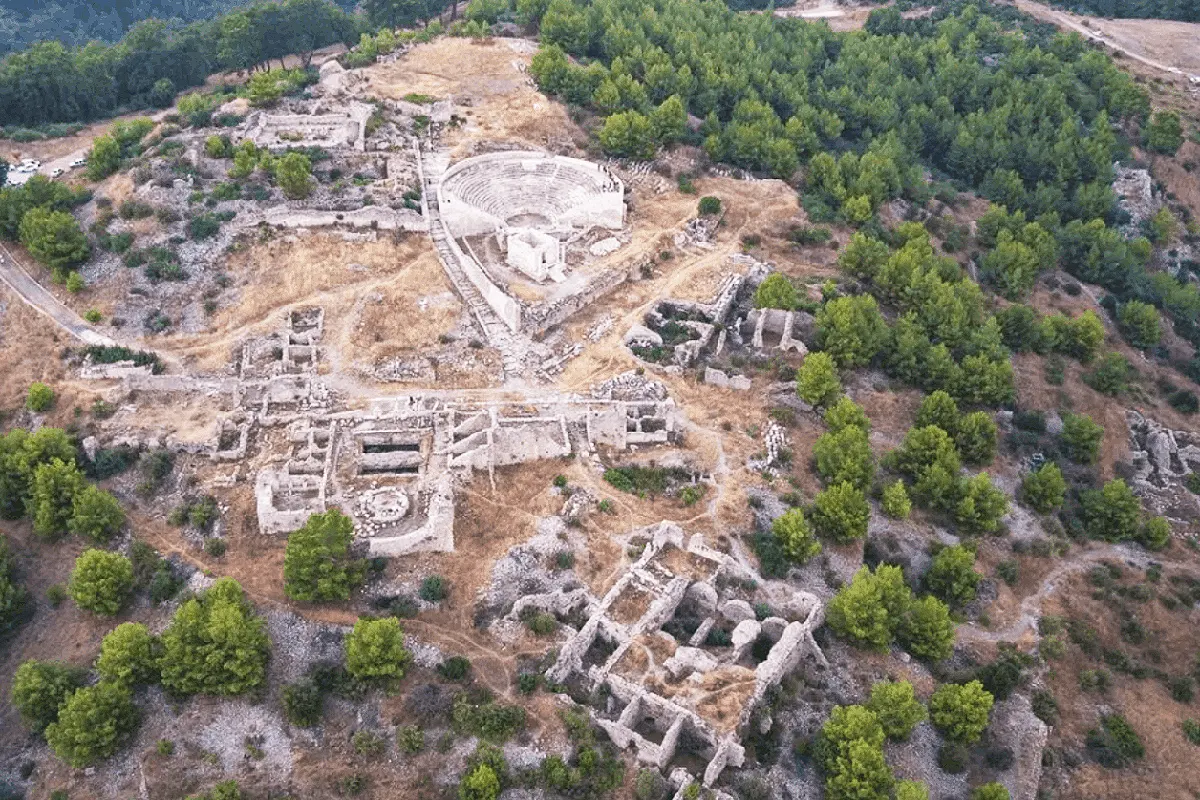
Excavations at the ancient city of Rhodiapolis, situated in the Kumluca district of the province of Antalya on the Mediterranean coast of Turkey, are set to resume next year after having been suspended for a decade, whilst work continues to uncover and preserve the site’s archaeological heritage. The city’s significant ruins preserve remains from the Lycian, Hellenistic, Roman and Byzantine periods, including a theatre, thermal baths, an agora, temples, a church, cisterns and monumental tombs.
The governor of the Kumluca district, Bahadır Güneş, visited the ancient city alongside a delegation comprising officials and experts, and told the Anatolia news agency that they regard Rhodiapolis as Kumluca’s window onto history; Güneş explained that a large part of the ancient city has already been uncovered thanks to previous archaeological work, although he emphasised the importance of resuming the archaeological excavations at the ruins, which began in 2006 but were suspended 10 years ago following a series of problems and errors detected during the restoration work on the ancient theatre and the monument to Opramoas.
The site endured until the Byzantine period
Dr Beste Tomay, an assistant professor in the Department of Archaeology at the Faculty of Science and Letters in Adıyaman University, who is also an adviser to the excavation work, emphasised that Rhodiapolis occupies an important place amongst the Lycian cities due to its historical and cultural significance.
“This year we are carrying out field surveys, reviewing previous studies and compiling an inventory of the storage facilities. From next year, we will resume excavation work,” said Dr Tomay, who also pointed out that the ancient city contains a theatre, baths, an agora, temples, churches, cisterns and monumental tombs dating from the Lycian and Byzantine periods. “Therefore, uncovering the entire ancient city will represent a significant historical and cultural contribution to the region” she added.
A Lycian city that flourished under the Roman Empire
Rhodiapolis or Rhodiopolis was an ancient Lycian city notable for being a Roman city that was very well planned and highly compact; built on a limited and rugged site, this necessitated the creation of an exceptionally intricate and dense urban layout, leaving no empty spaces between buildings apart from the streets themselves.
It is believed that the city was founded by settlers from Rhodes; indeed, the name Rhodiapolis means ‘Rhodian city’ or ‘city of Rhodes’. It was a relatively small city within the Lycian League, although it had the right to mint its own coins. Finds from the Hellenistic period uncovered during previous excavations — mainly monuments and, above all, inscriptions and coins — are few in number but confirm that the settlement, in the period immediately following the death of Alexander the Great, was small compared to the Roman city that developed in the centuries that followed.
Precisely because of the dense and compact construction in the urban area of Rhodiapolis, most of the older buildings were overbuilt by later Roman structures, with the theatre’s cavea being the only preserved monument dating from the late Hellenistic period.
Rhodiapolis was mysteriously abandoned in the 7th century
By the Roman period, the city had become famous as the home of the wealthy philanthropist Opramoas. However, it suffered severe damage from an earthquake in the 2nd century AD and, although it managed to recover from that disaster, it was gradually abandoned by its inhabitants during the 7th century AD. Archaeologists have not yet determined exactly why Rhodiapolis was abandoned, although it is likely that regional economic changes, Arab raids in the Mediterranean or even climatic changes and environmental factors contributed to this.
The oldest remains at Rhodiapolis date from the Greek Classical period, although the most significant ones belong to the Roman and Byzantine periods. Among these, archaeological excavations have brought to light the remains of the mausoleum of Opramoas — featuring numerous inscriptions —, churches, temples, a theatre — with a capacity for approximately 1,500 people —, some Roman baths, the agora — which forms a single complex with a stoa —, the sebasteion, cisterns, a necropolis — where an inscription in the Lydian language stands out — and several dwellings.
📚 If you want to learn more about the history of Turkey, we recommend:
🧿 Discover here more recommended products about Turkey
As an Amazon Associate, we earn from qualifying purchases. This comes at no extra cost to you and helps support this website.
VOTE

EDITORIAL TEAM
🧿 About us
.
Edited and reviewed by:

Pablo Gómez is a specialist in Turkey and has been editor-in-chief of Hispanatolia since 2011. He has been analysing current affairs and geopolitics in Turkey and the surrounding region since 2006.
…
📣 Your ADVERTISING on Hispanatolia
.
🤗 HELP US WITH A DONATION:
💗 Paypal