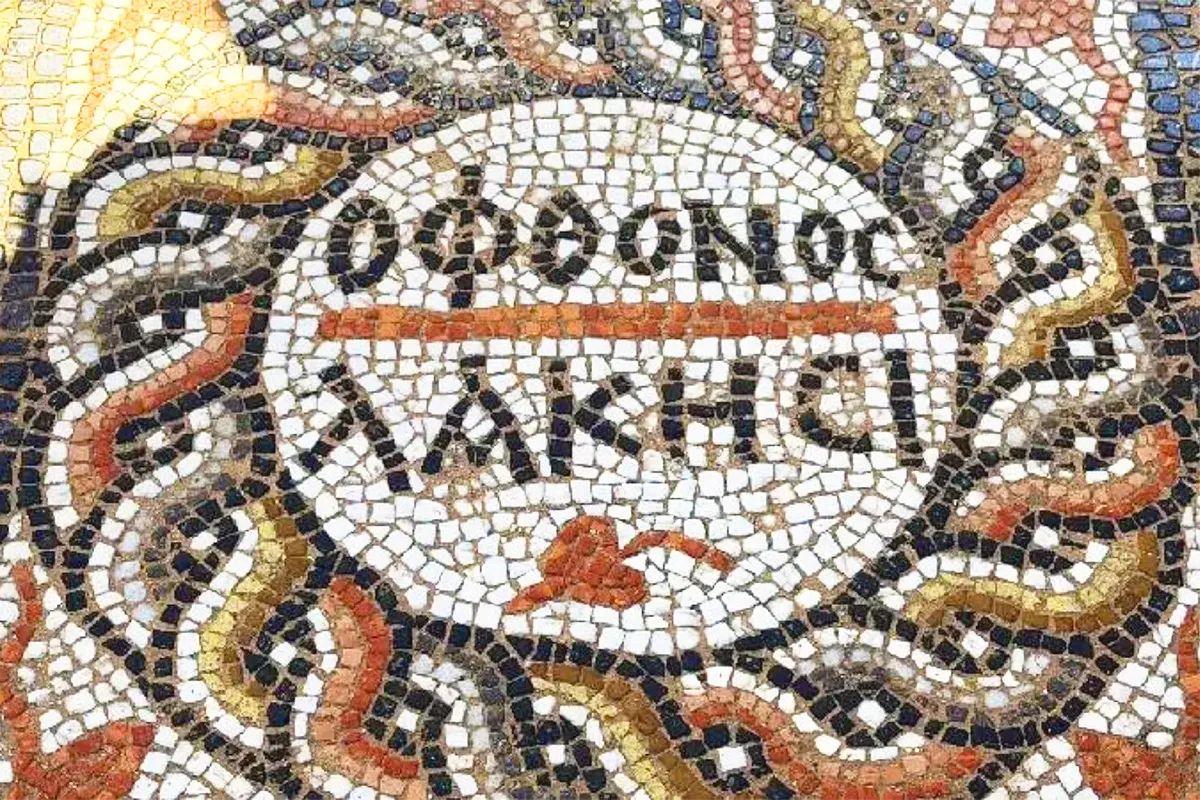
Archaeologists working in the ruins of an ancient Roman city in the district of Alanya on Turkey‘s southern coast have discovered a curious Roman mosaic, approximately 15 square metres in size and dated to between the 4th and 6th centuries AD, which includes a unique inscription which, translated into a modern expression, would be equivalent to something like “let the envious ones burst”.
Syedra, an ancient port city in the historic region of Cilicia with a history stretching back some 3,000 years, has been excavated by archaeologists under the direction of Professor Ertuğ Ergürer, a member of the Faculty of Tourism at Alaaddin Keykubat University in Alanya (Antalya), who confirmed that the surprising find was made during work being carried out at one of the largest residences in the ancient city.
Ergürer explained that the archaeological team unearthed a well-preserved mosaic at the central entrance of the building. “We believe that the mosaic dates back to between the 4th and 6th centuries,” Ergürer said, adding that one of the keys to the discovery was the presence of two distinct inscriptions, according to Turkish daily Hürriyet.
Finding something like this was a “great surprise” for the archaeologists
“In the central part of the mosaic there is an expression that can be interpreted as ‘enjoy using it‘ or ‘use it with good luck‘. And at the entrance of the room, inside a circular frame, there is a second inscription. The first word in the inscription means ‘envy’ or ‘envious‘, and the second means ‘to burst’ or ‘to explode‘… This corresponds to the expression ‘let the envious burst‘ or ‘haters gonna hate‘ which we still use today. To find such a phrase at the entrance of a structure built some 1,500 years ago was a big surprise for us,” said the expert.
Both Ergürer and the team of archaeologists working in the area believe that the building was probably one of the most important residences of ancient Syedra, so excavation and restoration work will continue to be carried out in other areas of the building, which consisted of a total of three storeys high and was accessed from the north side of the residence.
The archaeologists maintain that the complex, which consists of numerous rooms and a large central courtyard, was in use between the 2nd and 7th centuries AD, although over the centuries it underwent changes of ownership, extensions, the construction of new floors and even the closure of some areas of the residence.
In a late phase of use, the entrance and the upper part of the area of the building where this Roman mosaic was located were covered, thanks to which it has come down to us in an almost excellent state of conservation, although it has been necessary to carry out some restoration work on it. Syedra was already in the news last year when archaeologists excavating the ruins of the city found the remains of an ancient Roman stadium 1,800 years old, capable of holding thousands of spectators, thus demonstrating the importance and status of this city under the Roman Empire.
📚 If you want to learn more about the history of Turkey, we recommend:
🧿 Discover here more recommended products about Turkey
As an Amazon Associate, we earn from qualifying purchases. This comes at no extra cost to you and helps support this website.
VOTE

EDITORIAL TEAM
🧿 About us
.
Edited and reviewed by:

Pablo Gómez is a specialist in Turkey and has been editor-in-chief of Hispanatolia since 2011. He has been analysing current affairs and geopolitics in Turkey and the surrounding region since 2006.
…
📣 Your ADVERTISING on Hispanatolia
.
🤗 HELP US WITH A DONATION:
💗 Paypal