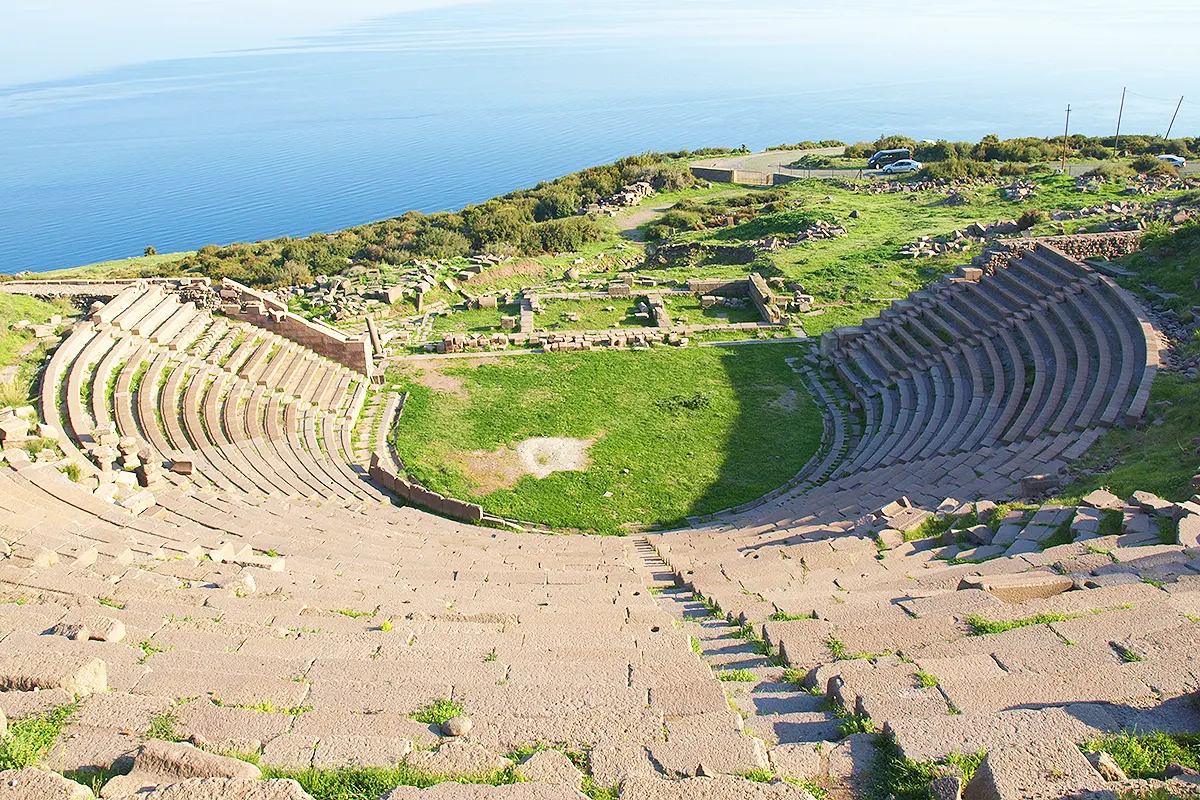
The Turkish Ministry of Culture and Tourism appears to have given the go-ahead for a project to restore the 2,200-year-old Greek theatre in the ancient city of Assos, located in the modern-day Turkish province of Çanakkale and home to the philosopher Aristotle, who lived there, being visited centuries later by St Paul and the evangelist Luke.
Professor Nurettin Arslan, head of the archaeological excavations in Assos, explained to Turkish media that the restoration project prepared by the ministry is now in its final phase and that “the restoration of the theatre will probably begin this year“. “After the restoration, this place could become one of the most important cultural destinations not only in Çanakkale, but in the whole country, hosting theatre performances and concerts during the summer months,” the professor added.
Arslan pointed out that such theatres were public constructions that existed in almost all ancient cities built along the Aegean coast, but that in the specific case of the theatre of Assos what made it special was that the audience, while enjoying the performance, could look out over extraordinary views of the waters of the Aegean Sea and the nearby island of Lesbos. “Among all the ancient cities in the province of Çanakkale, Assos stands out as one of the best preserved. Once the theatre is fully restored, it will become an important venue for social events,” he said.
Home of the philosopher Aristotle
Located today next to the village of Behramkale in the Ayvacık district (Çanakkale province), Assos was an ancient Greek city that has been continuously inhabited until the present day. Built on a hillside of volcanic origin, Assos was founded about 1,000 BC by settlers from the island of Lesbos, who settled in the south of a region known in antiquity as Troas. Today, in the archaeological ruins of Assos you can see the ancient city wall with its towers, the theatre, the agora, a gymnasium, a stoa and the necropolis, among other remains.
Other important remains include the old harbour and the bouleuterion (an ancient parliament, the oldest in Anatolia). One of the most important buildings that can still be seen in Assos, however, is the ancient temple of Athena, considered to be one of the oldest Doric-style temples in Anatolia, dating from the Archaic period (7th-6th century BC). Of particular importance at Assos is the fact that it was the first ancient city excavated by American archaeologists: between 1881 and 1883, by Joseph Thacher Clarke and Francis H. Bacon. Excavations were later resumed in the 20th century in 1981, and continue to this day.
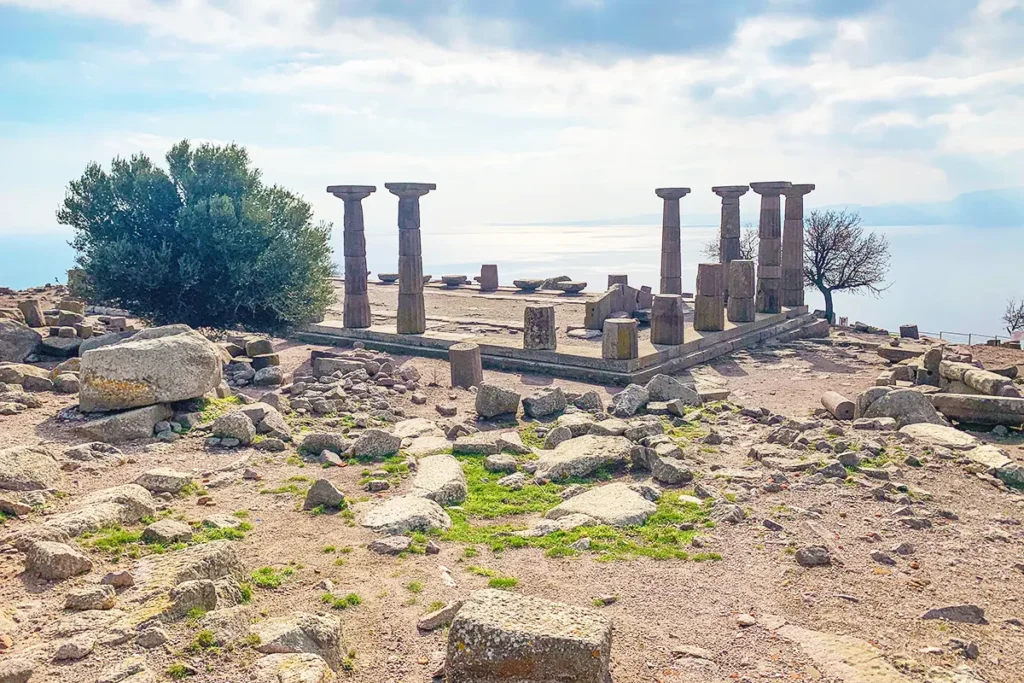
The theatre is thought to have been built at the end of the 4th century BC and continued to be used during Roman era with various modifications; for example, because of the gladiatorial and animal shows (venatio) that were held there during Roman rule, railings were added to the lower rows to protect the spectators, while in the upper rows an area was designated for the worshippers of Serapis, an ancient Egyptian deity that became very popular in Hellenistic and Roman times .
The famous philosopher Aristotle moved to the city, where he founded an academy and married the niece of the local ruler, Hermias, also undertaking important studies in zoology, biology and botany. This was the golden age of Assos, which came to an end when years later the Persians conquered the city, forcing Aristotle to flee to Macedonia. Alexander the Great would later expel the Persians after conquering Assos in 334 BC, and by the 2nd century BC the entire region came under the control of the Roman Empire.
According to Christian tradition, Luke the Evangelist visited the city, as did the Apostle Paul himself, who is said to have arrived in Assos during his third missionary journey through Asia Minor (between 53 and 57 AD) on his way to Lesbos. From this time onwards, however, Assos entered into a gradual decline that continued during the medieval period under Byzantine and Ottoman rule, until it became the small town it still is today.
The restoration of the Greek theatre of Assos – with a capacity of some 5,000 spectators, and a breathtaking view over the Aegean Sea – could now restore some of its former glory to these ruins, making it an important cultural and tourist hub on the Turkish coast.
📖 If you want to learn more about the history of Turkey, we recommend:
🧿 Discover here more recommended products about Turkey
We include affiliate links: if you buy through them, you don’t pay extra money and you help this website.
VOTE

EDITORIAL TEAM
🧿 About us
.
Edited and reviewed by:

Pablo Gómez is a specialist in Turkey and has been editor-in-chief of Hispanatolia since 2011. He has been analysing current affairs and geopolitics in Turkey and the surrounding region since 2006.
…
📣 Your ADVERTISING on Hispanatolia
.
🤗 HELP US WITH A DONATION:
💗 Paypal