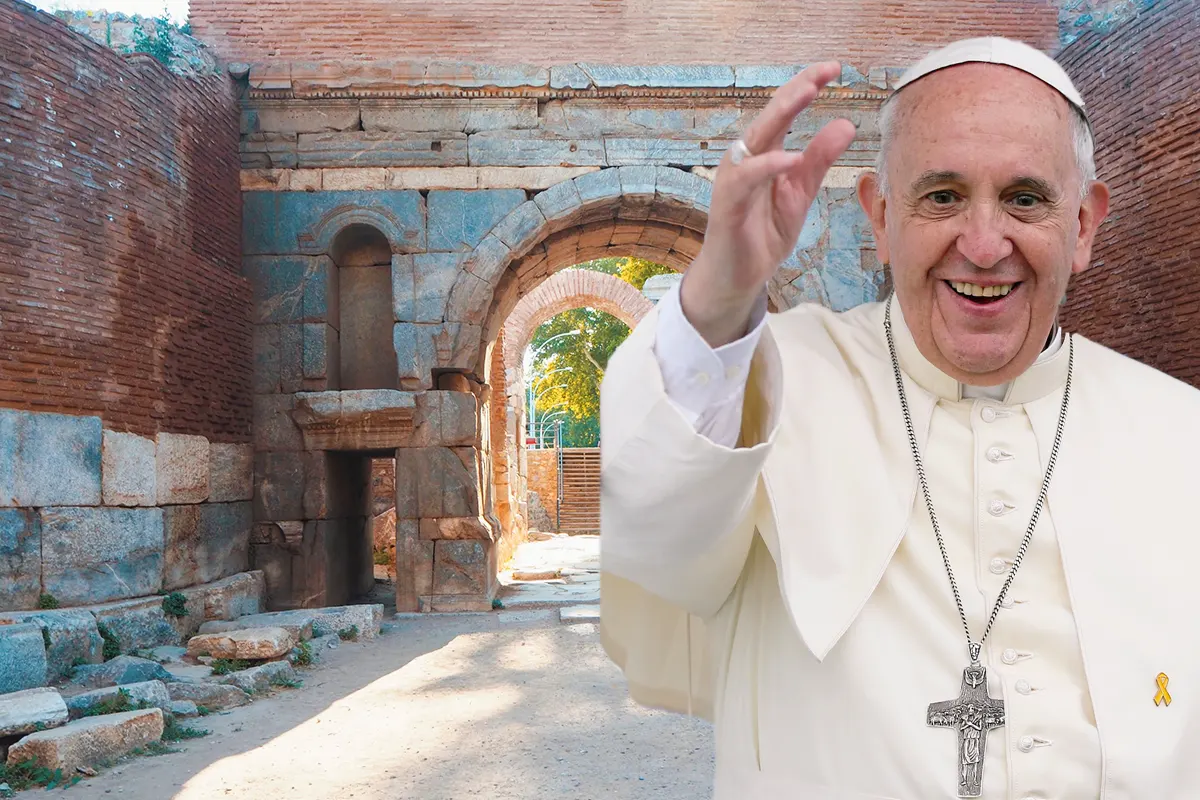
The unexpected death yesterday of Pope Francis at the age of 88 has shaken the global Christian community, but it has also brought particular sadness to a small town in Turkey: İznik. Its name will probably not be familiar to many people, but if we say that the ancient name of this town on the shores of the lake of the same name was Nicaea, and that it was here that the first council in the history of Christianity was held 1,700 years ago, it is easy to understand why this place was and is so important for Christianity, the Papacy and the Vatican.
Last March, the Vatican confirmed that, despite his delicate state of health, Pope Francis was maintaining his plans to visit Turkey in May and travel to the small town of İznik, where in 325 AD, Roman Emperor Constantine the Great convened a great council of bishops and Christian scholars from all over the known world to establish the foundations of ‘Catholic’ doctrine (that is, ‘universal’, derived from the Greek katholou or ‘general’). It was in İznik that the so-called Nicene Creed was drafted, establishing fundamental pillars of Christianity such as the concept of the Trinity or the true nature of Jesus.
The announcement yesterday by Cardinal Kevin Farrell, Vatican’s camarlengo, of Francis’ death came as a heavy blow in İznik, where residents were eagerly awaiting the Pope’s visit, who was scheduled to travel to this historic town in the Turkish province of Bursa between 24 and 25 May. In coordination with the Turkish Ministry of Culture and Tourism, local authorities and business people had been working hard in recent months to get everything ready for the visit of the Supreme Pontiff, adapting sites such as the basilica submerged in Lake İznik and the Hagia Sophia Mosque, a former church where the First Council of Nicaea was held in 325, 1,700 years ago.
The people of İznik pray for Francis
Turkish media reported that, upon learning of Francis’ sudden death, residents and merchants in İznik organised a free distribution of lokma (a popular sweet usually distributed at funerals in memory of the deceased) and even prayers for the death of the Pontiff. ’His visit would have brought economic vitality and spiritual importance to our city. Now, we are sad and uncertain about what will happen,’ said a local shopkeeper.
‘It would have been an extraordinary moment not only for İznik, but for the entire Christian world,’ said another person who helped organise a public prayer in memory of the late Pope. ‘We are saddened by the Pope’s death, but we are ready to welcome whoever comes in his place. We will show the warmth and hospitality for which Turks are famous,’ added another shopkeeper in the city.
Despite this uncertainty and sadness at the death of Pope Francis, local authorities are pressing ahead with preparations for the celebration of the 1,700th anniversary of the Council of Nicaea, as confirmed by the city’s mayor, Kağan Mehmet Usta: ‘We woke up with the news of Pope Francis’ death. He had personally expressed his desire to visit İznik for this important occasion. We extend our condolences to the Catholic community and to all Christians. Our preparations continue,’ he said.
Turkey could be the new Pope’s first official trip
Indeed, Pope Francis, who had previously visited Turkey in November 2014, had spoken about his plans to visit Turkey, emphasising that the anniversary of the Council of Nicaea represented a key milestone in the history of the Church and humanity. ‘This council marked a turning point in the journey of the Church and of all humanity,’ Francis had publicly declared last November.
For now, the Vatican has not yet confirmed whether any other representative of the Catholic Church, or even the successor to Pope Francis, will attend the events planned for the end of May to mark the anniversary of the Council of Nicaea. The Holy See plans to send a delegation to İznik in the coming days, which could determine whether a visit to this small walled town in Turkey could indeed be the first official trip of the new Pope.
VOTE

EDITORIAL TEAM
🧿 About us
.
Edited and reviewed by:

Pablo Gómez is a specialist in Turkey and has been editor-in-chief of Hispanatolia since 2011. He has been analysing current affairs and geopolitics in Turkey and the surrounding region since 2006.
…
📣 Your ADVERTISING on Hispanatolia
.
🤗 HELP US WITH A DONATION:
💗 Paypal