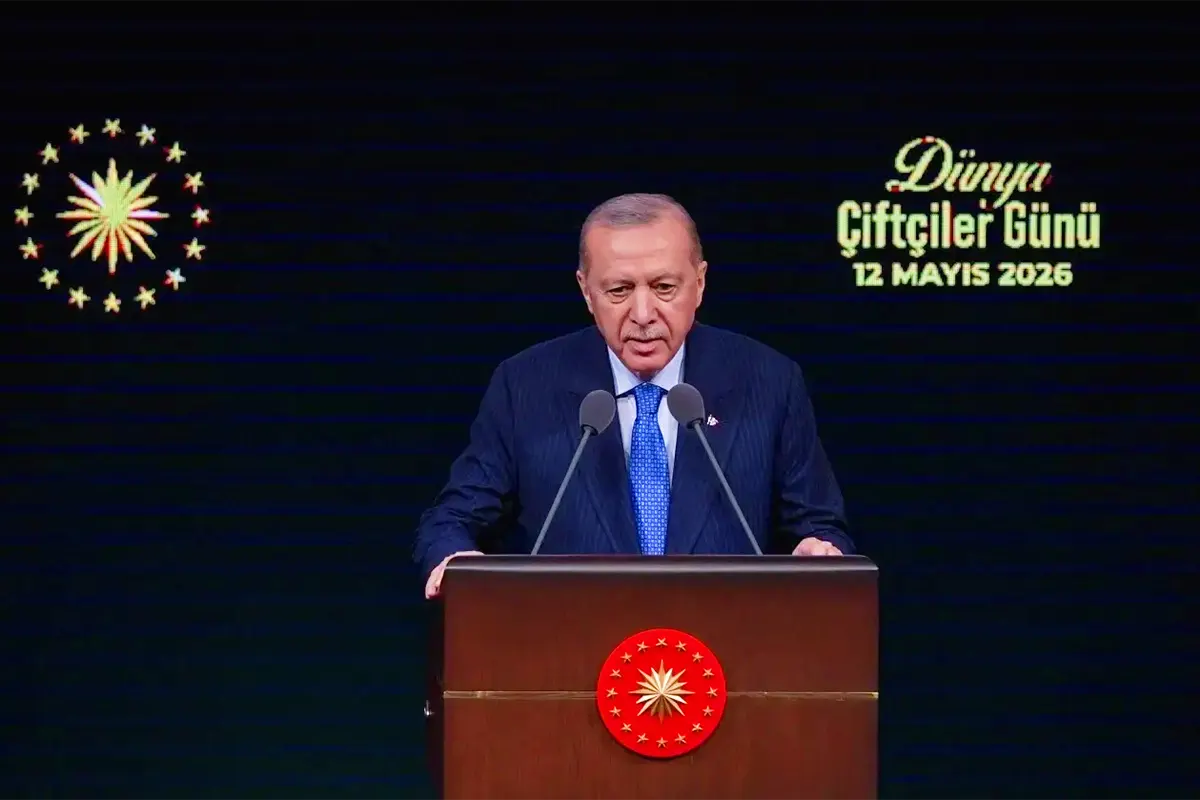
Turkish President Recep Tayyip Erdoğan has stated that Turkey has taken all necessary measures to avoid being affected by the war in the Middle East between the United States and Iran and the de facto blockade of the Strait of Hormuz, assuring that the country has sufficient fertilisers and other products to guarantee food production and supply.
“Thanks to the measures we have implemented, particularly production planning, we currently have no food supply security issues. We are also implementing new regulations and support mechanisms,” said Erdoğan, who noted that the government is doing everything possible to protect the country from the “ring of fire” surrounding it through a balanced foreign policy and that it has managed to guarantee “without any problem” the food security of the country’s 86 million citizens, in remarks made during an event to mark World Farmers’ Day, as reported by the Anatolia news agency.
“Everyone now understands the importance of food security”
“If today agriculture and livestock farming are thriving in Türkiye, and if production and exports are breaking new records every year, it is thanks to your work,” said the Turkish president, addressing a delegation of farmers gathered during the event, held at the Beştepe National Congress Centre within the presidential palace complex in Ankara. “If today in Turkey our land and water resources and our forests are protected in the most efficient manner, it is thanks to your care. Every product that reaches our tables contains your good intentions, your hard work and your sincere efforts,” he emphasised.
Erdoğan recalled that last year 706 billion liras – some 13.25 billion euros – were allocated to aid for the agricultural sector, including direct support, loans, investments, intervention purchases and export subsidies. As he explained, this figure has risen this year to 939 billion liras (17.62 billion euros), and he further emphasised that “everyone now accepts this fact: water stress and the climate crisis, as well as recent outbreaks of pandemics, wars and conflicts, have confirmed the importance of food security”.
“These figures are not our own; they belong to an international organisation: we are third in the world for vegetable production and fourth for fruit production. We are among the top three for 21 vegetable crops. We also hold leading positions globally and in Europe for the production of raw milk, beef, chicken and eggs. We are leaders in honey production in Europe and second in aquaculture. We are among the top ten countries in the world for seed production. We export seeds to 117 countries,” declared the Turkish leader, assuring that the country is self-sufficient in numerous agricultural sectors.
“We have secured the supply of fertilisers and have sufficient reserves”
The Turkish president emphasised that Ankara had taken pre-emptive measures against potential crises arising from the conflict in the Middle East. “We have made our plans in line with these realities, saying: ‘Whoever holds the key to the granary, holds the power’. We have been on alert from day one to prevent the conflicts that have deeply shaken Iran and our sister countries in the Gulf from affecting our agricultural production. In agriculture, we have already secured the supply of fertilisers and raw materials for fertilisers; our reserves are at sufficient levels,” he insisted.
According to Erdoğan, not only are there currently no problems relating to agricultural production or food supply, but the Turkish government is also already preparing for the autumn sowing campaign in terms of fertilisers: “Our dams are filling with water and we have no irrigation problems. We are confident that our agricultural production, which fell last year due to frosts and drought, will rise again this year.”
These statements come after United Nations experts have warned that tens of millions of people could face hunger and starvation if fertilisers are not soon allowed to pass through the Strait of Hormuz.
VOTE

EDITORIAL TEAM
🧿 About us
.
Edited and reviewed by:

Pablo Gómez is a specialist in Turkey and has been editor-in-chief of Hispanatolia since 2011. He has been analysing current affairs and geopolitics in Turkey and the surrounding region since 2006.
…
📣 Your ADVERTISING on Hispanatolia
.
🤗 HELP US WITH A DONATION:
💗 Paypal