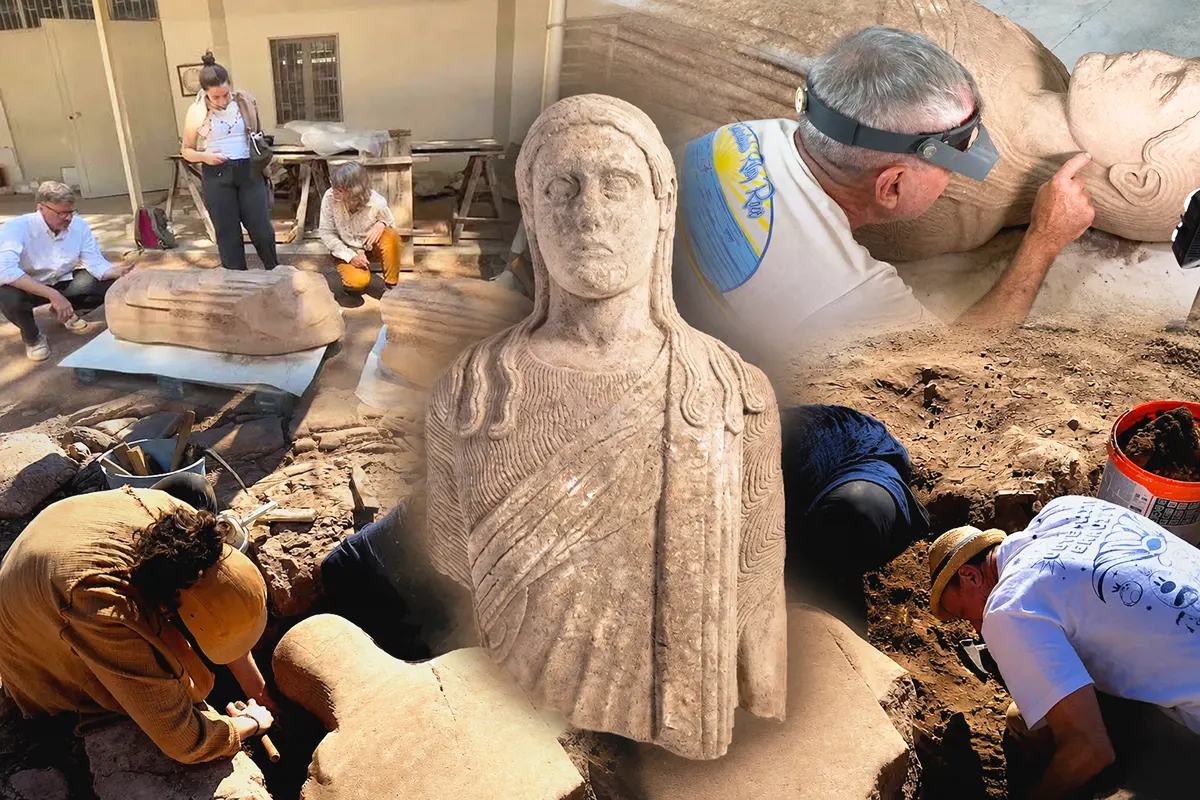
A marble statue, 2.2 metres tall and approximately 2,500 years old, has been discovered by archaeologists during excavations in the ancient city of Sardis, in the Aegean province of Manisa, in western Turkey, as recently announced by the country’s Minister of Culture and Tourism, Mehmet Nuri Ersoy.
Dated to the first half of the 5th century BC, the marble statue provides important insights into the art and social life of that period, thanks to its monumental dimensions, its good state of preservation and the details of its clothing, which display characteristics typical of Lydian culture.
The monumental sculpture, depicting a young man standing, was found during archaeological excavations carried out in the ancient city of Sardis, located in the Salihli district of the Turkish province of Manisa, under the coordination of the General Directorate of Cultural Heritage and Museums, as reported by the Turkish news channel TRT Haber.
Turkey’s Minister of Culture and Tourism, Mehmet Nuri Ersoy, confirmed the discovery in a post on his social media account: “A unique discovery in Sardis, Anatolia, which will shed light on archaeology! During excavations at the ancient city of Sardis, in Manisa, we have unearthed a statue of a young man approximately 2,500 years old, dating from the first half of the 5th century BC. The 2.2-metre-tall marble statue, with its monumental dimensions, excellent state of preservation and extraordinary details, is among the rare examples of sculptural art from its era,” he said.
“It was reused as paving stone on a colonnaded street during the Roman period; the statue has been preserved over the centuries largely because it was laid face down. The unusual details of its clothing show traces of Lydian culture. The statue, which appears to depict a specific individual, provides important insights that will help us understand life, belief systems and cultural interactions in Sardis during that period,” the minister emphasised.
Thanks to the fact that it was placed face down, the statue has survived for 2,500 years
The statue has been dated to between 470 and 450 BC. Its dimensions, larger than those of a person, make it one of the few examples of its kind from that era. It was found split into two large pieces, although the feet are missing, along with some smaller fragments. During the Roman period, it was reused as a paving stone on the colonnaded street of Sardis, situated at the entrance to the city, and laid face down: an arrangement that allowed the facial features and other important details to be largely preserved for over 2,000 years.
Although the effigy’s upright posture and long hair are reminiscent of examples from the 6th century BC, the facial features, the anatomical details of the hands and other characteristics point to the first half of the 5th century BC. The young man depicted is wearing a thick himation (a loose-fitting cloak from ancient Greece), a fine chiton (a light tunic of Greek origin) and, underneath, another garment with horizontal stripes. This type of attire, which does not appear in similar sculptures from Anatolia and Greece, reveals the local characteristics of the work and its connection to ancient Lydia.
In the statue’s right hand there is a piece of fruit which is believed to have been an offering as a sacrifice to a god or goddess. It is speculated that it might be a quince. The work dates from the period when Sardes was the capital of the satrapy of the western province of Achaemenid Persia. The monumental sculpture is also notable for combining the sensibility of classical art developed in the Aegean region with Lydian traditions of dress and visual language.
It is known that, in antiquity, most marble statues of this type were painted. In the case of the statue from Sardis – a city whose ruins were designated a UNESCO World Heritage Site in 2025 – now discovered by archaeologists in Turkey, it is covered by a thick, hard layer of sediment; the conservation team will therefore have to clean the work without damaging any pigments that may have survived to the present day. Specialists in ancient polychrome sculpture will take part in the work, examining any remnants of paint present both on the surface of the sculpture and in the soil surrounding it, to determine what colours it originally had. Once the necessary procedures have been completed, the sculpture will be exhibited at the Manisa Archaeological Museum.
VOTE

EDITORIAL TEAM
🧿 About us
.
Edited and reviewed by:

Pablo Gómez is a specialist in Turkey and has been editor-in-chief of Hispanatolia since 2011. He has been analysing current affairs and geopolitics in Turkey and the surrounding region since 2006.
…
📣 Your ADVERTISING on Hispanatolia
.
🤗 HELP US WITH A DONATION:
💗 Paypal