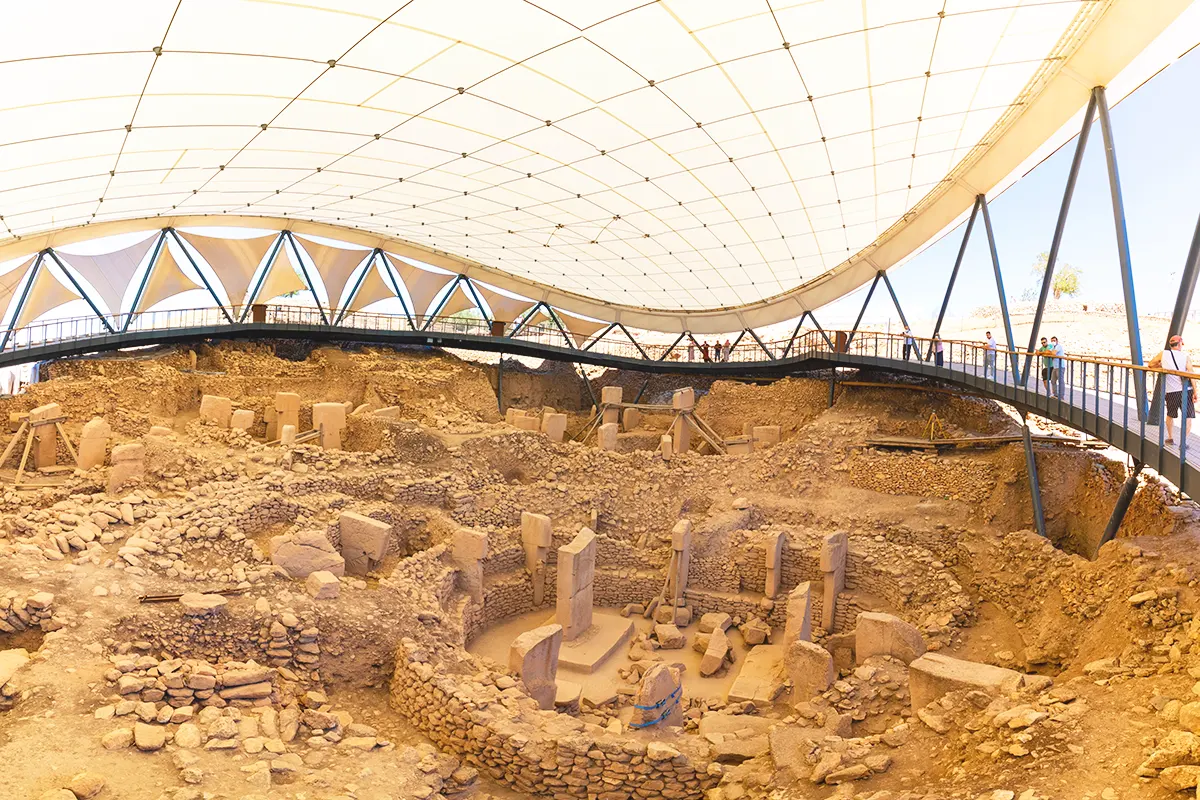
Göbekli Tepe, considered the oldest known sanctuary in human history and often referred to as the “ground zero of history”, has marked eight years since it was inscribed on the UNESCO World Heritage List on 1 July 2018: a period during which it has welcomed more than 4 million visitors.
Its designation as a World Heritage Site fuelled growth in visitor numbers to the site. Although the COVID-19 pandemic forced it to close temporarily to tourists and the devastating earthquakes of 2023 led to a temporary drop in visitor numbers due to the aftermath of the quakes in the region, a total of 4,409,590 people have visited the site over the past eight years.
“Göbeklitepe is an opportunity for Şanlıurfa. And if we want to be a little more ambitious, it is actually an opportunity for Turkey. Our region, with the Taştepeler Project and the excavation work being carried out at 12 different sites, has gained significant momentum in becoming a major attraction for the world,” said Mehmet Kamil Türkmen, president of the Şanlıurfa Province Tourism Development Association, as quoted by the news channel TRT Haber.
Karahantepe, another site nominated for UNESCO World Heritage status
“It is an extremely important and shining star of south-eastern Turkey and of our country; we must appreciate what it represents. Without a doubt, it is a must-visit site. Şanlıurfa holds a very important position in this regard. There is a tentative list and two nominations (with UNESCO). Balıklıgöl and Harran are among those nominees. In the coming years, Karahantepe will also be added to the permanent World Heritage List,” announced Türkmen.
Gülsüm Sayın, a Turkish tourist from the province of Mersin, said she was delighted after visiting the site: “I was curious and here I am, seeing it for myself. These places really are worth visiting. I recommend it to everyone”. “I’m happy to have seen this place,” said Sabri Şahin, another Turkish tourist who had travelled from Germany, adding that he had been very curious about Göbeklitepe after discovering it online: “The artefacts and figures are very ancient. It’s a very beautiful place,” he added.
When it was discovered in 1963, it was thought to be a Byzantine cemetery
Göbekli Tepe is an archaeological site situated 18 kilometres from the city of Şanlıurfa, near the village of Örencik. The site was discovered during archaeological surveys carried out in 1963, although researchers at the time mistakenly believed that the upper parts of the pillars – the only area uncovered at that stage – were simply gravestones, probably Byzantine; definitive proof of its enormous importance did not come until 1986, when a farmer found a strange stone statue whilst ploughing his field.
The archaeological excavations began in 1995, driven by the German archaeologist Klaus Schmidt and with authorisation from the General Directorate of Cultural Heritage and Museums of Türkiye, and brought to light astonishing T-shaped stone pillars dating from the Neolithic period, ranging in height from 3 to 6 metres and weighing between 40 and 60 tonnes, which were decorated with figures of wild animals.
A discovery that changed our understanding of the origins of civilisation
Regarded as one of the most significant archaeological discoveries of recent decades, Göbekli Tepe transformed the view that researchers held regarding the origins of civilisation. Its stone monuments, erected some 11,500 years ago by hunter-gatherer communities, demonstrated that human groups without fully developed agriculture or permanent settlements were already capable of organising complex construction and ceremonial projects.
Before Göbekli Tepe, the prevailing view was that humans 11,500 years ago formed relatively small and mobile groups of hunter-gatherers, with limited social organisation, capable of organising small-scale hunts or ceremonies, creating rock art and small ritual sculptures, or erecting simple, temporary structures. But the discovery of Göbeklitepe overturned all that, demonstrating that the first major religious structures had not emerged after the development of agriculture – some 10,000 years ago – or the first cities – some 6,000 years ago – but much earlier.
Göbekli Tepe’s fame has continued to grow ever since, thanks to the new archaeological discoveries that are still being made at the site, which is so vast that even today only between 5% and 10% of the total area has been unearthed, to the extent that many archaeologists believe it will take at least 150 years to excavate it completely. In 2011, the site was added to the UNESCO Tentative List of World Heritage Sites, and was subsequently inscribed on the permanent list of World Heritage Sites during the 42nd session of the World Heritage Committee, held in Bahrain on 1 July 2018.
🧿 TOP TOURS IN TURKEY
VOTE

EDITORIAL TEAM
🧿 About us
.
Edited and reviewed by:

Pablo Gómez is a specialist in Turkey and has been editor-in-chief of Hispanatolia since 2011. He has been analysing current affairs and geopolitics in Turkey and the surrounding region since 2006.
…
📣 Your ADVERTISING on Hispanatolia
.
🤗 HELP US WITH A DONATION:
💗 Paypal