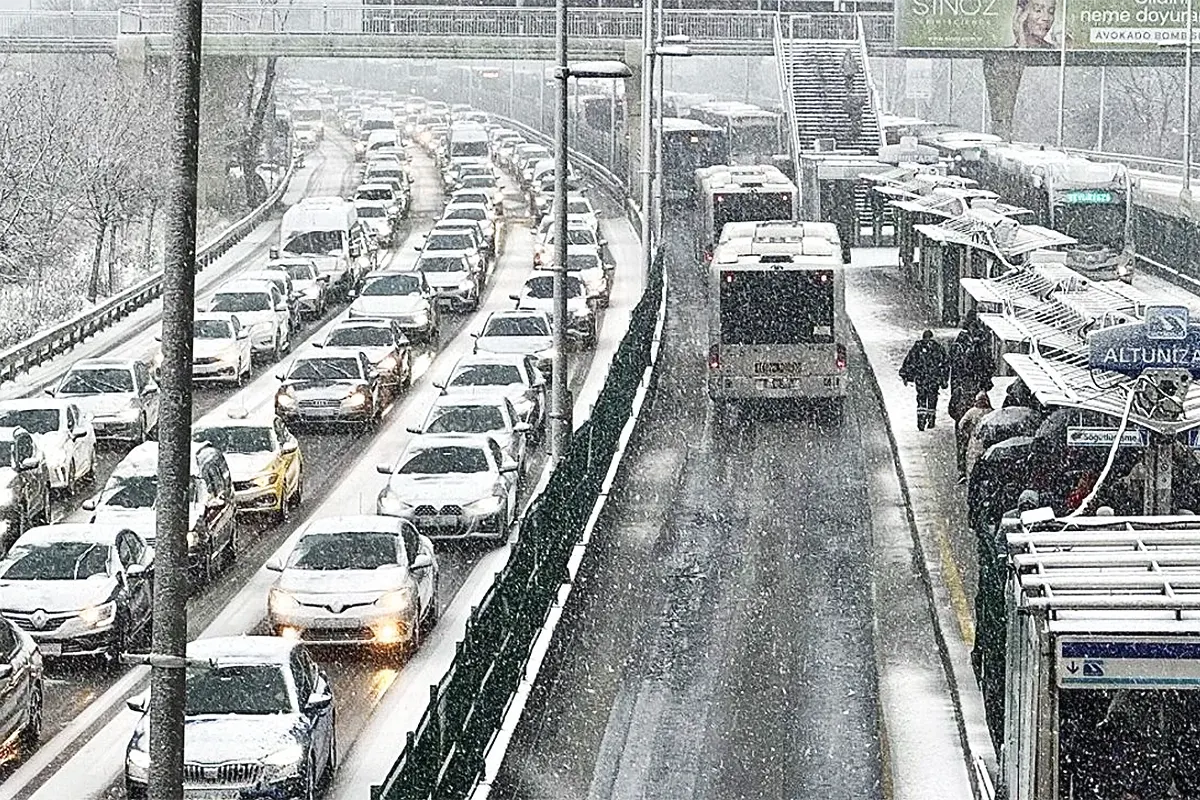
The snowfall that began in Istanbul on Saturday 17 January and continued yesterday, Sunday, intensified on Monday morning, causing street closures in several districts and a widespread traffic and transport breakdown on the first working day of the week, causing traffic congestion to reach peaks of 81% at morning rush hour, leading authorities to ban heavy goods vehicles and delivery vehicles until further notice.
Following warnings issued by the state weather service for the arrival of a new cold snap, precipitation turned from sleet on Saturday night to persistent snow on Sunday, which intensified this morning, covering large parts of the city’s higher districts in white and severely affecting public and private transport in Turkey’s most populous city. Although schools remain closed for the mid-term holidays, thousands of commuters jammed the main roads and city entrances, turning traffic into chaos.
On the Asian side of the Turkish metropolis, the snow affected districts such as Beykoz, Ümraniye or Çekmeköy, where several side streets were closed, while on the European side, the districts of Sultangazi, Bağcılar, Avcılar, Küçükçekmece, Arnavutköy or Başakşehir were also severely affected by the snowfall, with notable difficulties in road traffic due to the accumulation of snow and ice at points such as the Arnavutköy-Habipler road, Turkish broadcaster TRTHaber reported.
Teams of municipal workers have been carrying out intensive snow ploughing and salting work since early morning, but this did not prevent traffic jams on the approaches to the 15 July Martyrs’ Bridge, the Fatih Sultan Mehmet Bridge, the Golden Horn Bridge and the Eurasia Tunnel, as well as major traffic jams on the D-100 motorway and the TEM motorway (especially between Esenyurt and Esenler), aggravated by non-injury collisions such as those at Sefaköy and Bahçelievler, which added to traffic congestion.
Traffic congestion in Istanbul reached 85%
According to the Istanbul Metropolitan Municipality’s Mobile Traffic Map, at 08:15 this morning traffic congestion stood at 78% on the European side of the city, 85% on the Asian side and around 80% in the city as a whole. On the other hand, as many people chose to commute to work by tram, metro, bus or metrobus, the pressure of commuters at stops and stations increased. Intermittent snowfall also caused visibility problems in areas of Ümraniye and Beykoz, leaving many buses and trams immobilised to the despair of commuters.
In response to this situation, the Istanbul Governor’s Office announced a traffic ban for heavy goods vehicles and delivery vehicles from 10:00 this morning until further notice. But the snowfall did not only affect transport: pedestrians also had problems walking on pavements, streets and stairs turned into ice rinks by the low temperatures, causing numerous falls as many residents tried to clear the snow from their vehicles in the higher parts of the city. The good news: the weather forecast points to a gradual rise in temperatures throughout the week, with maximum temperatures in Istanbul rising from today’s 4°C to around 10°C by the end of the week.
VOTE

EDITORIAL TEAM
🧿 About us
.
Edited and reviewed by:

Pablo Gómez is a specialist in Turkey and has been editor-in-chief of Hispanatolia since 2011. He has been analysing current affairs and geopolitics in Turkey and the surrounding region since 2006.
…
📣 Your ADVERTISING on Hispanatolia
.
🤗 HELP US WITH A DONATION:
💗 Paypal