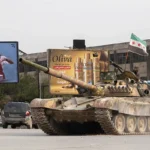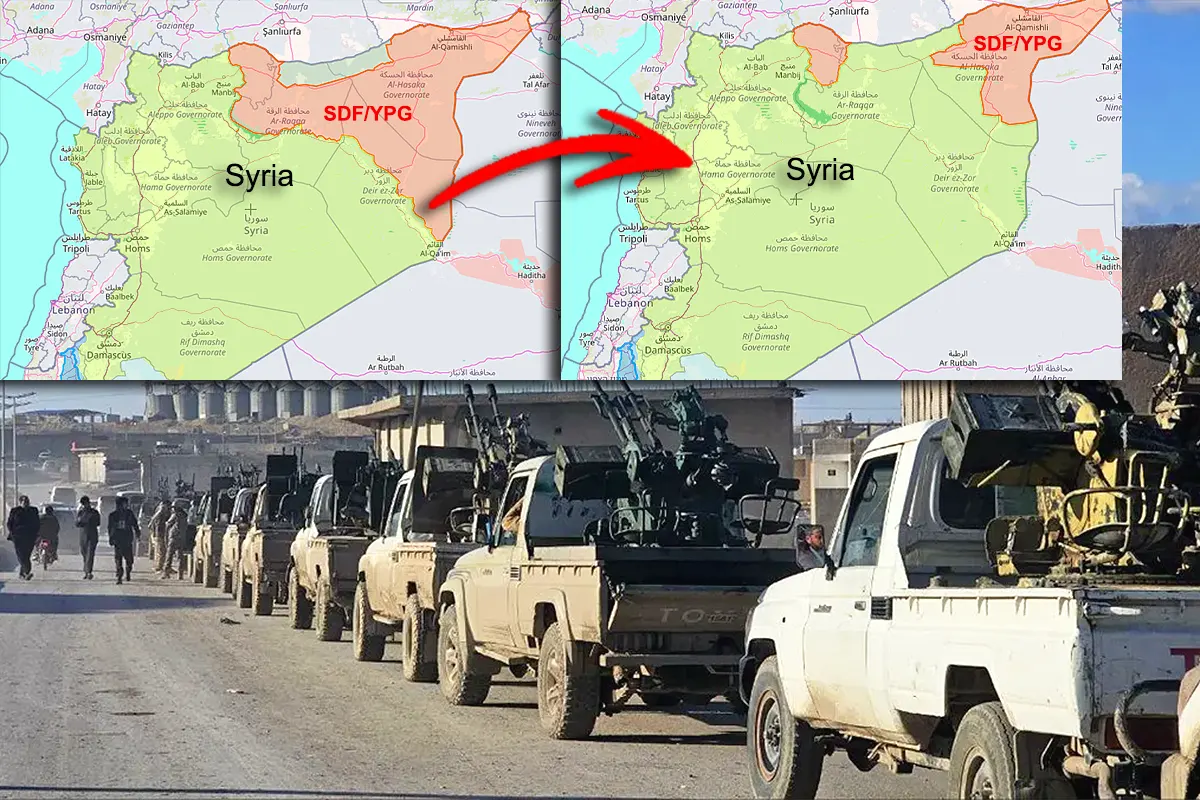
The Syrian Interior Ministry said on Monday that Syrian army units have begun deploying in eastern Deir ez-Zor province along the Euphrates River after SDF/YPG positions collapsed yesterday, forcing its forces to withdraw and accept a new deal with Damascus, in a severe blow to the aspirations of the Syria‘s affiliate of the PKK terrorist group.
“Our forces have begun entering the countryside in eastern Deir ez-Zor province as part of a plan aimed at an orderly deployment in all towns and villages,” said a ministry statement quoted by Syria’s official SANA news agency, Turkish news agency Anatolia reported. The ministry explained that the deployment is part of a plan to expand the state presence with the aim of protecting civilians and public and private property, as well as strengthening security and stability in the area.
The Syrian government launched in recent days an operation against the SDF (composed mostly of elements of the YPG, the Syrian affiliate of the PKK) after what it denounced as repeated breaches of agreements signed in March last year by the self-styled Syrian Democratic Forces and several days of fighting with SDF/YPG forces in neighbourhoods under their control north of Aleppo.
In Raqqa, Arab tribal militias drove out SDF forces and took full control pending army deployment to ensure security, while hundreds of residents celebrated the SDF/YPG’s escape and tore down statues, flags, posters and other symbols of the group. Such uprisings were repeated across eastern and northeastern Syria, especially in areas where the Arab population is the majority.
During the retreat, SDF/YPG forces blew up bridges in Raqqa in an attempt to slow the Syrian army’s advance, but despite these measures and a call for general mobilisation, government troops continued to advance, also seizing the strategic Syrian city of Tabqa and the Euphrates Dam.
Celebrations among civilians in ‘liberated’ areas of Syria
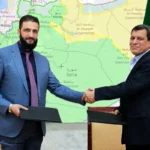
Finally, late on Sunday, Syrian President Ahmed al-Sharaa announced an agreement with SDF/YPG leader Mazlum Kobane Abdi, which includes a ceasefire and the full integration of the pro-Kurdish SDF/YPG administration and forces into Syrian state institutions. The agreement includes the immediate handover of Arab-majority provinces such as Raqqa and Deir ez-Zor, including key infrastructure such as the Al-Omar and Tanak oil fields. Abdi, leader of the SDF/YPG, did not hesitate to speak of a “conspiracy” in statements to Rohani TV: “The war was imposed on us, others planned it; we signed a new agreement with Damascus to stop the bloodshed,” he said, assuring that in due course he would explain “to our people” the reasons for the agreement.
“Our joy at the liberation is indescribable,” Mohammed Khalil, a 50-year-old driver in Deir ez-Zor, told news agencies. “We hope that everything will get better; there was no freedom under the SDF,” he said. “We want the children to be able to go back to school without fear, and for electricity, water and bread to return; we are not asking for a miracle, we just want stability and a normal life,” said Safia Keddo, a 49-year-old teacher, who is happy that the SDF/YPG militias have left.
For its part, the Turkish foreign ministry welcomed the agreement on a ceasefire and full integration of the SDF/YPG into Syria’s civilian and military institutions in a statement, expressing the hope that it would serve to reinforce the country’s stability, security and territorial unity. “With the recognition of the realities on the ground, we hope that it has been fully understood by all groups and individuals in the country that Syria’s future lies not in terrorism or division, but in unity, cohesion, and integration,” the statement said.
Security sources told Turkish media that the agreement between Damascus and the US-backed pro-Kurdish militias was a “historic turning point“, and acknowledged that Turkish intelligence played an extremely important role in preventing an escalation between the parties and reaching an agreement.
VOTE

EDITORIAL TEAM
🧿 About us
.
Edited and reviewed by:

Pablo Gómez is a specialist in Turkey and has been editor-in-chief of Hispanatolia since 2011. He has been analysing current affairs and geopolitics in Turkey and the surrounding region since 2006.
…
📣 Your ADVERTISING on Hispanatolia
.
🤗 HELP US WITH A DONATION:
💗 Paypal