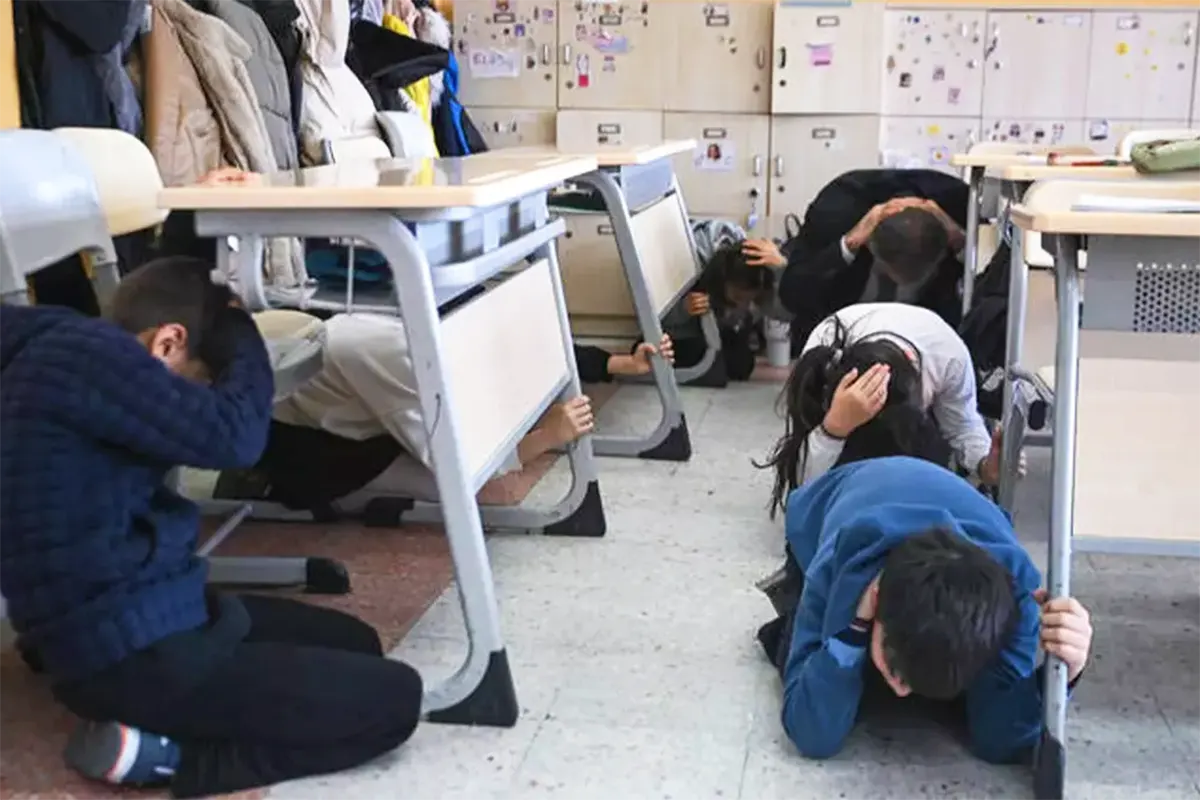
Following the recent earthquakes that shook Istanbul last week, all public and private schools in the Turkish metropolis resumed classes on 28 April with a very special lesson: a training on disaster awareness, aimed at preparing students for future earthquakes and other natural disasters. This is in addition to the guidelines provided by the Disaster and Emergency Management Agency (AFAD) to the population on how to prepare an emergency kit so that people are ready in the event of an earthquake.
According to Turkish media reports, during this training students were taught how to prepare this survival kit, but also what to do and how to protect themselves in the event of an earthquake. The aim is to teach them basic behaviours during earthquakes, such as the ‘drop, cover and hold on’ technique, and the importance of meeting points.
After the 6.2 magnitude earthquake that struck the coast of Istanbul on 23 April, classes were suspended on 24 and 25 April, as well as in other provinces in the Marmara region such as Tekirdağ, Kocaeli and Yalova, where schools were also closed. However, this training on natural disasters and earthquakes has only been provided in schools in Istanbul so far.
Is the worst over… or is this a precursor to a bigger earthquake?
Almost a week after the 6.2 earthquake that struck off the coast of Silivri, west of Istanbul, experts are still debating whether this new seismic swarm has significantly reduced the risk of major earthquakes in the future, while others warn that what has happened is merely a prelude to the ‘Big One’ that seismologists have been warning will occur before the end of this century, given that the Marmara region lies on one of the most active tectonic faults in the world.
‘Since the Gölcük and Düzce earthquakes of 1999 (in the Marmara region), we have been expecting an earthquake of magnitude 7.4-7.5 along the fault. Fortunately, the earthquake recorded recently was 6.2 and there were no fatalities,’ said Japanese earthquake expert Yoshinori Moriwaki in an interview with the international edition of the Turkish newspaper Sabah. However, Moriwaki added that the danger is far from over: ’This was just a warning.’
Professor Naci Görür, a well-known Turkish seismology expert, stresses that this recent earthquake does not represent the feared major earthquake expected in the Marmara region that will affect Istanbul, and said that while the small tremors that occur regularly along the Kumburgaz fault line – which runs through the Sea of Marmara – help to relieve tension, they are not the ‘big earthquake’ that experts are concerned about. On the contrary, he said, ‘These earthquakes increase the tension in the fault, bringing it closer to rupture,’ Görür warned.
Hasan Sözbilir, another expert seismologist, believes, however, that the partial rupture of the fault during the recent earthquake could be considered a positive sign. ‘If the entire fault had broken, we could have witnessed an earthquake measuring 7.4 to 7.5. This partial rupture is actually a positive thing, as it reduces the overall risk,’ said Sözbilir, who maintains that the region has been spared a potentially much more destructive earthquake.
For his part, Professor Şener Üşümezsoy, who has become popular in recent days because he predicted the recent earthquake in Istanbul just a few weeks ago, is one of those who maintains a more positive message and believes that ‘There is no further risk of earthquakes in Marmara’: ‘The fault that caused the great Izmit earthquake in 1999 is not related to the recent event. The tension caused by that event has already been relieved.’
VOTE

EDITORIAL TEAM
🧿 About us
.
Edited and reviewed by:

Pablo Gómez is a specialist in Turkey and has been editor-in-chief of Hispanatolia since 2011. He has been analysing current affairs and geopolitics in Turkey and the surrounding region since 2006.
…
📣 Your ADVERTISING on Hispanatolia
.
🤗 HELP US WITH A DONATION:
💗 Paypal