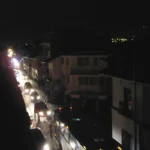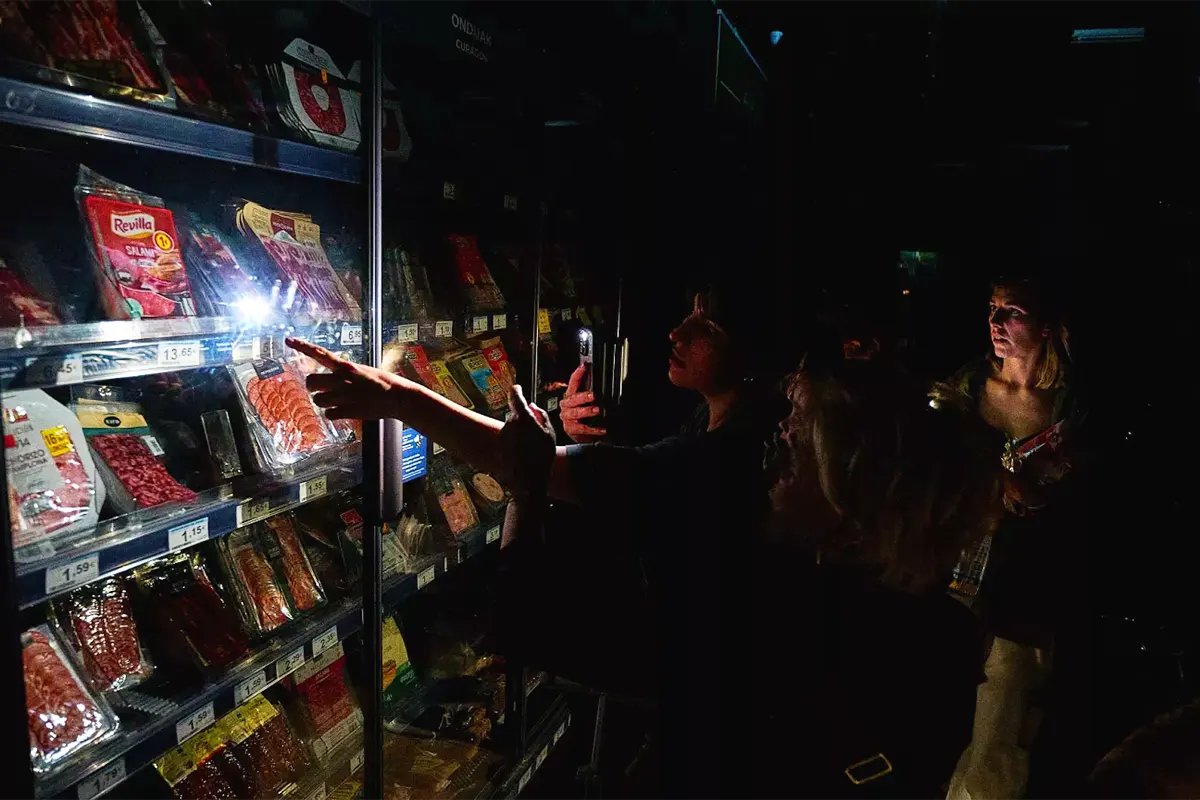
Spain and Portugal were searching for answers this morning as power supplies appeared to be almost fully restored following yesterday’s massive blackout across the Iberian Peninsula, which left major cities such as Madrid, Barcelona, Seville and Lisbon without power for hours, causing traffic chaos, paralysing metro and train services, and millions of euros in losses for shops, restaurants and other businesses and companies.
In Spain, the blackout affected virtually the entire country, with the exception of the autonomous cities of Ceuta and Melilla in North Africa, the Balearic Islands and the Canary Islands, whose network is independent from the mainland. The situation forced airports and hospitals to rely on electric generators, as did telecommunications operators, despite which service interruptions occurred throughout the day. The situation was no better in Portugal, where from Lisbon to Faro, scenes of chaos caused by the lack of electricity were witnessed.
Power restored, but problems persist
Both countries appeared to have regained most of their electricity supply this morning, according to news agencies, but the effects of yesterday’s power cut were still being felt this morning in cities such as Madrid, where many drivers were forced to abandon their cars overnight and the authorities announced that buses would be free today to facilitate the transport of citizens to their workplaces. Most hospitals are now operating normally, but IT problems persist and normal service is not expected to be restored until at least tomorrow, especially in primary care.
The metro and some trains services appeared to be running again, albeit with some delays. Spanish operator Red Eléctrica confirmed this morning that it had been able to restore almost all power supplies, although problems persist on the rail network and in some areas of Castilla-La Mancha, while it completely ruled out a cyberattack, pointing to a drop in solar generation as the primary cause of the blackout and dismissing other external causes suggested yesterday, such as an abnormal weather phenomenon.
Spanish Prime Minister Pedro Sánchez announced that he would hold operators accountable and demand new measures to ensure that ‘this never happens again,’ stressing that greater generation from nuclear power plants would not have prevented the blackout: ‘If we had been more dependent on nuclear power, the recovery would not have been so quick,’ he said.
In Portugal, the national operator REN confirmed on Monday night that all electrical substations were back in operation. Since the early hours of the blackout, the Portuguese authorities have maintained that the cause was in Spain, a country with which Portugal is interconnected and on which it is dependent.
France, Germany and Italy, others affected by the ‘European blackout’
The massive blackout did not only affect the Iberian Peninsula; parts of south-western France, especially areas close to Spain, also suffered brief power cuts yesterday, but the rapid response of the authorities prevented the problem from spreading and the supply was restored in a short time. French Industry Minister Marc Ferracci said on Tuesday that France is better prepared to prevent blackouts like those that occurred yesterday in the Iberian Peninsula, and assured that the impact of the power cut in France had been ‘minimal’.
Southern Germany and northern Italy also reported power cuts, although their duration and scope were much more limited and normality was restored within a short time. This was not the case in Andorra, located between Spain and France, where residents suffered power cuts throughout Monday.
What caused the blackout?
Now that normality has been largely restored, questions are being asked: What caused this unprecedented massive blackout? Was it an accident, human error, or external intervention? But more importantly, could it happen again?
The pressure is now on the Spanish government, which this morning assured that it would hold the companies in the sector accountable for what is possibly the biggest power failure in history, not only in Europe but worldwide. The only thing that seems clear, according to recent statements by Red Eléctrica officials, is that at around 12:30 p.m. yesterday, Spain suffered a sudden and, for now, unexplained drop in electricity generation of 15 gigawatts in just five seconds, equivalent to 60% of national demand, which caused instability in the system; for safety reasons, the connection between Spain and France via the Pyrenees was then automatically cut, causing the collapse of the peninsular system.
Determining the causes of what happened is – beyond political rhetoric – key to preventing a disaster of this magnitude from happening again, but for now almost everything is speculation and there are few certainties about what happened before those 5 seconds, which are the key to understanding what happened. Although public opinion demands immediate answers, most experts and analysts in the sector believe that an investigation to identify the clear causes of the sequence of failures that led to a blackout of this magnitude could take months.
It is a fact that the Iberian Peninsula, and Spain in particular, has one of the highest rates of renewable energy generation from wind and solar in the world, which is why many point to the possible impact of these types of energy sources—which generate energy intermittently, depending on weather conditions—on the stability of the system, which may have led to its collapse.
However, there is no agreement on whether the problem was a drop in supply or, on the contrary, an excess of supply, given that yesterday was a sunny and windy day in much of the peninsula. If the failure was caused in some way by an imbalance in the grid caused by renewable energy generation, some experts are already pointing out that this could happen again in the coming months if not urgent measures are taken to prevent it.
Cyberattack ruled out for now
What does seem to have been ruled out at this stage is the theory of a cyberattack, an option that gained attention in the early hours – especially on social media – but has lost credibility as details have emerged about how the massive blackout unfolded. Of course, no option should be ruled out until the investigation is complete; but both Spain and Portugal have assured that there is no evidence to support this and that a collapse of this magnitude caused externally is almost impossible.
Whatever happened, we must not lose sight of the fact that yesterday several European countries were left without around 100,000 megawatts of electricity… A figure that reminds us how fragile our technology – and our society – can be if we do not take steps to prevent another similar disaster in the future.
VOTE

EDITORIAL TEAM
🧿 About us
.
Edited and reviewed by:

Pablo Gómez is a specialist in Turkey and has been editor-in-chief of Hispanatolia since 2011. He has been analysing current affairs and geopolitics in Turkey and the surrounding region since 2006.
…
📣 Your ADVERTISING on Hispanatolia
.
🤗 HELP US WITH A DONATION:
💗 Paypal