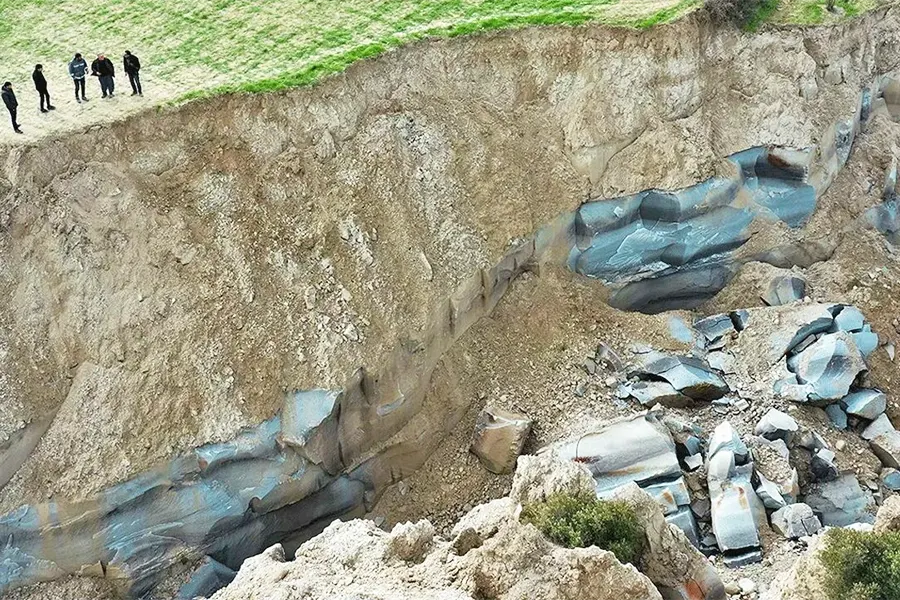
A team of German scientists has identified a massive tectonic fault stretching some 1,500 kilometres between southeastern Turkey and northwestern Iran that would have formed from the remnants of an ancient ocean that existed some 250 million years ago. The fault, which has accumulated ‘a large amount of energy’, could trigger a major earthquake in the future, experts warn.
The finding, reported in Germany on news websites such as merkur.de and echoed by many Turkish newspapers such as Milliyet, was carried out by a team from the University of Göttingen that studied how Iraq’s Zagros Mountains shaped the land surface in the northeast of the region over the last 20 million years. As a result of the research, which was published in the scientific journal Solid Earth, it was discovered that the remains of the plate of the ancient Tethys Sea, a primitive ocean that millions of years ago separated the Arabian plate from the Eurasian plate, are still connected to the Arabian plate.
The study revealed, however, that this ancient oceanic plate, which has been found to remain under the Arabian plate, has ruptured off Turkey. Thus, the researchers believe that the fault was formed due to the downward thrust of the remnants of the Thetis plate, creating major subduction zones in the Earth’s crust.

Professor Renas Koshnaw, who led the research, noted that ‘this plate continues to pull the region downwards, creating a space for more sediment to accumulate. However, this depression appears to become shallower in the direction of Turkey. This indicates that the former oceanic plate is separating in that area and that its gravitational pull is decreasing. The rift extends from Turkey to Iraq like a leaf torn from a calendar’.
‘Major earthquakes in the future cannot be ruled out’
The Italian scientific website Sciencecue has also echoed this important discovery, saying, ‘A 1,500-kilometre-long rift is forming between Turkey and Iran. What is happening at the bottom of the ocean?’ ‘Although the Earth looks solid and unchanged from the outside, its subsoil is not static at all,’ the Italian portal added.

Leading Turkish geologist Naci Görür also referred to this scientific finding, explaining that this fault marks the boundary between the Arabian plate and the tectonic structure to the east of the Anatolian plate, adding that in that region ‘there are provinces such as Diyarbakır, Bitlis, Şanlıurfa or Mardin’. ‘The region to the north is classified as a subduction zone, while the Arabian plate is to the south. The boundary between the two is the Bitlis-Zagros thrust belt, which has the potential to generate large earthquakes when activated.’
Görür stressed that significant seismic energy has accumulated in the Bitlis-Zagros belt, partly due to stress transfer from the East Anatolian fault. ‘This region has accumulated a considerable amount of energy, making it increasingly dangerous. Cities such as Adıyaman, Hakkari, Bitlis, Diyarbakır, Mardin, Şanlıurfa or Siirt are at risk of earthquakes. That is why I keep alerting the public to be prepared for an earthquake,’ said the expert.
Although for now it is not possible to pinpoint when this massive tectonic fault discovered in the region could trigger earthquakes, Görür pointed out that the earthquakes that swept through southeastern Turkey on 6 February 2023 caused the Arabian plate to shift 10 metres northwards. ‘This movement has further compressed the Eastern Anatolian plate, increasing the stress build-up. The possibility of even larger earthquakes in the future cannot be ruled out,’ the Turkish scientist warned.
VOTE

As a history lover, Pablo Gómez was captivated by Turkey from the first day he visited it in 2006: he got married there, has a house there… and has since become an expert on Turkey’s current affairs. With a long experience in media, he has been at the helm of hispanatolia.com since 2011.