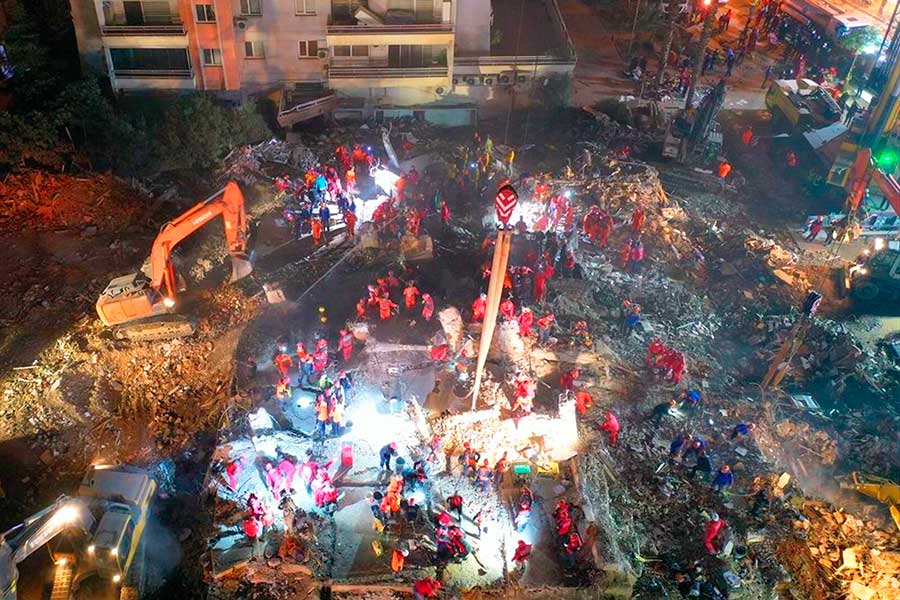
The recent earthquakes that shook Istanbul this week, leaving more than 150 injured and forcing more than 100,000 people to sleep outside their homes, have once again highlighted that Turkey, as a country crossed by several tectonic faults, has a high seismic activity that requires its population to be prepared for possible earthquakes. In this regard, the Turkish Disaster and Emergency Management Agency (AFAD) has published a series of tips and a list of items that should be included in any emergency kit, not only in Turkey, but anywhere in the world where there is a risk of a disaster that requires people to prepare to survive during the first hours after the event.
According to information published in Turkish media based on instructions from AFAD, the first 72 hours after a disaster, and especially after an earthquake, are critical because this is the maximum time it is normally estimated that emergency services can take to reach the entire population with help. Therefore, any survival kit should include the necessary items for at least 3 days. AFAD recommends preparing these emergency kits not only for the home, but also for the car, and even preparing a common kit for workplaces and schools, which can be put together by identifying which items may be necessary in case of an emergency for employees or students.
It is advisable to place this kit in a place that is easily accessible to everyone, preferably near the exit. It is also best to prepare an individual kit for each family member to meet their own food or medication needs (especially in the case of babies or people with certain medical conditions), and of course for pets. The contents of these kits should be checked regularly to ensure that everything is in good condition: that food has not expired, that electronic devices and tools are in working order, etc.
What should the emergency kit include?
It is important to prepare the contents of these kits not only to be able to survive for several days without outside help in the event of a disaster such as an earthquake, but also to suit the specific needs of the people who will use them, their surroundings and their environment. In general terms, among the essential items that should be included in an emergency kit, AFAD mentions the following:
- Drinking water: at least one litre per person per day, covering needs for three days.
- Non-perishable food: canned food, nuts, biscuits, energy bars, etc.
- First aid: usual or necessary medicines (including ibuprofen and paracetamol, some anti-diarrhoea medication, etc.), bandages, disinfectants, etc.
- Flashlights: these can be rechargeable (check the charge regularly) or battery-powered (keep a pack of batteries in stock).
- Radio: a dual FM/AM radio that works with a dynamo or batteries, with sufficient reception.
- Spare clothing: underwear and socks, a T-shirt, and, depending on the weather, a jacket and a raincoat.
- Hygiene products: wet wipes, soap, toilet paper, sanitary towels.
- Protective equipment: disposable masks and gloves, hydroalcoholic sanitiser gel.
- Multi-purpose tools: it is best to have a good quality multi-purpose knife made of stainless steel.
- Cash: keep enough for several days in case electronic systems such as ATMs or credit cards fail.
- Documentation: backup copies of identity documents and important paperwork (property deeds, insurance policies, etc.), as well as a list of emergency contacts with their phone numbers.
The clothes you should pack should be suitable for the climate of the region and your usual needs; for example, in warm climates, a warm jacket may not be necessary, but you may need a sun hat or even sunglasses with UV protection. At the same time, if you live in an area with harsh winters, a normal jacket may not be enough, and you should pack some thicker socks, for example.
Food and hydration are key factors in any emergency situation, including in case of earthquake. When it comes to water, we must take into account our daily needs not only for drinking, but also for personal hygiene and cleanliness, so we should store at least 2 litres per person per day: that is, 6 litres per person. With regard to food, it is recommended to choose packaged foods with long expiry dates and fibre-rich biscuits and nuts, which are filling and provide a lot of energy. Finally, AFAD recommends checking the contents of your emergency kit at least every 6 months, especially food, drinks, medicines and hygiene items.
VOTE

EDITORIAL TEAM
🧿 About us
.
Edited and reviewed by:

Pablo Gómez is a specialist in Turkey and has been editor-in-chief of Hispanatolia since 2011. He has been analysing current affairs and geopolitics in Turkey and the surrounding region since 2006.
…
📣 Your ADVERTISING on Hispanatolia
.
🤗 HELP US WITH A DONATION:
💗 Paypal