More than 100,000 000 people have spent the night away from their homes, mainly housed by the authorities in mosques, schools, school dormitories and other public facilities, due to the succession of tremors following the strong 6.2 earthquake that struck Istanbul yesterday, leaving hundreds injured. At least 266 aftershocks have been recorded as of this morning, some with an intensity greater than 5.
According to the Turkish Disaster and Emergency Management Agency (AFAD), the earthquake struck at 12:49 on 23 April (11:49 CET) at a depth of about 7 kilometres below the Sea of Marmara off the coast of Silivri, west of the European side of Istanbul, and lasted 13 seconds. The earthquake originated in a segment of the North Anatolian Fault that runs through the Marmara region, the most populated in Turkey, and was felt not only in Istanbul but also in cities as far as 300 kilometres from the epicentre.
At least 266 aftershocks following the main earthquake
Quoted by Turkish media, Interior Minister Ali Yerlikaya reported from the AFAD crisis centre that the main earthquake, measuring 6.2 on the Richter scale, was felt mainly in Istanbul and the provinces of Tekirdağ, Yalova, Bursa, Sakarya and Balıkesir, noting that by 9:00 a.m. today, at least 266 aftershocks had been recorded, the largest of which reached a magnitude of 5.9. Of the rest, 258 tremors had a magnitude of between 0 and 4, while seven aftershocks reached an intensity of between 4 and 5.
Preliminary scientific analyses show that the 6.2 earthquake was caused by a rupture in a section of the fault about 15 kilometres long and 9.5 kilometres wide, which caused a lateral displacement of about 30 centimetres. According to AFAD, most of the aftershocks are concentrated along an area located between 10 and 15 kilometres east of the epicentre of the main earthquake, near the northern end of the Central Marmara Trench and the main fault.
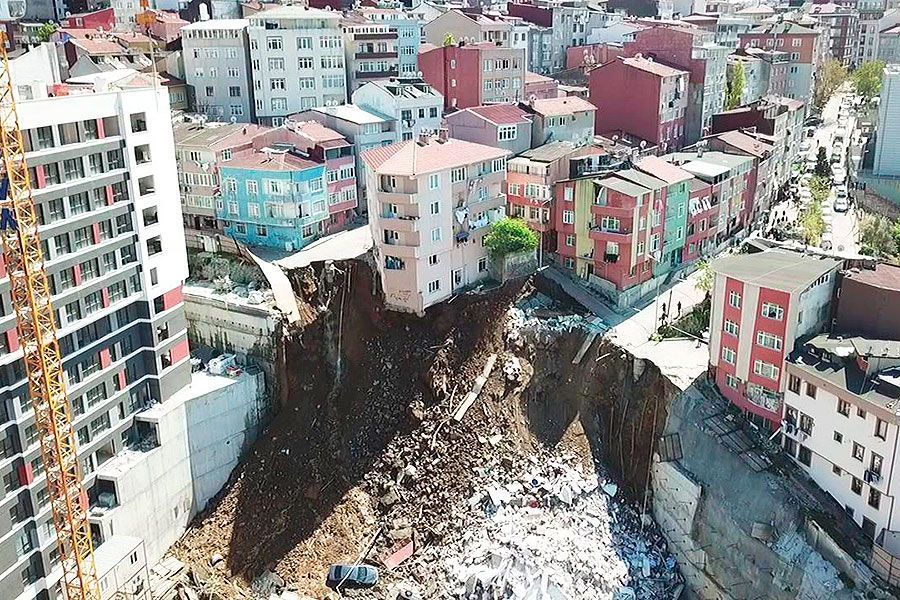
AFAD warns that tremors could continue over the next few days and urges citizens to remain alert. Although no major structural collapses have been reported as a result of the earthquakes, teams from Turkey’s Ministry of Environment, Urban Planning and Climate Change are continuing to carry out inspections and studies on the ground, particularly in buildings and structures that have been damaged. Apart from the collapse of an abandoned building in the historic district of Fatih, some damage to the facades of seven other buildings has been reported, although the authorities have warned residents of Istanbul not to enter potentially damaged buildings until inspections have been completed.
The 112 emergency services have responded to more than 10,000 calls since yesterday, 296 of which were related to damage caused by the earthquake to buildings. 236 people were injured or required medical assistance after the earthquake, mainly due to injuries sustained while rushing to leave buildings or even jumping out of windows in panic, but also due to cases of anxiety caused by the tremors.
101,000 people housed in temporary shelters
The earthquakes were felt with great anxiety among the 16 million inhabitants of Istanbul, where classes were suspended on 24 and 25 April and female civil servants with young children were given leave. Classes were also suspended in other provinces in the Marmara region where the earthquake was felt, such as Tekirdağ, Kocaeli and Yalova.
The fear of returning to their homes for fear of another major earthquake in Istanbul, and the anxiety created by the succession of aftershocks, has led tens of thousands of people to spend the night away from their homes. According to Minister Yerlikaya, the authorities have responded to requests for shelter from more than 101,000 people, but the actual figures are higher as many spent the night in their cars and parks or with family and friends in areas far from the epicentre of the main earthquake.
To accommodate this large number of people, local councils have opened schools, gyms, dormitories and mosques to serve as temporary shelters. Areas have been set aside in schools for sleeping, and indoor sports halls have been prepared for children to play and spend their free time. In total, more than 50,000 Istanbul residents have been housed in educational centres, while another 50,000 have been accommodated in 774 mosques throughout the city, where they have been provided with food and drink.
Yerlikaya himself provided details of this assistance, stating that more than 11,000 personnel and 903 vehicles were deployed to meet the needs of these people, and that more than 527,000 portions of soup, 16,000 loaves of bread, more than 400,000 catering products, 55, 000 food packages, some 400,000 hot and cold drinks, and more than 500,000 bottles of water, were provided. ‘All necessary measures have been taken, and potential risks are being assessed meticulously,’ the minister said.
Anxiety and fear among Istanbul residents after the earthquake
The fear caused by the earthquakes has triggered a surge in anxiety cases, with more than 88,000 people receiving psychological support in the last 24 hours. In addition to the more than 100,000 people housed in schools and mosques, many residents spent the night in their vehicles or in tents in parks throughout the city.
‘There is no damage to the buildings, but we are here as a precaution. If the earth continues to shake tomorrow, we will return,’ said Erdal Doğan, who spent the night in a park in Kağıthane, a district north of Istanbul. ’There was a tremor, then a pause, and then it shook again. My children were scared, but I stayed calm. We quickly grabbed ours essentials and moved to a safer place,’ explained another resident camping in the area.
Seismologists have already warned that tremors will continue over the next few days and that some could exceed 5 on the Richter scale. However, there does not yet seem to be a scientific consensus on whether yesterday’s 6.2 earthquake was a precursor to the ‘Big One’ that Istanbul has been expecting for years, or whether the earthquake and subsequent aftershocks have helped to relieve pressure on the tectonic plate, reducing the immediate risk of a major earthquake, as some experts such as Professor Şükrü Şahin believe. He has become famous just a few weeks ago when he predicted that there would be a 6-6.5 earthquake in Silivri, precisely the epicentre of yesterday’s quake.
Meanwhile, amid the uncertainty created by the earthquakes and the fear of new tremors, it seems that many residents are choosing to leave Istanbul, with a noticeable increase in traffic leaving the city last night.
Representatives from the tourism and real estate sectors also say they have noticed a sharp rise in demand from Istanbul residents who want to spend the next few weeks in provinces far from the region, such as Antalya, or who are looking for flats and houses in Istanbul in the districts to the north of the city, further away from the Marmara Sea and therefore considered safer. On the other hand, there has also been an exponential increase in online sales of emergency kits and tents, which in turn has caused prices to skyrocket.
VOTE

As a history lover, Pablo Gómez was captivated by Turkey from the first day he visited it in 2006: he got married there, has a house there… and has since become an expert on Turkey’s current affairs. With a long experience in media, he has been at the helm of hispanatolia.com since 2011.