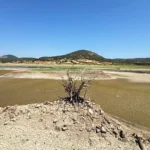
The water table continues to fall in the Konya Plain in central Turkey as a result of the indiscriminate use of water resources and the extraction of groundwater. Here, specialists working in the area point out that the alterations caused by the uncontrolled consumption of water generate cavities underground, that end up manifesting themselves in the form of giant holes: more than 650 have already appeared in the region, and more and more are appearing near residential areas.
Experts who have studied the region stress that the depletion of water under the ground is closely linked to this phenomenon, mainly due to agricultural irrigation, creating favourable conditions for the appearance of new giant holes in the surface. Every year new craters appear in Konya, and the risk increases especially during periods of drought and intensive irrigation.
Speaking to Turkish media, Şükrü Arslan, chairman of the Konya branch of the Turkish Chamber of Geological Engineers, said that around 20 new sinkholes were formed in the region last year alone. Arslan said these formations are mainly concentrated in the Karapınar district, although similar sinkholes have also been observed in the Çumra and Karatay districts.
The geologist further explained that the occurrence of these phenomena increases especially after periods of rainfall or at the end of long periods of drought; it seems that episodes of ground collapse occur more frequently during the months of April and May, but also between August and September.
A phenomenon linked to uncontrolled groundwater abstraction
The expert warned that the indiscriminate use of water is one of the main causes of these land subsidence episodes, and stressed the importance of applying water-saving measures, especially in agricultural irrigation. Arslan also warned that if the uncontrolled extraction of water resources under the subsoil of the Konya Plain continues, new sinkholes will inevitably appear in the region.
According to experts, agricultural irrigation causes significant fluctuations in the groundwater level, which in some places can reach variations of up to 10 metres. These drops – in times of drought or excessive irrigation – and sudden rises – when water is brought in by rainfall – favour the dissolution of rocks and soil underground, generating underground caves which, over time, collapse, causing the roof to collapse and giving rise to these large craters on the surface. It is currently estimated that there are already more than 650 giant holes in the entire Konya basin.
VOTE

EDITORIAL TEAM
🧿 About us
.
Edited and reviewed by:

Pablo Gómez is a specialist in Turkey and has been editor-in-chief of Hispanatolia since 2011. He has been analysing current affairs and geopolitics in Turkey and the surrounding region since 2006.
…
📣 Your ADVERTISING on Hispanatolia
.
🤗 HELP US WITH A DONATION:
💗 Paypal