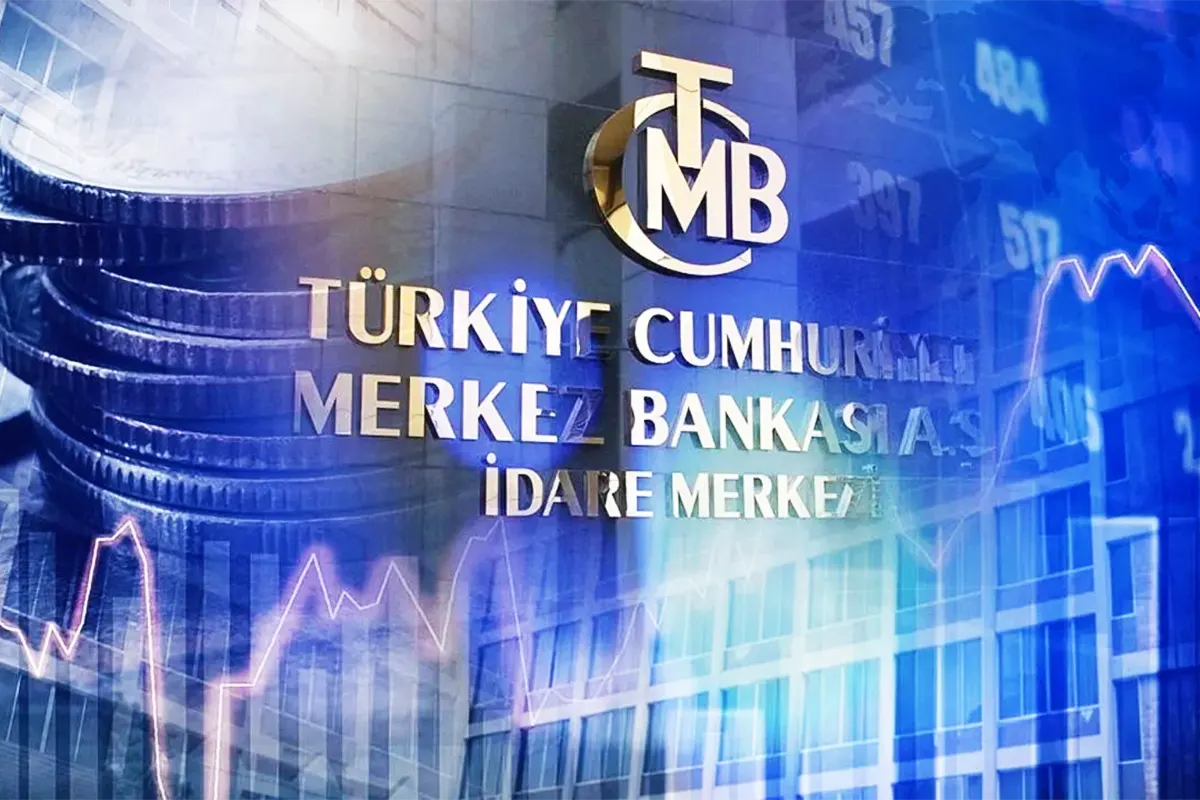
The Central Bank of Turkey decided on Thursday to keep its official interest rate unchanged, setting the one-week repo auction rate at 37%, in line with market expectations, due to rising inflation; furthermore, the bank’s Monetary Policy Committee also left the overnight lending rate unchanged at 40% and the overnight borrowing rate at 35.5%.
The Monetary Policy Committee of the Central Bank of the Republic of Turkey (TCMB, using its Turkish acronym) announced its long-awaited decision on interest rates today, keeping its one-week benchmark interest rate at 37%, Turkish media reported. At the meeting, it was emphasised that restrictive monetary policy would continue until the objective of price stability linked to inflation was permanently achieved.
Indeed, inflation rates in Turkey have continued to rise during the first few months of the year, accelerating in April due to the direct impact of rising gas and oil prices caused by the conflict in the Middle East, despite a slight moderation in the CPI observed in May. The Committee noted in this regard that the volatility of energy prices, driven by uncertainty stemming from geopolitical events, continues to contribute to high levels of inflation.
The Bank reiterated in this regard that it will not ease its monetary policy until price stability is achieved, and that it will continue to reinforce the disinflation process, taking into account the balance of demand, the evolution of the exchange rate and market expectations. It also specified that future decisions on interest rates will depend on price developments, the expectations of economic agents and the main trends in the economy.
Data for the first quarter have shown that the slowdown in economic activity has continued, whilst indicators suggest that the weakness in domestic demand persists. “In the event of a significant and sustained deterioration in the inflation outlook, monetary policy will be tightened,” warned the TCMB.
Şimşek acknowledges that the conflict in Iran is affecting the Turkish economy
Earlier this week, the Turkish Finance Minister, Mehmet Şimşek, acknowledged in a television interview that the conflict in the Middle East is generating inflationary pressures on Turkey’s economy, and stated that, had this external factor not arisen, inflation would probably have closed 2026 at around 20%.
“If we take into account the direct and secondary effects of the war, as well as the oil price levels that the markets are anticipating for the whole year, there is at least an additional 5 percentage points of inflationary pressure,” said Şimşek.
Last May, the Central Bank of Turkey raised its inflation forecast for the end of this year to 26%, due to uncertainties surrounding the global economy and the rise in energy costs caused by tensions between the US and Iran. The next meeting of the Monetary Policy Committee is scheduled for 23 June, but most economists believe the Central Bank will leave its benchmark interest rate unchanged at 37% until at least September.
VOTE

EDITORIAL TEAM
🧿 About us
.
Edited and reviewed by:

Pablo Gómez is a specialist in Turkey and has been editor-in-chief of Hispanatolia since 2011. He has been analysing current affairs and geopolitics in Turkey and the surrounding region since 2006.
…
📣 Your ADVERTISING on Hispanatolia
.
🤗 HELP US WITH A DONATION:
💗 Paypal