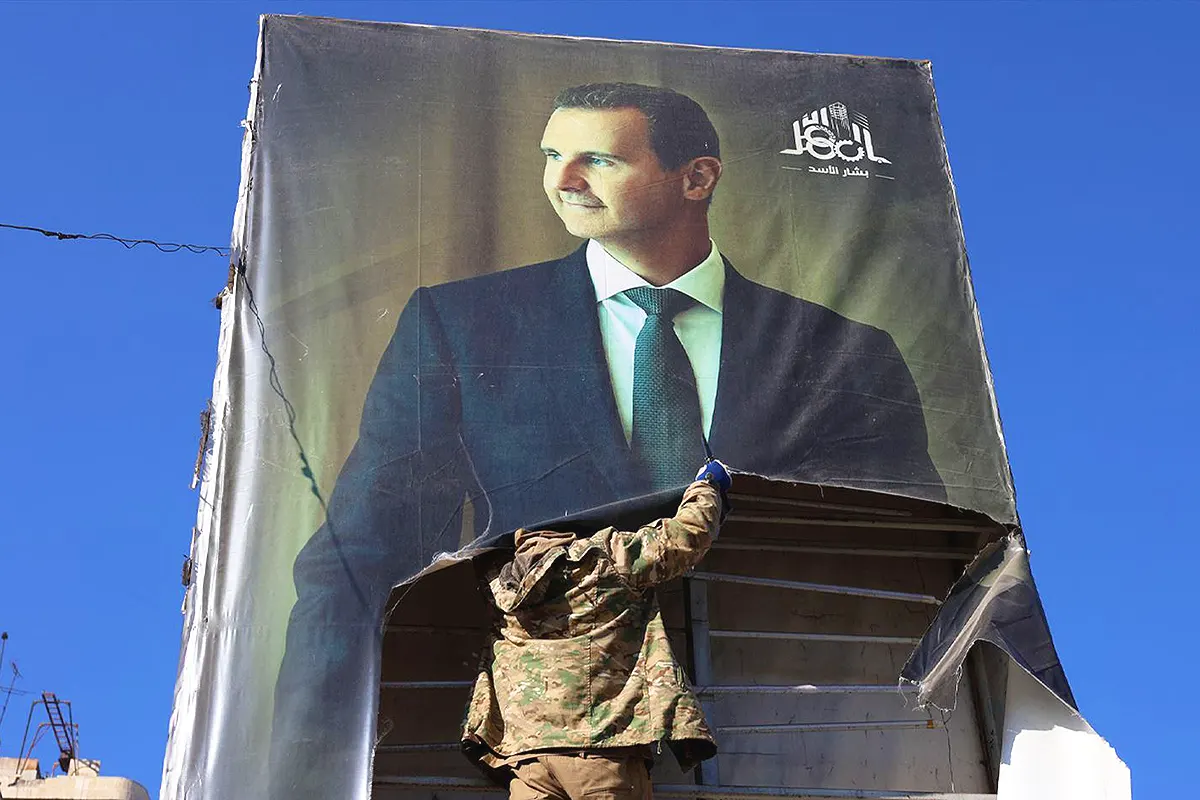
A court in Syria sentenced on 11 August former Syrian President Bashar al-Assad, who was tried in absentia, to death after finding him guilty of atrocities committed during the country’s civil war, which lasted for almost 14 years.
The Fourth Criminal Court in Damascus handed down its verdict on Tuesday against several defendants, including Bashar al-Assad and other members of the Assad family, such as his brother Maher al-Assad and his cousin Atif Najib, a former official believed to have played a key role in the security operations carried out in Daraa during the early stages of the nationwide protests that began in 2011. Seven other defendants who are on the run were also sentenced, according to the Turkish news agency Anatolia.
The defendants showed “no remorse”
The presiding judge, Fahreddin Aryan, noted that the investigations and witness statements proved Atif Najib’s involvement in the interrogation of some detainees in Daraa following the start of the protests in Syria. Aryan stated that Najib had led the 2011 security operation against civilians in Daraa and found him guilty, handing down his death sentence. Najib, who denied the charges during the trial, showed “no remorse”, as the judge noted.
According to the verdict published by the official Syrian news agency SANA, the court also found the fugitives Bashar al-Assad, Maher al-Assad, Fahd Jasim al-Fureij, Mohammed Ayman Ouosh, Luay Ali al-Ali, Qusay Ibrahim Mahiyub, Wafiq Saleh Nasser and Talal Faris al-Asimi, finding them guilty of “premeditated murder” and “torture resulting in death”, and therefore ruled that they too should be sentenced to death.
The court further stated that the defendants’ responsibility for the offences under investigation had been established on the basis of the investigations carried out and the statements of witnesses. With the exception of Atif Najib, all the other convicted individuals are on the run and have fled the country following the fall of the Assad regime in late 2024.
Bashar al-Assad fled Syria and remains in exile in Russia
Bashar al-Assad and his brother Maher al-Assad left the country following the success of the Syrian rebel offensive in December 2024, and sought refuge in Russia. Although Syrian law permits the imposition of the death penalty on defendants found guilty by a court, the new government led by the president and former rebel leader Ahmed Al-Sharaa has so far not carried out any death sentences.
The Syrian civil war began in Daraa in March 2011, after 15 students were arrested for allegedly writing slogans against the Assad regime on the city’s walls. Witnesses claimed that the young men were tortured, sparking a protest demanding their release that ended in a brutal bloodbath; from that point on, the security forces violently suppressed the peaceful demonstrations and used live ammunition to disperse the growing protests in Syria.
This death sentence against the former Syrian president and other key figures in the regime marks the first judicial conviction against Bashar al-Assad since his fall from power. His execution is, for the time being, impossible to carry out, as Assad is not in Syria. Legal experts have also warned that the death sentence against the former president could complicate any future efforts to secure his extradition from Russia; nevertheless, the new Syrian authorities have presented the trial as an important step in the efforts to bring to justice the crimes committed under the dictatorship, and the verdict has been welcomed by the victims.
VOTE

EDITORIAL TEAM
🧿 About us
.
Edited and reviewed by:

Pablo Gómez is a specialist in Turkey and has been editor-in-chief of Hispanatolia since 2011. He has been analysing current affairs and geopolitics in Turkey and the surrounding region since 2006.
…
📣 Your ADVERTISING on Hispanatolia
.
🤗 HELP US WITH A DONATION:
💗 Paypal