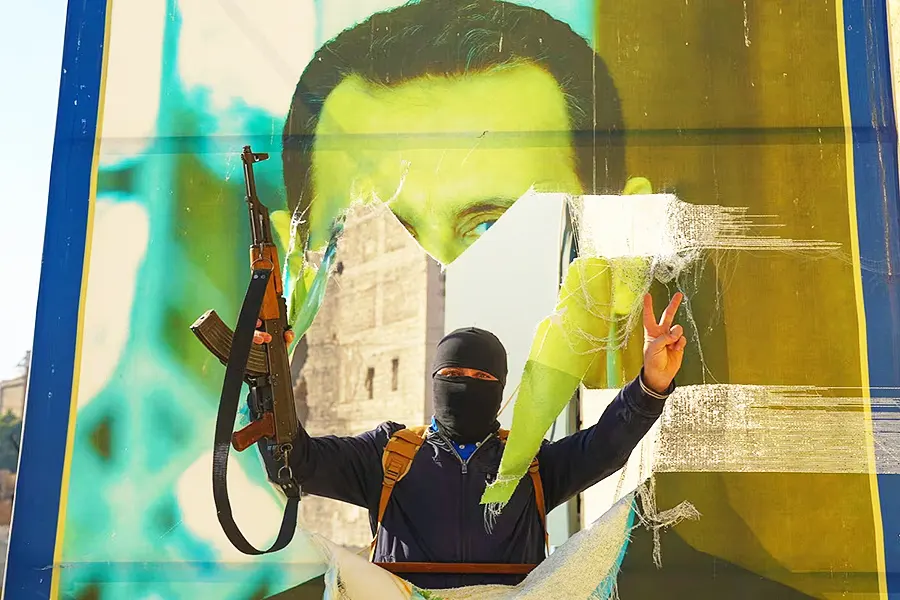
Syrian rebels seized control of the capital, Damascus, in the early hours of Sunday morning, putting an end to 54 years of Assad family dictatorship in Syria after capturing the cities of Aleppo, Hama and Homs in record time, while speculation is rife about the whereabouts of Bashar al-Assad, who some media suggest may have died trying to flee.
The fall of Damascus – reported by numerous media outlets around the world – also marks the end of 61 years of rule by the Baath party, which came to power in Syria in 1963 following a coup, after which Hafez al-Assad came to power in 1971 and was succeeded after his death in 2000 by his younger son Bashar al-Assad.
In the hours before the fall of Damascus, opposition forces had late yesterday seized control of Homs after the last Syrian-Arab army forces and Hezbollah militias defending the city withdrew; previously, a series of uprisings in the southern provinces of Daraa, Suwayda and Quneitra had led the Syrian regime to lose control of this region and face an unexpected siege on Damascus from the south, while members of the Free Syrian Army advanced from the east across the desert, cutting the highway connecting the capital to the rest of the country.
The loss of Homs, a vital communications hub connecting Damascus with the coast and with the provinces of Latakia and Tartus, inhabited by the Alawite minority to which Assad belongs and where Russia had its main military bases, triggered the final events: in a few hours, opposition supporters took to the streets in the capital and gradually took control of the government buildings still controlled by regime forces, who put up little resistance except for some fighting in the city centre – trying to cut off the road to the presidential palace – and southeast of Damascus, towards the international airport.
First steps towards a transitional Syrian government
In a video message posted on social media, Syrian Prime Minister Mohammad Ghazi al-Khalali, appointed by Assad in late September following a government reshuffle, reported his readiness to work with the Syrian opposition while calling for respect for property and lives. ‘We extend our hand to the opposition, who have promised that there will be no reprisals and who have reached out to us,’ he said.
‘Syria belongs to all Syrians. This country can return to normality, this country can have good relations with its neighbours and with the world… This is in the hands of the government that the Syrian people will choose. We are ready to cooperate with the newly elected government. We are ready to provide them with all the support and transfer the state documents to them,’ he added.
Abu Mohammed al-Jolani, leader of the Islamist rebel group Hayat Tahrir al-Sham (HTS) which has led the lightning offensive that has overthrown the Assad government, made clear to his followers in a video message that institutions and properties must be respected: ‘These institutions will remain under the supervision of the former prime minister until they are officially transferred. It is strictly forbidden to approach public institutions. Shooting in the air is also forbidden,’ he announced.
The Syrian opposition in exile confirmed in recent hours that they plan to meet with representatives of Arab and European countries as well as the United Nations to agree on a transition in the country. The initial plan is for the current prime minister to oversee Syrian state institutions until they are transferred to a new transitional government body with full executive powers to ensure an orderly and peaceful transition.
Where is Assad?
As for the final fate or whereabouts of Assad himself, there has been much speculation in recent hours about his situation. The rapid takeover of the capital – which the Syrian regime could not hold out for even 24 hours amid a general disbanding of its forces – forced the Syrian dictator to make quick and hasty decisions, and according to intelligence sources Assad may have taken a plane after midnight – shortly before the rebels took control of the airport – to flee to the Alawite stronghold of Latakia on the country’s Mediterranean coast.
Websites such as Flightradar report that a Syrian plane – an Ilyushin 76, code 9218 – took off from Damascus International Airport coinciding with the final rebel takeover of the capital despite the fact that hours earlier all flights had been suspended, suggesting that Assad himself was on board, perhaps with some members of his inner circle.
The plane, which initially flew towards Latakia, made a sharp turn as it passed near Homs – which had been captured hours earlier by the rebels – and then disappeared from radar after a sharp drop from 3,650 to just 1,070 metres, leading some sources to believe that it may have been shot down or suffered a technical failure that caused it to crash.
The information has not been confirmed, but the theory of Assad hastily fleeing Damascus by air to Latakia – where Russia has an air base – is consistent with the events of the last few hours in the Syrian capital and the personality of the Syrian dictator, who could have sought refuge in the provinces most loyal to him in order to cling to power and try to continue resisting from there with his most loyal forces, seeking hypothetical support by air and sea from Russia or -even- considering a possible final exile in Moscow.
VOTE

As a history lover, Pablo Gómez was captivated by Turkey from the first day he visited it in 2006: he got married there, has a house there… and has since become an expert on Turkey’s current affairs. With a long experience in media, he has been at the helm of hispanatolia.com since 2011.