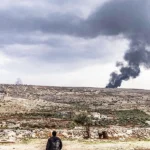
Syrian rebels today finally took control of the city of Hama, Syria’s fourth largest, two days after beginning a siege of the city and just five days after seizing control of Aleppo, Syria’s second most populous city and the country’s economic heartland.
Several international media confirmed the fall of Hama – whose name precisely means ‘fortress’ in Arabic – after heavy fighting in which forces loyal to Assad tried to hold on to a city that is key to protecting the route leading to Damascus through Homs, the third most important city in the country – located just 50 km south of Hama – and which could be the next to fall into the hands of the Syrian opposition.
The rebels had encircled Hama on three different fronts in recent days, leaving only the southern escape route under Syrian regime control, precisely the one taken by Syrian-Arab army soldiers in the last few hours to flee the city. The Damascus government itself acknowledged in a statement shortly afterwards the loss of Hama after an ‘intensification of fighting between our soldiers and the terrorist groups… who were able to penetrate through several fronts and enter the city’, adding that its forces had been ‘redeployed’ outside Hama: a euphemism also used after the loss of Aleppo to refer to the withdrawal of troops fighting on Assad’s side.
Hama: a moral and military blow to the Syrian regime
The loss of Hama is a double blow for the Syrian regime, which has lost one of its most important cities and a strategic point for halting the advance of the opposition from northern Syria and protecting the coastal cities of Latakia and Tartus, where the main military bases of Russia are located, after in recent days Moscow has been withdrawing its ships from the port of Tartus; but this defeat also shows the weakness of Assad forces, which have only withstood the rebel siege for two days despite Assad sending a large number of reinforcements to the city with ‘dozens of trucks’ loaded with tanks, weapons and soldiers, according to the Syrian Observatory for Human Rights, based on sources on the ground.
Despite these reinforcements and aid provided by countries such as Russia, and even though the Syrian president ordered a 50% pay increase for professional soldiers in the army to try to boost their morale, the battle for Hama has exposed the enormous vulnerabilities eroding Assad’s power base, whose army is composed – with the exception of a few elite units based in Damascus – of ill-equipped, poorly paid soldiers with low morale, who have often resorted to looting the places they were meant to defend in order to survive or simply to make up for delays in payment.
An ill-equipped and poorly paid army
Evidence of this are the endemic recruitment problems that the Syrian Arab army has suffered from since the outbreak of the civil war, and which have become more acute in recent years, worsening further of course since the fall of Aleppo: it is a fact that rebel forces met little resistance in taking the country’s second largest city because, quite simply, Assad’s forces in many cases abandoned their posts and fled, also leaving behind large quantities of military equipment and ammunition that were captured by the rebels, as evidenced by images and videos in recent days.
With Iran weakened and Russia focused on Ukraine, Bashar al-Assad faces mounting domestic pressure that the fall of Hama will undoubtedly exacerbate. As the territory under his control shrinks and his army suffers military setbacks that show its lack of capacity to oppose the rebels, the ever wavering support for his regime weakens and tensions rise within his inner circle and military leadership, while pockets of social discontent that had been muted for years are once again coming to the fore and, in some cases, even rising up and driving out regime soldiers, as has happened in Talbisah, north of Homs, for example.
Assad’s legitimacy increasingly questioned
The rapid fall of Aleppo has not only shaken the foundations of the regime’s legitimacy and given wings to its opponents: it has also dealt a severe blow to the Syrian government’s economy, weighed down by years of war and international isolation, with 3 out of 4 Syrians living below the poverty line despite recent years of relative peace. We could therefore be on the verge not only of an economic collapse of the Assad regime, but also a social one.
Even among those who supported his government after the outbreak of the Syrian civil war, even before this offensive there were growing voices of discontent before the fall of Aleppo; and the capture of Hama by Syrian rebels will only have exacerbated that sentiment. In recent days there have even been rumours of military uprisings, and the loss of two of the country’s four major cities in a matter of days – when it took the Syrian regime four years of siege just to recapture Aleppo – has completely eroded the image of Assad, who can only take refuge in his palatial stronghold in Damascus.
VOTE

As a history lover, Pablo Gómez was captivated by Turkey from the first day he visited it in 2006: he got married there, has a house there… and has since become an expert on Turkey’s current affairs. With a long experience in media, he has been at the helm of hispanatolia.com since 2011.