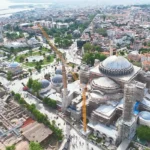
Turkey has begun a new phase of work on the Hagia Sophia of Istanbul that will, in fact, involve the largest restoration project in its almost 1,500-year history. The work will focus on protecting the domes of the historic monument from the risk of collapse due to possible earthquakes, reinforcing the steel frame and replacing the lead roof of the structure.
‘Although we are not carrying out this work because of an earthquake, the main objective of this work is to strengthen Hagia Sophia as much as possible against a possible earthquake,’ Professor Hasan Fırat Diker, a member of the Hagia Sophia Scientific Commission, told the Turkish media.
‘In response to the risk of weakening of the arches and collapse of the dome due to the impacts that can occur on the semi-domes during an earthquake, we will remove the layers of lead that cover the surface of the dome, which is the most vulnerable part of the structure, and then carry out an adequate reinforcement of it,’ Diker explained.
Hagia Sophia will remain open to the public during the restoration
Professor Mehmet Selim Ökten, an engineer who teaches at Mimar Sinan University in Istanbul and also a member of the scientific committee in charge of supervising the renovation work on Hagia Sophia, confirmed that this ‘new phase’ of the restoration work on Hagia Sophia, which began yesterday, will be the most important intervention in the entire history of the temple.
‘A tower crane will be installed on the eastern façade, and then we will cover the upper part of this unique structure with a protective system. This will enable us to work more safely and to study the layers of the building scientifically, including the damage it suffered from fires and earthquakes in the 10th and 14th centuries,’ said the expert.
‘We have finished our work on the four minarets of the main structure. But for this unique cultural heritage site, we plan to use modern, lightweight materials and keep the building open to the public,’ said Ökten, while acknowledging that it is not yet possible to determine when the restoration work will be completed.
The future ‘Big One’ in Istanbul threatens Hagia Sophia
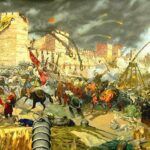
Built in the year 537 by the Roman emperor Justinian I the Great, Hagia Sophia was transformed into a mosque after the fall of Constantinople in 1453 at the hands of the Ottomans led by Sultan Mehmed II the Conqueror. In 1934, after the founding of the Turkish Republic, a decree by Atatürk turned the building into a museum; however, in 2020 Hagia Sophia was reopened as a mosque by a presidential decree following a legal resolution that deemed its conversion into a museum illegal.
In 2023, two 7.8 and 7.6 earthquakes devastated south-eastern Turkey, destroying thousands of buildings and leaving more than 53,000 people dead. Although Istanbul was not affected by this disaster, seismologists have been warning for years that the Turkish metropolis is likely to suffer before the end of this century a ‘Big One’ with potentially catastrophic consequences, which could cause the collapse of thousands of buildings if measures are not taken in time.
VOTE

EDITORIAL TEAM
🧿 About us
.
Edited and reviewed by:

Pablo Gómez is a specialist in Turkey and has been editor-in-chief of Hispanatolia since 2011. He has been analysing current affairs and geopolitics in Turkey and the surrounding region since 2006.
…
📣 Your ADVERTISING on Hispanatolia
.
🤗 HELP US WITH A DONATION:
💗 Paypal