Istanbul, the only city in the world that spans between two continents, is a treasure of history and culture that has become a must-see destination for many travellers. Among the many wonders to be seen on a trip to Istanbul, one monument that has witnessed centuries of transformation stands out: the amazing Hagia Sophia.
A journey back in Istanbul’s history
When you walk through the gates of Hagia Sophia, you find yourself immersed in a journey through time. The history of this iconic building goes back more than 1,500 years. Hagia Sophia, called Hagia Ayasofya in Turkish, is an architectural marvel built in the 6th century by Emperor Justinian, and served as a cathedral for almost a millennium. In 1453, with the fall of Constantinople, it was converted into a mosque by Sultan Mehmed II, and the minarets that can still be seen today were built, rising to the sky as witnesses to a new era.
The first Hagia Sophia was actually built in 360 AD during the reign of the Roman Emperor Constantine the Great, who transformed the ancient city of Byzantium into Constantinople. However, this original structure was destroyed in 404 AD by fire during a religious revolt in the city. Emperor Theodosius II ordered the construction of a second church on the same site, inaugurated in 415, which in turn was destroyed by another fire during the Nika riots in 532 AD.

Hagia Sophia, as we know it today, was built by the Byzantine Emperor Justinian I in 532 AD. It was designed by two notable architects of the time, Anthemius of Tralles and Isidore of Miletus. It took approximately five years to be built, and is notable for its imposing dome and innovative architecture for the time, which inspired many buildings for the next centuries. In 553 and 557, two earthquakes in Constantinople cracked the original dome, which collapsed during another earthquake in 558, and was immediately rebuilt with lighter materials and with a greater height.
For almost a thousand years, Hagia Sophia served as one of the main Eastern Christian churches of the Byzantine Empire. However, in 1453, after the conquest of Constantinople by the Ottomans under Sultan Mehmed II, the church was converted into a mosque and underwent modifications to follow Islamic rituals. Minarets were added and some Christian elements, such as the mosaics, were removed.
Hagia Sophia: a blend of Christian and Islamic art
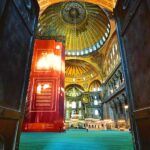
The design of Hagia Sophia is, in fact, an impressive blend of Byzantine and Islamic styles. Its dome, considered a masterpiece of engineering, rises majestically, flooding the interior with heavenly light.
The mosaics that adorn its walls tell biblical stories and depict emperors and empresses, evoking a sense of reverence. At the same time, however, there are elements of Islamic architecture and art, such as the four minarets, the Arabic calligraphic inscriptions on the medallions and the dome, and the mihrab (altar) indicating the direction to Mecca.

Hagia Sophia is a symbol of Istanbul’s rich multicultural heritage. Walking through its corridors, one can feel the influence of both Christianity and Islam. Arabic inscriptions mingle with Christian mosaics, reminding us that this place has been the witness and protagonist of a complex – and fascinating – history.
Church, mosque, museum… And again, mosque
After the Ottoman conquest, Hagia Sophia remained a mosque until the founding of the Republic of Turkey in 1923, when its first president Mustafa Kemal Atatürk converted it into a museum as part of his plan to modernise and secularise the country. The building continued functioning as a museum, until in July 2020, a court decision ruled that the transformation into a museum had been illegal, and Hagia Sophia was converted back into a mosque.
This decision generated significant controversy in Turkey, but especially in other Christian-majority countries, which considered the move populist and an attack on the historicity of the site, although it must be said that – contrary to what many claimed at the time – UNESCO did not remove Hagia Sophia from its list of World Heritage Sites because of its conversion into a mosque.
The controversy continues today. Those who support its reopening as a mosque recall that Hagia Sophia had a religious use as an Islamic temple for almost five centuries, until its transformation into a museum, and that this history should also be respected; they also recall the deplorable state of many Ottoman mosques and historic buildings in neighbouring Greece (one of the countries that most protested the move), where the Muslim minority has until recently been denied permission to build a mosque in Athens.
Letting controversies aside, for those visiting Istanbul who simply want to contemplate the beauties and wonders of Hagia Sophia, it is worth noting that its conversion to a mosque means that entrance is now free, and that the opening hours of Hagia Sophia have been extended until late night (as a museum it used to close at 5pm), which gives us plenty of room to plan our visit without stress and deadlines.
Tips for visiting Hagia Sophia
If you plan to visit Hagia Sophia, I recommend arriving early in the morning to avoid the crowds, especially in high tourist season, and enjoy the serene atmosphere that surrounds this incredible place.

Do not forget to dress modestly as a sign of respect by covering legs, arms, and also hair in the case of women, and bear in mind that shoes must be removed before entering the place, as it´s usual when entering other mosques. Also remember that, for respect and privacy reasons, during the 5 daily prayers access to the temple is forbidden to those not attending to pray.
In short, Hagia Sophia is much more than a building; it is a witness to the living history of Istanbul. Every corner of its walls breathes the essence of all the civilisations that have passed through this place; and by visiting it, you will feel like you are immersing yourself in a unique experience that will linger in your memory, even long after you have returned home. Enjoy your visit to this extraordinary monument, and if you want to learn more about its fascinating past, be sure to visit the Hagia Sophia History Museum. And remember, apart from seeing Hagia Sophia, there are much more things to do in Istanbul!!
✈️ If you are travelling to Turkey, we recommend:
We include affiliate links: if you buy through them, you don’t pay extra money and you help this website.
🧿 TOP TOURS IN ISTANBUL
VOTE

EDITORIAL TEAM
🧿 About us
.
Edited and reviewed by:

Pablo Gómez is a specialist in Turkey and has been editor-in-chief of Hispanatolia since 2011. He has been analysing current affairs and geopolitics in Turkey and the surrounding region since 2006.
…
📣 Your ADVERTISING on Hispanatolia
.
🤗 HELP US WITH A DONATION:
💗 Paypal