
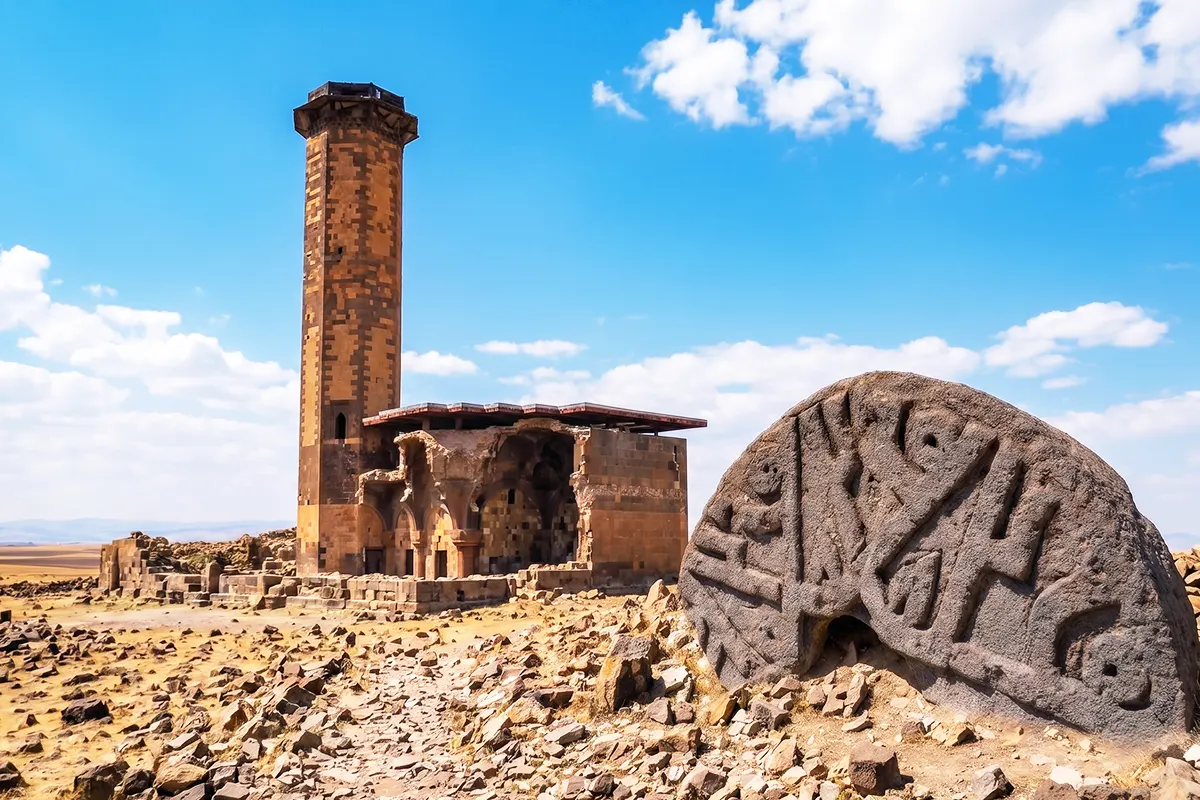
A decorated stele bearing the name of the Prophet Muhammad repeated six times in Kufic script – the oldest and most ornate form of Arabic calligraphy – has been discovered during excavations at the Seljuk cemetery located in the ruins of Ani, an ancient city in eastern Turkey designated a UNESCO World Heritage Site, as announced by the country’s Minister of Culture and Tourism, Mehmet Nuri Ersoy.
Ersoy reported the discovery on his social media accounts to mark the anniversary known in Turkish as Mevlid Kandili, the date commemorating the birth of the Prophet Muhammad: “On this blessed night, as we experience the spiritual atmosphere of the Mawlid al-Nabi, we have unearthed a unique artefact in Ani, which opened the door to Turkish-Islamic history in Anatolia with the conquest by Sultan Alparslan in 1064,” said the minister, as quoted by the Turkish newspaper Dunya.
The minister noted that the Seljuk cemetery in the ancient city, where excavations have been underway since 2021, has led to the discovery of an ornamental stone on which the name “Prophet Muhammad” appears six times in Kufic script. Three of the inscriptions are found on a band surrounding a central motif in the shape of an eight-pointed star.
The site was home to the first Turkish-Islamic cemetery in history
The piece measures 51 by 21 centimetres and was crafted using the relief technique. The original design included six repetitions of the name Muhammad around an eight-pointed star; however, only half of the object has been found, so currently only three of the inscriptions are actually visible.
Archaeologists believe the fragment may have formed part of one of the Seljuk mausoleums in the cemetery. The find constitutes a very important archaeological record for understanding the Turkish-Islamic identity of Ani, the religious beliefs of the period and the funerary practices that developed during Seljuk rule in eastern Anatolia.
Furthermore, data obtained during the excavations indicate that the Seljuk cemetery in Ani was the first Turkic-Islamic cemetery in history and the first cemetery for Turkic martyrs built on the Anatolian peninsula, according to experts.
Ani, a unique World Heritage Site
The city of Ani was conquered by Sultan Alparslan in 1064 and is regarded as one of the starting points of Turkish-Islamic history in the region, having played a key role as the gateway for the Turks into Anatolia, a region hitherto dominated by the Byzantines.
Known as the “City of 1001 Churches”, the ruins of Ani – designated a UNESCO World Heritage Site in 2016 – are of particular importance for understanding the beginnings of Turkish-Islamic civilisation in Anatolia and are home to several key structures, such as the first mosque built following the conquest, the first Turkish mosque built in Anatolia and the first prayer hall erected by the earliest Turks in the region.
📚 If you want to learn more about the history of Turkey, we recommend:
🧿 Discover here more recommended products about Turkey
As an Amazon Associate, we earn from qualifying purchases. This comes at no extra cost to you and helps support this website.
VOTE

EDITORIAL TEAM
🧿 About us
.
Edited and reviewed by:

Pablo Gómez is a specialist in Turkey and has been editor-in-chief of Hispanatolia since 2011. He has been analysing current affairs and geopolitics in Turkey and the surrounding region since 2006.
…
📣 Your ADVERTISING on Hispanatolia
.
🤗 HELP US WITH A DONATION:
💗 Paypal

+ POSTS
 3,000-year-old Babylonian text confirms location of Noah’s Ark according to the Bible
  Archaeologists restore a fresco of Jesus and Mary in ancient Nicaea
  Iznik prepares for Pope Leo XIV’s visit on the anniversary of the Council of Nicaea
  New finds in the Roman theatre of Nicaea before the Pope’s visit