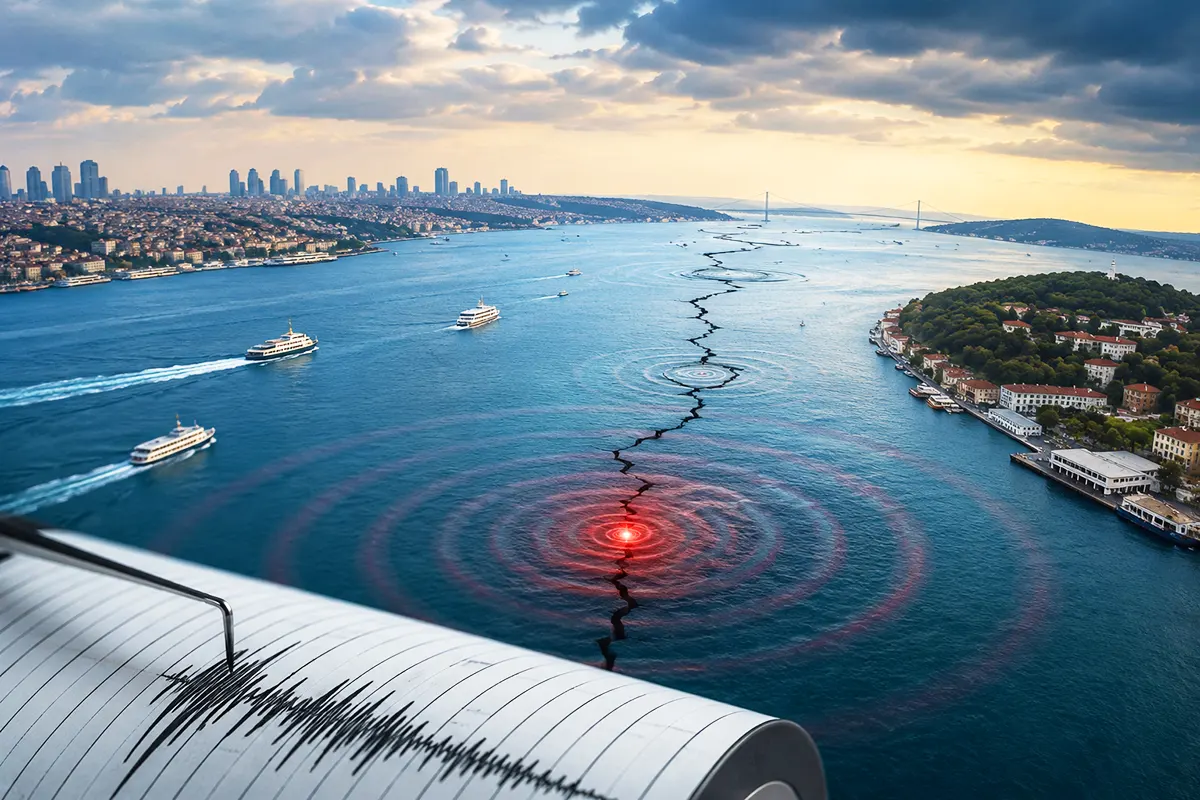
More than 170 microseismic events have been recorded since 18 August around the Princes’ Islands fault, located in the Sea of Marmara off the coast of Istanbul. The largest of these tremors occurred south of the islands on 19 August, sparking concern among many residents. However, experts say that this seismic swarm, on its own, is not a sign that a major earthquake is about to occur.
According to data collected by the Disaster and Emergency Management Authority (AFAD), the earthquakes in recent days have occurred at depths of approximately between 7 and 15 kilometres. The strongest tremor recorded in the area had a magnitude of 3.2 and occurred off the islands at 17:43 local time (16:43 CET) on 19 August. Tremors of magnitudes 2.9, 2.8, 2.7 and 2.6 have also been detected in the same area.
Experts rule out an imminent major earthquake
The specialists consulted have pointed out, however, that this cluster of seismic activity cannot in itself be considered a sign of an impending major earthquake and have urged people to avoid panic. Members of AFAD’s Scientific Council on Earthquakes have stated that interpreting these tremors as ‘precursors’ or ‘signs’ of earthquakes of greater magnitude is a claim without scientific basis. This was confirmed by Professor Hasan Sözbilir, who explained that “At present, there is no reliable method for determining in advance whether a cluster of micro-earthquakes is a precursor to a major earthquake”.
Professor Şükrü Ersoy, for his part, pointed out that it is normal for tectonic faults to periodically generate this type of small seismic activity, but he insisted that “there is no need for our citizens to panic”.
“To suggest that a major earthquake will occur immediately following minor seismic activity is purely speculative,” insisted Ersoy, who emphasised that the debate should not centre on when a major fault rupture will occur, but rather on how well-prepared buildings are for a potential earthquake: “As long as we have strong, earthquake-resistant structures, there is nothing to worry about,” he emphasised.
Scientists turn to social media to reassure the public
Another member of the Scientific Council, Professor Eşref Yalçınkaya, a seismologist at Istanbul-Cerrahpaşa University, carried out a striking demonstration on his social media to explain the recent seismic activity, according to reports in the Turkish media.
Yalçınkaya used a wooden stick as an example, which bends slowly whilst held at both ends. As he explained, the small cracks that appear in the stick are comparable to the small earthquakes that occur along a tectonic fault.
The seismologist pointed out that these small fractures in a fault may occasionally diminish, increase or shift to other points, until the process eventually leads to a complete rupture, and emphasised that the Marmara Sea fault has accumulated significant tectonic stress over a long period.
“The Marmara Sea fault has been tilting for approximately 250 years. One day it will rupture”, stated Yalçınkaya, who nevertheless added that the main cause of a major rupture is not the small earthquakes such as those recorded in recent days. As this specialist explained, the determining factor in the occurrence of a major earthquake is, on the contrary, the tectonic stress accumulated in the fault over time.
The earthquakes could be caused by secondary faults
The renowned Turkish professor Şener Üşümezsoy, known for having predicted weeks in advance the 6.2-magnitude earthquake that shook Istanbul a year ago, has also commented on this seismic phenomenon, stating for his part that “The Islands Fault is an ancient and dormant fault. No major earthquake will originate from here”.
According to Üşümezsoy, the small earthquakes recorded south of the island of Büyükada did not occur directly on the Islands Fault, but rather on branches of secondary and tertiary faults that cross the main Marmara Fault from south to north.
The Turkish expert has emphasised that these branches are incapable of accumulating sufficient stress to trigger a destructive earthquake. He therefore believes that the recent seismic activity represents a minor release of stress that had already built up in the area, as reported by CNN Türk.
The Kandilli Seismological Observatory is monitoring the area
The Kandilli Seismological and Earthquake Research Observatory, an organisation linked to Istanbul’s Boğaziçi University, has also described the recent activity as a sequence of micro-earthquakes clustered both in time and space, noting that such episodes occur occasionally in tectonically active regions. The institution has confirmed that the area where the activity is taking place is being monitored 24 hours a day.
In short, although the succession of micro-earthquakes caused by the recent seismic swarm in the Marmara region has sparked concern amongst the population in Istanbul and other provinces in the region over the possibility of a great earthquake, experts insist that these micro-earthquakes, on their own, do not necessarily mean that a major earthquake will occur in the near future.
VOTE

EDITORIAL TEAM
🧿 About us
.
Edited and reviewed by:

Pablo Gómez is a specialist in Turkey and has been editor-in-chief of Hispanatolia since 2011. He has been analysing current affairs and geopolitics in Turkey and the surrounding region since 2006.
…
📣 Your ADVERTISING on Hispanatolia
.
🤗 HELP US WITH A DONATION:
💗 Paypal